
 Exchange Ranking
 Top Exchanges
 24h Volume Ranking
 Popularity Ranking
 Exchange BTC Balance
 Proof of Reserves
 Decentralized Exchanges
 Funding Rate
 Funding Heatmap
 Liquidation Data
 Max Pain
 Long/Short Ratio
 Whale L/S Ratio
 Binance/Okex/Huobi L/S
 Bitfinex Margin L/S
 ETF Tracker
 Solana ETF
 XRP ETF
 Hong Kong ETF
 Bitcoin Treasuries
 Crypto Reversal
 Ethereum Reserves
 HyperLiquid Wallet Analysis
 Hyperliquid Whale Watch
 Large Transactions
 On-chain Movement
 Bitcoin ROI
 Stablecoin Market Cap
 Options Analysis
 News
News Articles
 Economic Calendar
 Features
 Wallet
 Contract Calculator


 Security
 Collections
 Watchlist
 Following
 BTC
BTC  ZEC
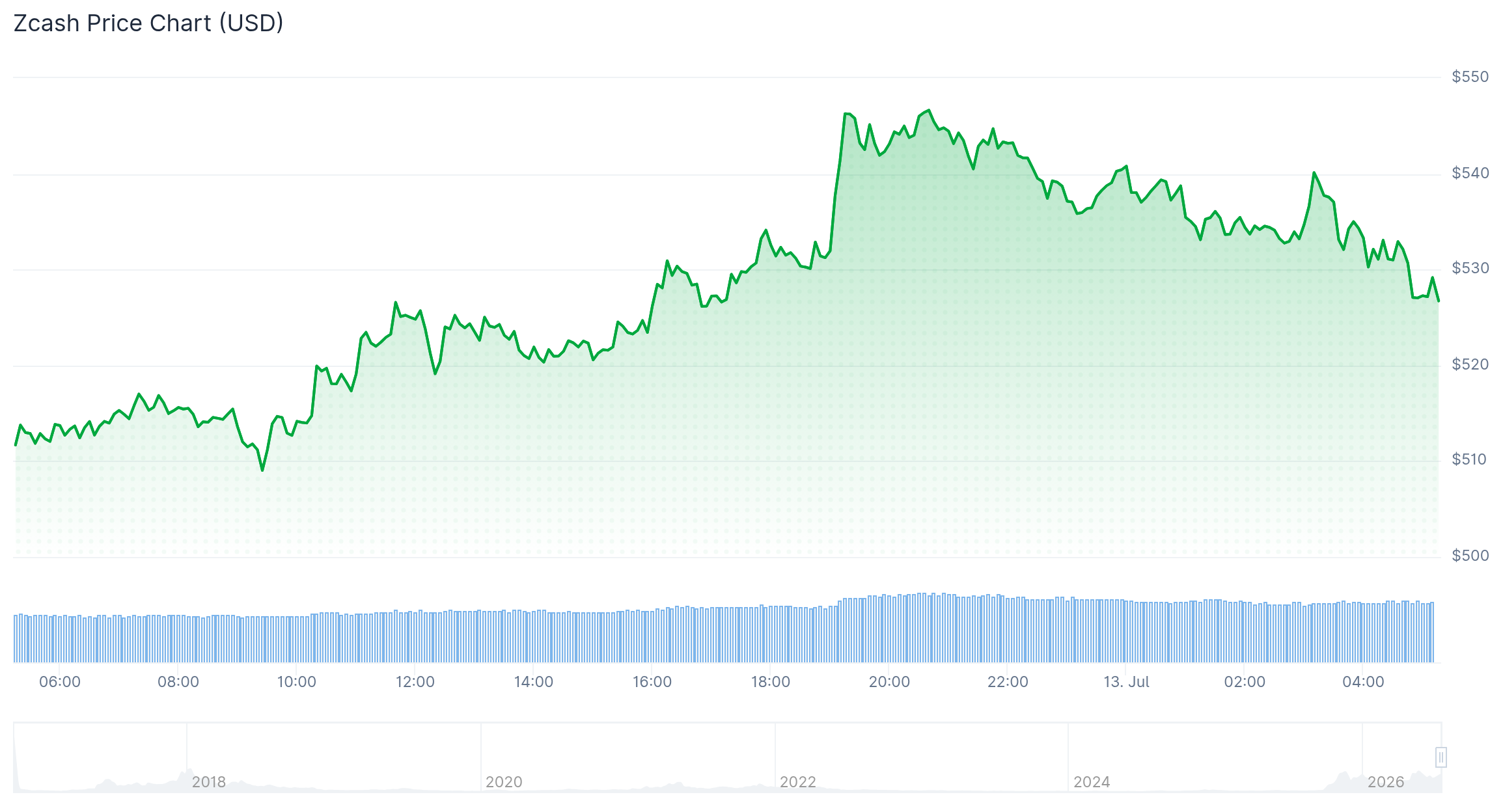
ZEC Zcash prices exceeded the target and pointed to the resistance level of US$540 to US$547.
Orchard trading doubts undercut a strong recovery.
After Zcash's price was listed in Forbes 'cryptocurrency rankings on July 10, it rose by about 5%, and the transaction price was close to US$531, performing well in the overall stable market.
The immediate bullish test is between $540 and $547, while a loss of $500 could expose the $478 retracement area and weaken the recovery.
Allium research found that trading volumes soared to 12 to 13 times normal levels before the Orchard vulnerability was privately discovered, but the data did not prove insider trading.
Long-term support comes from the 2024 halving event and 5.1 million shielded ZECs, while the July 2027 EU law rules pose a significant allocation risk.
 Zcash price
Zcash price exceeded the target and pointed to the resistance level of US$540 to US$547
Forbes set a market value threshold of at least US$5 billion when compiling its latest list. The ranking also favors assets with actual utility or value store attributes. Zcash meets these conditions with its privacy-centered payment design and fixed supply structure.
This recognition appears to bring new demand into Monday's trading session. CoinGecko data showed that ZEC prices were close to US$531, an intraday increase of about 5%. The token has also risen by about 15% in the past seven days, indicating that buying began before the latest media reports.
Zcash prices are currently below the $540 to $547 resistance zone. If the daily closing price breaks through this region, it may expose the next target level, around $595. Failure to hold $500 will weaken the current trend and bring $478 back into the spotlight.
The next macro test will come on Tuesday, when June U.S. CPI data will be released. If Bitcoin volatility changes overall risk appetite, Zcash prices may react violently. Achieving a breakthrough while increasing trading volume will provide a more reliable confirmation signal.
Supply conditions support bullish views. As of early June, the blocked address held approximately 5.1 million ZECs, nearly one-third of the circulating supply. Although coins in the blocked pool will not automatically exit the market, their growth may reduce visible exchange liquidity.
The November 2024 halving event also reduced the block reward from 3.125 ZEC to 1.5625 ZEC. This change slows the issuance of new tokens and strengthens Zcash's scarcity narrative. ZEC prices have risen by more than 1100% over the past year, despite a sharp correction in the process.
Orchard trading doubts undermine a strong recovery
The biggest risk comes from the Orchard vulnerability disclosed in early June. Researcher Taylor Hornby discovered the flaw on May 29. Developers said the vulnerability could create counterfeit ZEC tokens indefinitely within Orchard without detection.
 Source: Allium Research
Emergency response fixed the vulnerability within days. However, privacy is designed to prevent a decisive cryptographic audit of past utilization. There is currently no public evidence that the vulnerability has been exploited, but there is absolutely no way to prove that it has not been exploited.
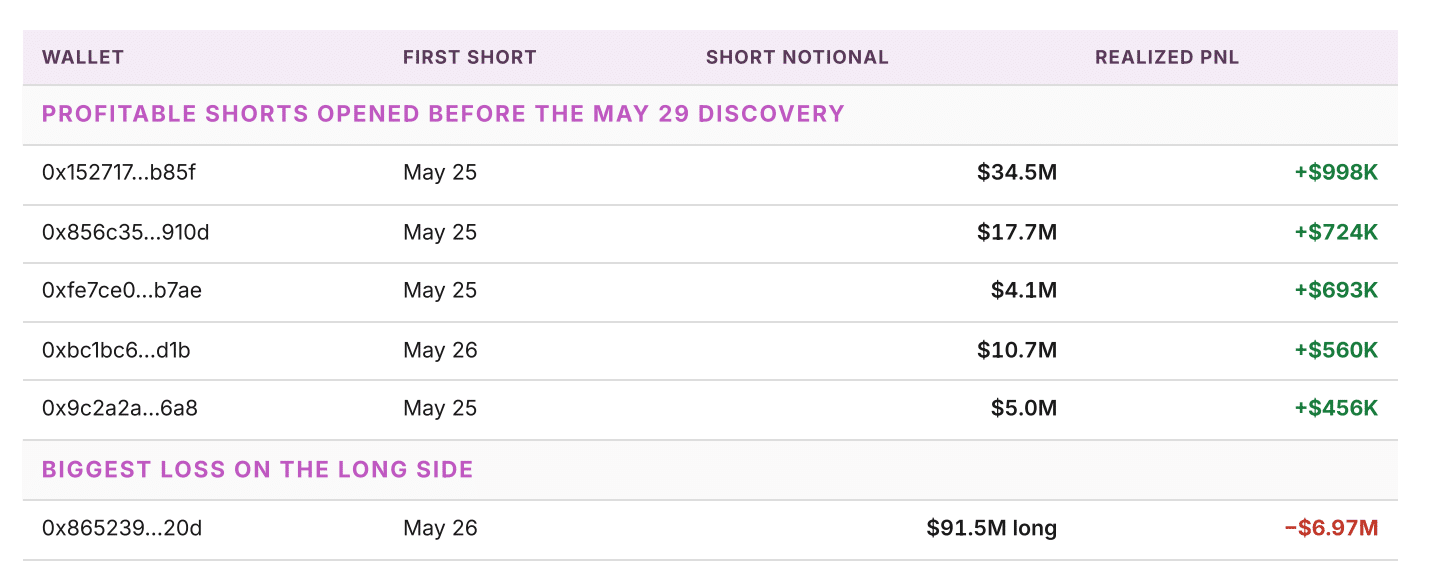
Allium Research later found that trading volumes jumped to 12 to 13 times normal levels on May 26. This activity occurred three days before the private discovery. Prior to the public disclosure, multiple profitable short positions also emerged, raising questions about advance layout.
These data do not prove insider trading. Each short position in the futures market corresponds to a long position, and at the same time, the long positions also incurred huge losses. This balance makes the transaction trajectory impossible to determine intent.
Despite this uncertainty, Zcash prices have rebounded, thanks to tighter supply and reduced U.S. regulatory pressure. The U.S. Securities and Exchange Commission ended its investigation into the Zcash Foundation in January without recommending enforcement action.
Europe presents another challenge. The EU's anti-money laundering regulations will restrict service providers from offering accounts that increase transaction confusion through anonymously enhanced tokens. These regulations are scheduled to take effect from July 2027.
























