
 Exchange Ranking
 Top Exchanges
 24h Volume Ranking
 Popularity Ranking
 Exchange BTC Balance
 Proof of Reserves
 Decentralized Exchanges
 Funding Rate
 Funding Heatmap
 Liquidation Data
 Max Pain
 Long/Short Ratio
 Whale L/S Ratio
 Binance/Okex/Huobi L/S
 Bitfinex Margin L/S
 ETF Tracker
 Solana ETF
 XRP ETF
 Hong Kong ETF
 Bitcoin Treasuries
 Crypto Reversal
 Ethereum Reserves
 HyperLiquid Wallet Analysis
 Hyperliquid Whale Watch
 Large Transactions
 On-chain Movement
 Bitcoin ROI
 Stablecoin Market Cap
 Options Analysis
 News
News Articles
 Economic Calendar
 Features
 Wallet
 Contract Calculator


 Security
 Collections
 Watchlist
 Following
 BTC
BTC Key Points
Bitcoin's on-chain trader loss rate has improved to-11%, the neutral range used in regression analysis.
The realized prices for 1-3 month and 3-6 month holders tend to align in the region of just over US$70,000.
Old Whales achieved a loss of approximately US$297.3 million on July 14, the second-largest single-day loss for the group since September 2025.
This reset becomes more convincing only when Bitcoin absorbs the freed supply and regains the cost base of recent holders.
Different data sets describe different aspects of the same adjustment process. Recently, investors have collectively reduced their cost base as their chips changed hands during the decline. The old whale has begun to make unusually large losses, indicating that the pressure has exceeded the scope of the latest participants in the market. However, bitcoin prices remain below the cost recovery levels of two important recent holder groups.
The result is that the chain structure appears to be less damaged than at its June low, but demand still needs to prove that the freed supply has found lasting buyers.
Holders have recently repriced lower, but are still underwater
CryptoQuant analysts report that Bitcoin's chain trader profit and loss margin has returned to-11%. The analyst classified the reading as neutral because it had returned to within the-12% limit that distinguishes bear market areas in the model. 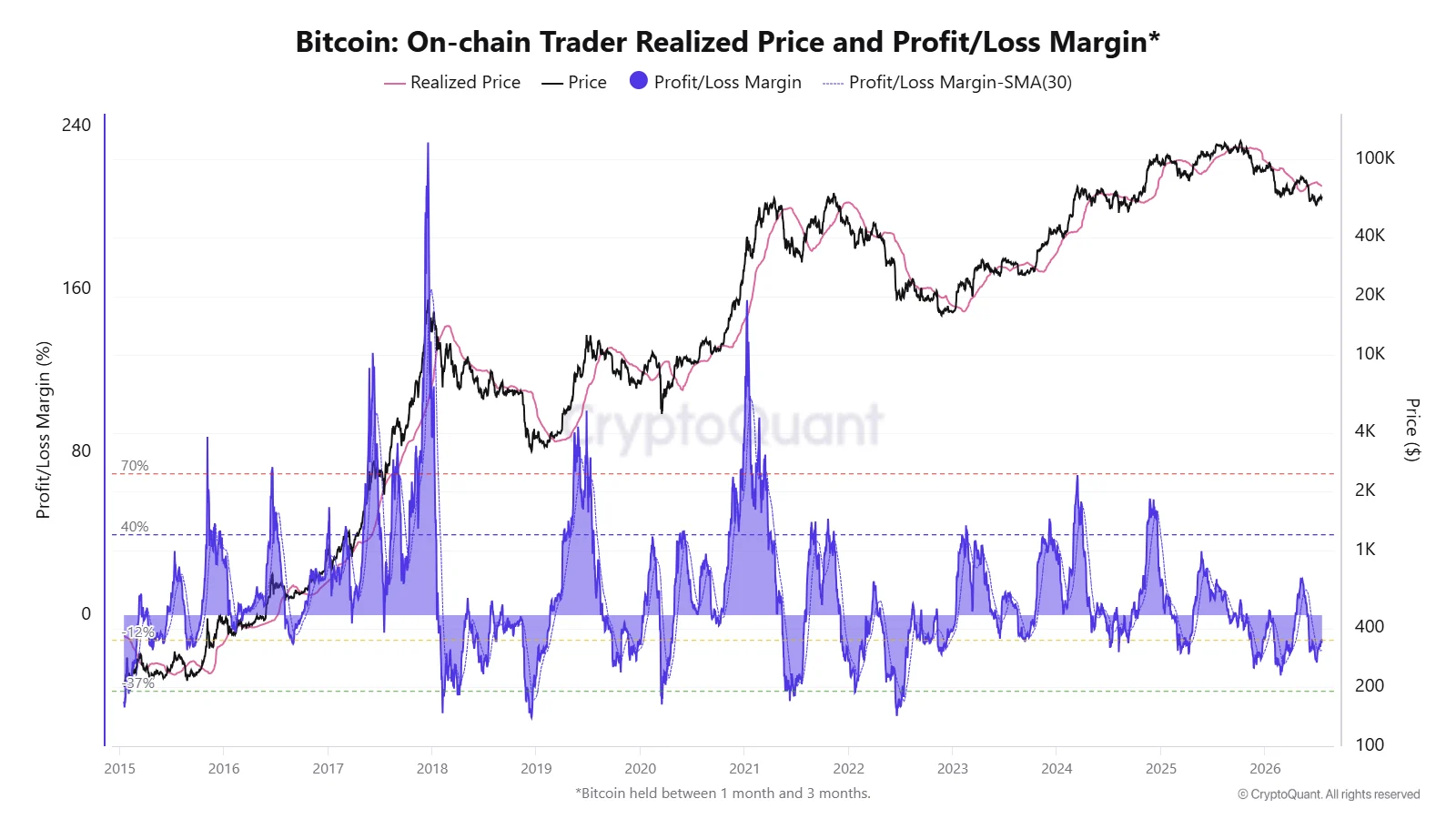 Traders on the Bitcoin chain have achieved prices and profit and loss margins.
Smaller loss rates may reflect a rebound in prices, but they may also occur when chips bought at a higher price or last-moved chips are sold and re-transferred at a lower price. Even if the market does not fully recover, this process reduces realized prices for active groups.
ShayanMarkets also found the same adjustment in the realized price UTXO age range. The realized price values chips within a group based on the market price at which the chips last moved along the chain, so it is more like a proxy indicator based on the average cost of the group than a record of the precise purchase price per investor. 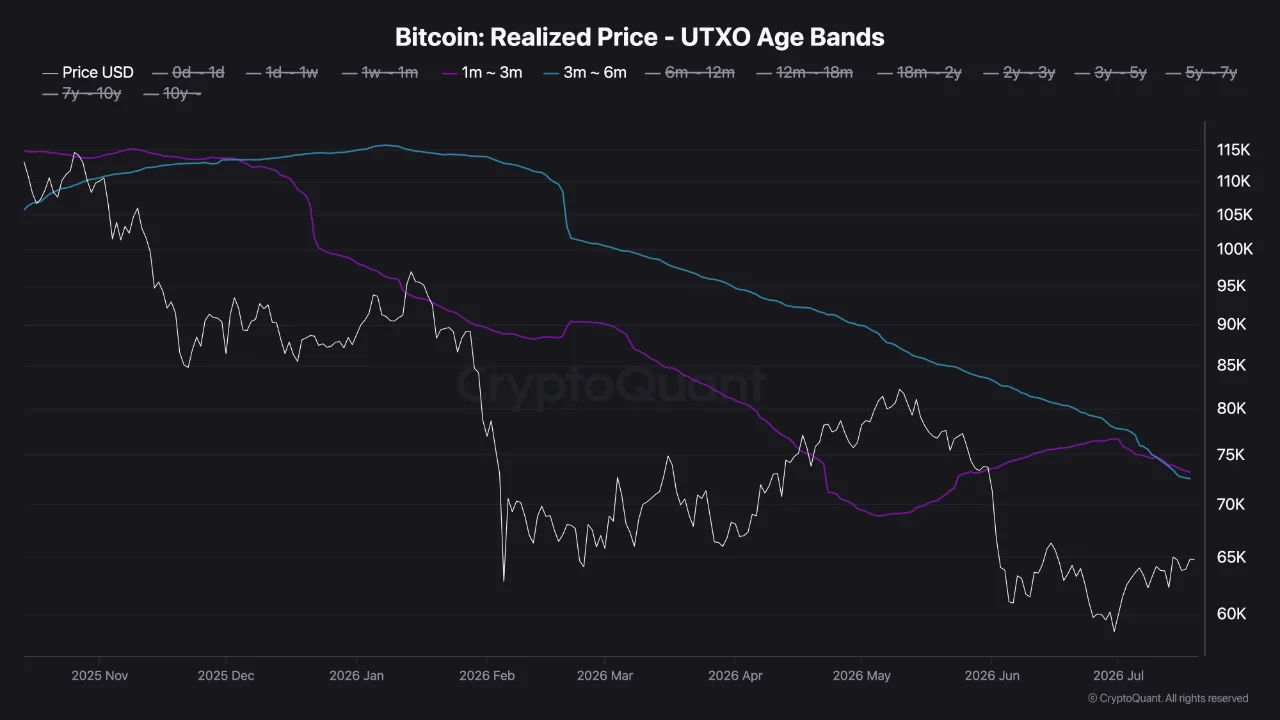 Bitcoin realized price by UTXO age range.
The realized prices for the 1-3 month and 3-6 month groups have converged to the region of just over US$70,000. Although the two groups entered the market at different stages, continued trading during the decline gradually pulled both readings lower.
These two analyses should not be regarded as independent bullish confirmations. They are all capturing the same repricing process among relatively recent holders: losses have been realized, chips have been transferred at lower value, and the level of collective cost recovery in the market has fallen.
This adjustment shortens the distance Bitcoin needs to recover before investors return to profitability in the near future. At the same time, it also concentrated potential selling in the same area. Holders who have suffered the decline may take advantage of the rebound to just over $70,000 to exit as they approach cost prices, making the common realized price an on-chain resistance area.
Old whales are now also participating in loss cashing
A third analysis shows that the pressure has hit a more solid part of the Bitcoin holder base.
According to CryptoQuant analyst Moreno, the old whale realized a loss of approximately US$297.3 million on July 14 when the Bitcoin trading price approached US$65,000. This is the second largest single-day negative reading for this group since September 2025. 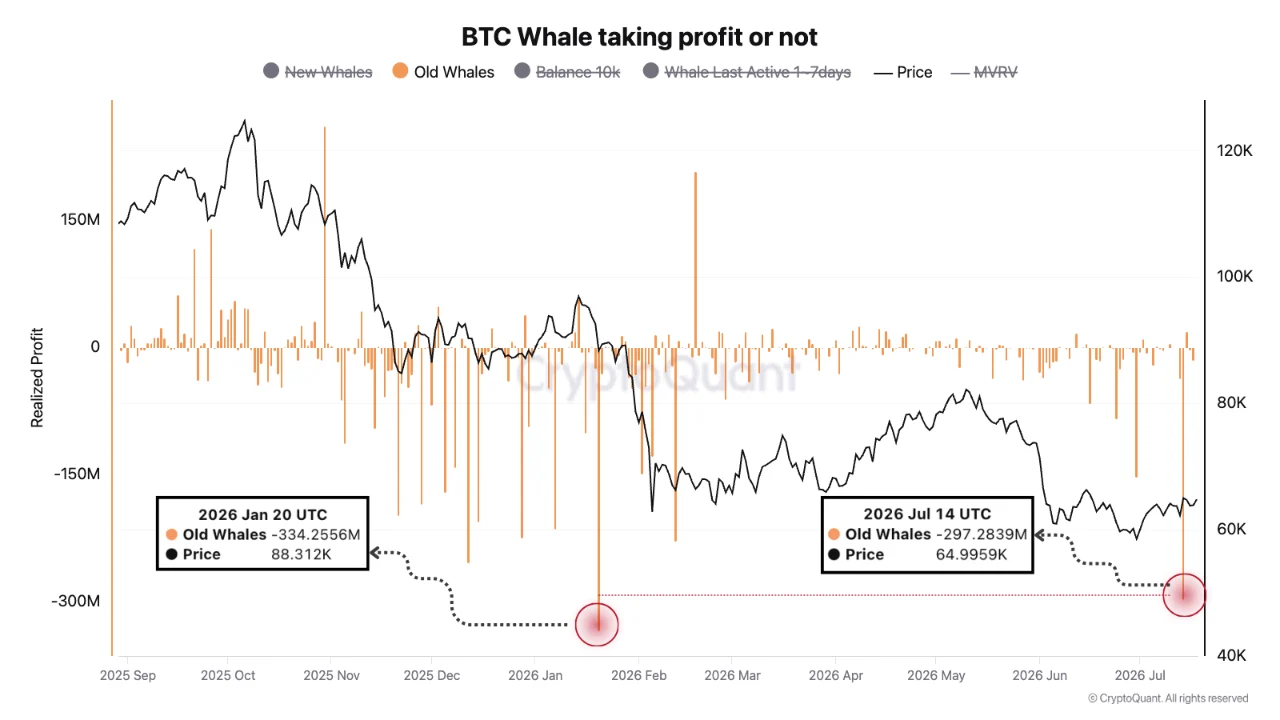 BTC Whale Profit/Loss Activity Chart/Source: CryptoQuant, Moreno.
The only bigger event occurred on January 20, when the old whale lost approximately $334.3 million and the BTC price was close to $88,300. That incident preceded a more severe stage of the decline, so the scale of the latest losses cannot be evidence of the end of capitulation.
Old whales are usually more able to withstand fluctuations than new entrants. Their decision to shift chips with losses suggests that the decline has lasted long enough or large enough to force some mature holders to reassess their exposure.
They were not the main party responsible for surrendering. New whales, recently active whales and groups holding a balance of 10,000 BTC all recorded much larger losses at multiple points in the decline. The July 14 incident suggests that older whales have joined the process, while newer, more sensitive capital is still creating greater pressure. 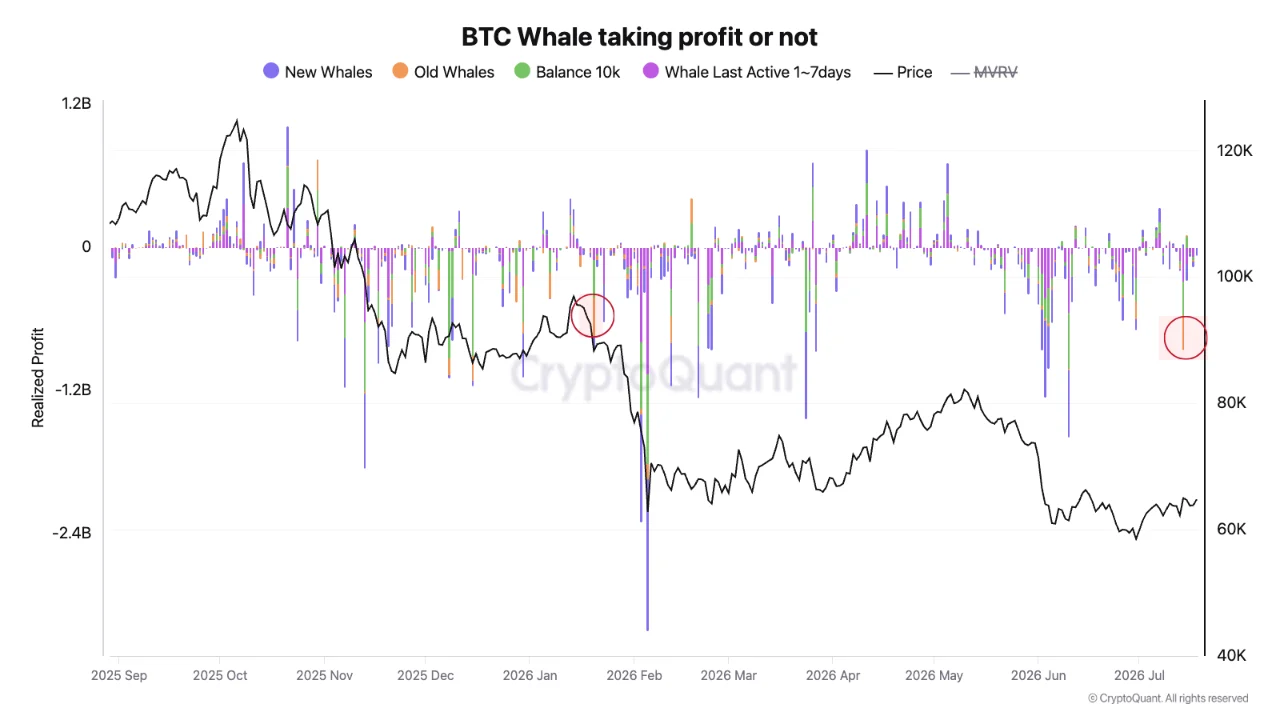 Old Whale Bitcoin Profit/Loss Analysis.
These three signals describe an ownership reset
The order between these data sets is more informative than any single reading.
Active traders have realized enough losses to bring their cost base down. Two groups of recent holders now share a similar level of cost back, while some older whales are just beginning to accept unusually large losses.
As a result, chips are shifting from holders holding higher reference prices to buyers taking over at closer to the current market price. This could create a healthier base, as new owners need smaller gains to return to profits and are less likely to sell after a moderate rebound.
Data cannot identify these buyers or determine that they have stronger beliefs. Realized losses confirm that ownership is changing; prices must show whether new demand can absorb supply without collapsing again.
What turns a reset into a reversal?
The following three developments will provide stronger confirmation:
Whale losses are beginning to recede: Markets should digest the July 14 event without a series of larger losses from older or recently active whales.
Bitcoin remains stable when chips change hands: Avoiding new lows while continuing losses are realized will indicate that buyers are accepting the released chips without gradually reducing the price.
BTC has regained the area of just over US$70,000: prices have been realized 1-3 months and 3-6 months after the price broke through convergence, and then successfully stepped back, which will indicate that the recent sell-off from holders has been absorbed. Recovering the prices already realized by on-chain traders will also bring this group's profit and loss margin back above zero, turning active traders from overall losses to profits.
If large whale loss events continue to gather, BTC hits a new low, or another rally fails below the recent holder cost base, the bearish interpretation remains valid. Under these conditions, lower realized prices reflect continued capitulation rather than the basis for a sustained recovery.
Bitcoin's ownership structure is being adjusted, but the market has not yet completed the final step. Losses have been realized and the cost base has moved down; demand must now push prices across the supply area of just over $70,000.
Even if it breaks through the early US$70,000 region, it itself cannot fully confirm the trend reversal. Bitcoin also needs to stay above recent holder costs, absorb new sell-offs, and avoid falling back below them quickly. Until these conditions are met, the data supports on-chain reset rather than inversion.
























