
 Exchange Ranking
 Top Exchanges
 24h Volume Ranking
 Popularity Ranking
 Exchange BTC Balance
 Proof of Reserves
 Decentralized Exchanges
 Funding Rate
 Funding Heatmap
 Liquidation Data
 Max Pain
 Long/Short Ratio
 Whale L/S Ratio
 Binance/Okex/Huobi L/S
 Bitfinex Margin L/S
 ETF Tracker
 Solana ETF
 XRP ETF
 Hong Kong ETF
 Bitcoin Treasuries
 Crypto Reversal
 Ethereum Reserves
 HyperLiquid Wallet Analysis
 Hyperliquid Whale Watch
 Large Transactions
 On-chain Movement
 Bitcoin ROI
 Stablecoin Market Cap
 Options Analysis
 News
News Articles
 Economic Calendar
 Features
 Wallet
 Contract Calculator


 Security
 Collections
 Watchlist
 Following
Intense competition from traditional brokers and decentralized exchanges is driving cryptocurrency exchanges to expand their business beyond digital assets into tokenized stocks, commodities and precious metals, CoinGecko said.
A study released on Wednesday by the crypto data provider showed that the market value of tokenized traditional assets, including precious metals, U.S. stocks, commodities, global indices and foreign exchange, increased from $1.4 billion in January 2025 to $6.6 billion in June 2026. The analysis covers activity on Binance, OKX, Bybit, Bitget, Gate and MEXC.
reported that the initial growth of the market was mainly driven by tokenized precious metals, and later expanded to U.S. stocks. By mid-2026, driven by investor interest in semiconductor stocks and expected initial public offerings, the trading volume and open interest in U.S. equity perpetual contracts have exceeded that of precious metals.
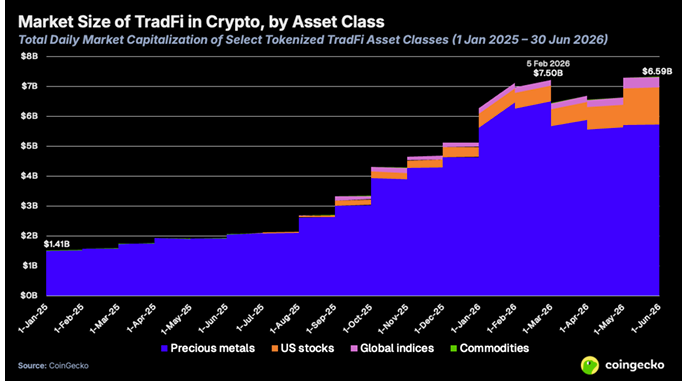
Tokenized traditional assets on cryptocurrency exchanges have increased nearly fivefold in 18 months, with precious metals driving early growth. Source: CoinGecko
Perpetual contracts account for the vast majority of trading activity, while the spot market remains relatively small. Derivatives dominate because traders prefer leveraged products and exchanges can list perpetual contracts without issuing or hosting underlying tokenized assets, the report said.
This expansion comes as centralized exchanges look beyond crypto trading to attract and retain users. CoinGecko said there is growing competition from decentralized exchanges, which are eating into market share, and traditional brokers that are expanding their digital asset offerings. Robinhood is one of the brokers that has significantly expanded its digital asset offerings, highlighting the growing trend of overlap between traditional financial and digital asset platforms.
Institutional demand drives tokenization
Institutional interest in tokenized assets continues to grow. A June report from Standard Chartered Bank predicted that by employing real-world assets, tokenization could help decentralized finance expand to a US$2.7 trillion market by 2030. In addition, Bernstein analysts estimate that as financial institutions increasingly accept blockchain-based assets, the broader tokenization market could reach $4 trillion by the end of the decade.
As CoinGecko highlighted the integration between cryptocurrency exchanges and traditional brokers, institutional adoption of tokenization highlights the speed at which the boundaries between traditional finance and blockchain infrastructure are blurred.
It is reported that BitGo has partnered with OTC Markets Group to expand access to tokenized securities for more than 150 broker-dealers. In addition, Tradable has partnered with Stellar Networks to link up to $1 billion in private credit assets, demonstrating that banks, brokers and crypto companies are increasingly building on the same blockchain infrastructure.
























