
 Exchange Ranking
 Top Exchanges
 24h Volume Ranking
 Popularity Ranking
 Exchange BTC Balance
 Proof of Reserves
 Decentralized Exchanges
 Funding Rate
 Funding Heatmap
 Liquidation Data
 Max Pain
 Long/Short Ratio
 Whale L/S Ratio
 Binance/Okex/Huobi L/S
 Bitfinex Margin L/S
 ETF Tracker
 Solana ETF
 XRP ETF
 Hong Kong ETF
 Bitcoin Treasuries
 Crypto Reversal
 Ethereum Reserves
 HyperLiquid Wallet Analysis
 Hyperliquid Whale Watch
 Large Transactions
 On-chain Movement
 Bitcoin ROI
 Stablecoin Market Cap
 Options Analysis
 News
News Articles
 Economic Calendar
 Features
 Wallet
 Contract Calculator


 Security
 Collections
 Watchlist
 Following
 ETH
ETH Just when you think cryptocurrencies have become boring, a new phenomenon called "Fake World Assets"(FWA) is lighting up crypto-Twitter. Yes, it really is.
This is the latest iteration of the on-chain twist craze-users randomly receive one or more collectibles, which are often of extremely low value but sometimes quite valuable value.
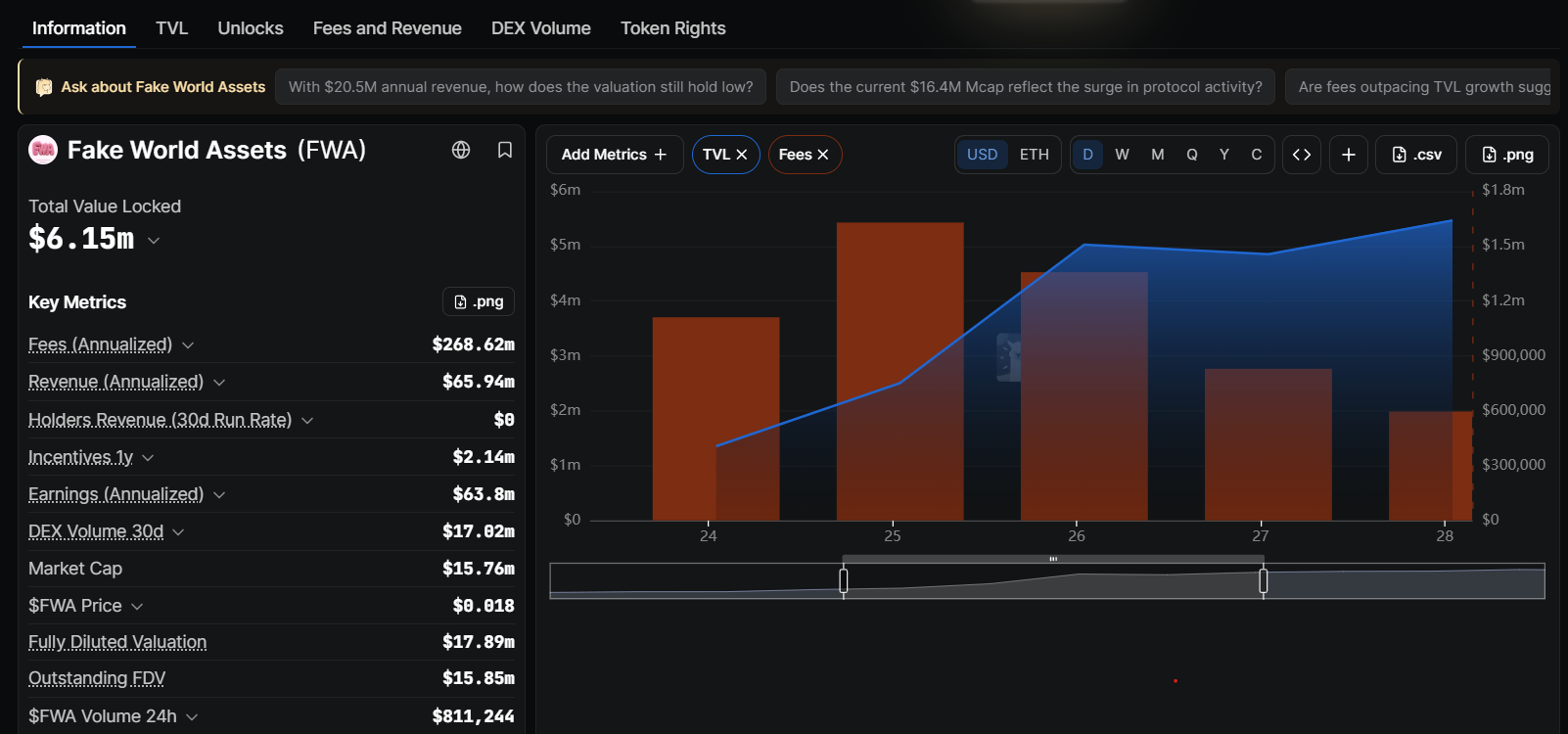
In just four days after its launch, FWA consumed a large amount of Ethereum Gas fees, and once became the largest Gas fee consuming application on the chain within 24 hours. At its peak on July 25, FWA generated approximately US$1.53 million per day, even surpassing Tether and Circle, and briefly becoming one of the applications with the largest consumption of block space in Ethereum. Its founder TokenWorks declared: "Four days after launch, FWA is the next big event."
TokenWorks is far from a bystander, but the total locked value (TVL) is still climbing, exceeding $6.15 million on July 31. Fee revenue has now fallen back to approximately US$350,000 per day, equivalent to an annualized operating rate of approximately US$268 million. As of August 1, FWA's transaction volume has reached 10,000 ETH, and the number of purchases has reached 100,000. Part of the activity is driven by users trying to obtain early FWA token incentives, but there also seems to be a real interest in gamification mechanisms.
Not everyone believes that the craze around FWA will continue. Simon Dedic, founder of venture capital firm Moonrock Capital and early supporter of the online collectibles platform, told Magazine: "I am very bullish on gamified business... but my doubts about FWA are specific." Dedic believes that most of the current activity is driven by generous token incentives rather than real demand. "It's all purely aimed at crypto gamblers, allowing them to gamble and speculate," he said.
So, is this just a brief craze, or is the industry finally finding something that lasts?
This is all interesting, but what is FWA?
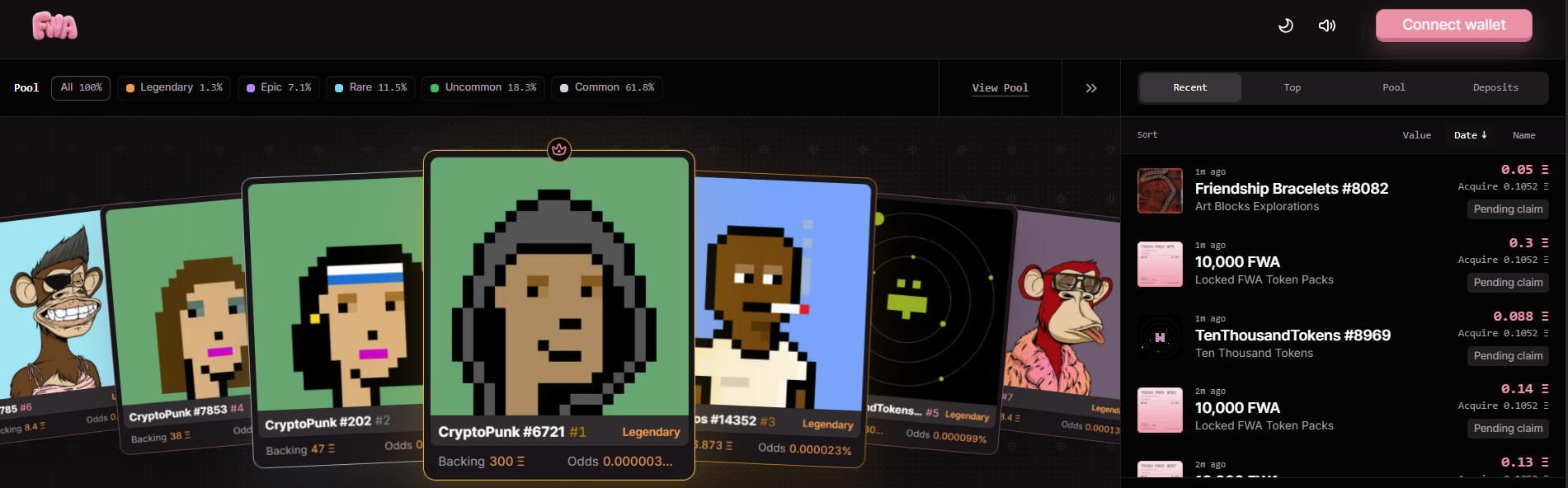
Cryptocurrencies have been trying for years to move the real world onto the chain, from stocks and bonds to collectible cards and Brazilian cattle. TokenWorks decided to do the opposite and created "fake world assets" that are actually NFTs. Instead of purchasing a specific collectibles like "Bored Ape", users pay to turn the "twist machine" on the chain and have a chance to win a randomly selected, Ethereum-backed NFT. Prizes are offered from dozens of well-known collections such as CryptoPunks, Azuki, Lil Pudgys and Art Blocks.
FWA is just the latest Ethereum-based agreement, giving a new twist to this craze. Gacha is the abbreviation for "gachapon/gashapon", which refers to a vending machine invented in Japan in the 1960s that spits out capsules containing random toys. This mechanism was later migrated to mobile and browser games, and the "trophy box" in 2010's Dragon Collection is often considered the first major twist game. At the same time, in the real world, the "Supplement Package" of the Pokemeng Trading Card also adopts a similar mechanism to randomly provide collectible cards of different rarities and values. These cards were later tokenized onto the chain by projects such as Collector Crypt, Beezie and Courtyard. As Magazine previously reported, the chain hit a record transaction volume of US$324 million in June. (Hundreds of tokenized cards are now packaged for FWA.)
The concept is expanding every week, with developers experimenting with random "token packs" containing ERC-20 tokens, and StockRip on the Robinhood chain demonstrating how to package tokenized stocks into NFT-based twist packs.
As AzFlin, founder of the DAO launch platform daos.world and former Uniswap engineer, said: "Just when you thought everything in the cryptocurrency world had been invented, new things appeared."
What is the attraction of the twisted egg on the chain?
The twist mechanism combines cryptocurrency, collectibles and gambling. As anonymous encryption commentator 2Lambroz said, from a player's perspective,"You're buying a lottery ticket about the pool."
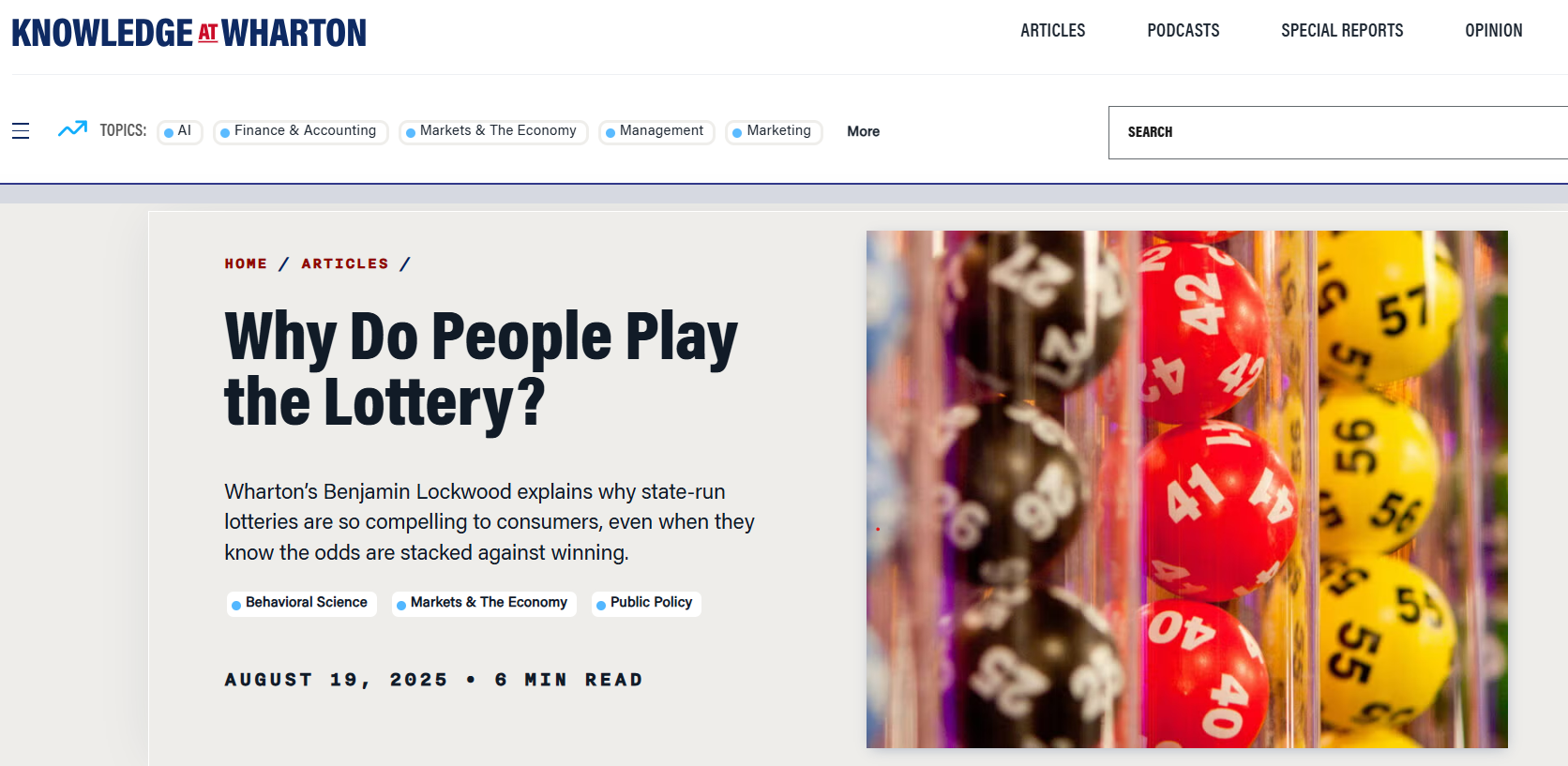
"People like to play lottery tickets, and it's important to take this seriously," said Benjamin Lockwood, an economist at Wharton. His research on state lotteries found that people value the experience itself, not just the chance to win. Meir Statman, a pioneer in behavioral finance, professor at Santa Clara University and author of "Prosperity and Well-Being," told Magazine: "There are similarities between twisting eggs on the chain and people bidding for the contents of abandoned lockers. Most people find something that only deserves to be thrown into the trash, but some find items that can be sold on eBay. Someone discovered a painting worth hundreds of thousands of dollars. These combine the desire for wealth with interest. That's what the lottery provides."
There are two sides to everything
The FWA agreement has two sides. NFT holders become liquidity providers (LPs), deposit collectibles and ETH, and earn a share of fees in the process. Players pay for the opportunity to randomly draw the NFT and then decide whether to keep it or redeem the vast majority of the ETH value attached to it. (Blockworks Research points out that about 70% of buyers currently choose to redeem their winnings for FWA.) As 2Lambroz explains, LPs actually want their NFT to stay in the pool long enough to earn fees before being drawn; and players chase the opportunity to win the jackpot at a price far less than the cost of a turn.
Materkel, who calls herself the most maximalist of Ethereum, said: "This is the most interesting NFT/casino primitive for cryptocurrencies in more than a decade, where users can actually play both the player and the dealer... The money on Ethereum is back!"
Can the craze last?
Although Dedic believes that most of the activity is related to token incentives, he said that "for intergenerational reasons, I am very optimistic about gamified business." "As Generation Z gradually becomes the most purchasing power group, shopping will become more and more gamified, accompanied by dopamine shocks." Moreover, Dedic believes that rather than providing random NFTs from the previous cycle, the mechanism is more suitable for assets people already want to own, such as Pokémon cards, watches and even collectibles such as whiskey. "I see huge potential in gamistically selling high-demand assets," he said."I don't see any prospects for building a Ponzi scheme to create demand for assets that no one wants."
The real test will come when the novelty fades and incentives fade. If the user continues to turn, then the blockchain may have found the retail use case that cryptocurrency has been looking for. If not, they will join the garbage pile of failed cryptocurrency experiments that once shone and then quickly died out.
























