
 Exchange Ranking
 Top Exchanges
 24h Volume Ranking
 Popularity Ranking
 Exchange BTC Balance
 Proof of Reserves
 Decentralized Exchanges
 Funding Rate
 Funding Heatmap
 Liquidation Data
 Max Pain
 Long/Short Ratio
 Whale L/S Ratio
 Binance/Okex/Huobi L/S
 Bitfinex Margin L/S
 ETF Tracker
 Solana ETF
 XRP ETF
 Hong Kong ETF
 Bitcoin Treasuries
 Crypto Reversal
 Ethereum Reserves
 HyperLiquid Wallet Analysis
 Hyperliquid Whale Watch
 Large Transactions
 On-chain Movement
 Bitcoin ROI
 Stablecoin Market Cap
 Options Analysis
 News
News Articles
 Economic Calendar
 Features
 Wallet
 Contract Calculator


 Security
 Collections
 Watchlist
 Following
 BTC
BTC  ETH
ETH Bitcoin ETF capital inflows accelerated, with IBIT dominating weekly purchases; Ethereum ETF capital inflows continued to rise, and trading volume remained sluggish.
Bitcoin ETF capital inflows reached approximately US$853.5 million in five trading days, setting the strongest weekly total since mid-April.
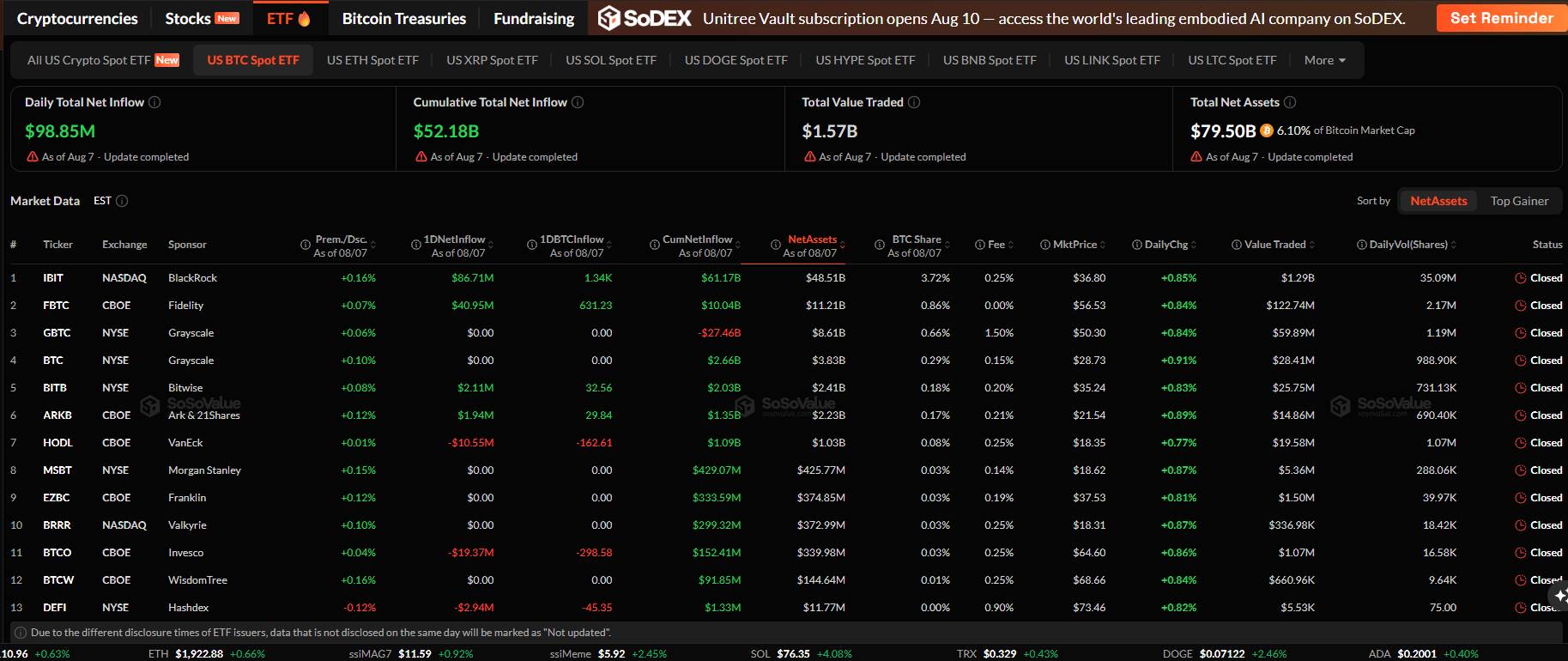
BlackRock's IBIT attracted US$693.7 million, accounting for more than 80% of Bitcoin fund inflows. Fidelity's FBTC attracted $116.4 million.
Total capital inflows to the Ethereum ETF totaled approximately US$244.9 million, extending its winning streak to five weeks. The Coldcard vulnerability only affects Bitcoin wallets.
Bitcoin ETF trading volume fell 9% to approximately US$8.19 billion. At the same time, Bitcoin tested the $65,000 mark, with resistance close to the short-term holder cost base of $67,523.
U.S. crypto funds recorded their strongest weekly total inflows since April, with Bitcoin ETF inflows leading a surge of $1.1 billion. Spot Bitcoin products have a net inflow of approximately US$853.5 million for five consecutive trading days. Ethereum funds increased by approximately $244.9 million in the same week. BlackRock's IBIT accounts for most of Bitcoin demand, while Fidelity's FBTC ranks second. Although weekly trading activity remains near multi-year lows, inflows continue to emerge. Bitcoin, after recovering from weakness in early August, is trading close to $65,000. However, resistance remained concentrated between $65,250 and $67,523. Technology levels and short-term holder costs may rise further in the latest week limit.
Bitcoin ETF inflows accelerate, IBIT dominates weekly purchases
Bitcoin ETF inflows reached approximately $853.5 million last week, its best performance since mid-April. These funds recorded net inflows over five trading days. It led by $244.4 million on Wednesday, compared with $211.5 million on Tuesday, increased $128.7 million on Thursday and contributed $98.9 million on Friday.
Source: SosoValue
BlackRock's IBIT absorbed US$693.7 million, accounting for more than 80% of weekly Bitcoin ETF inflows. Fidelity's FBTC increased by $116.4 million, or about 13% of total inflows. Together, these two largest funds account for most of the new capital driving Bitcoin ETF inflows.
Bloomberg analyst Eric Balchunas linked some of the purchases to a Coldcard wallet vulnerability. After the loophole emerged, several major funds recorded daily inflows. The vulnerability affected certain Bitcoin cold storage wallets, with more than $111 million reportedly stolen.
However, this timing does not fully explain the broader demand for crypto funds. Ethereum ETF inflows also recorded its best week since April. Ethereum holders have not been affected by this hardware wallet problem that targets only bitcoin. This weakens the direct link between loopholes and institutional capital inflows.
Bitcoin rose about 3% this week, breaking above $65,300 on Friday. U.S. non-farm payrolls fell by 23,000 in July, well below the expected increase of 80,000. After the report was released, traders lowered expectations for the Federal Reserve to raise interest rates in September.
Most of the Bitcoin ETF inflows occurred ahead of Friday's labor data. Thursday and Friday recorded the lowest inflows in five consecutive trading days. This model suggests that institutional buying was already active before the macroeconomic accident.
Ethereum ETF inflows continue to rise, trading volume remains sluggish
Ethereum ETF inflows reached approximately US$244.9 million this week, extending the positive earnings record to five weeks, setting the longest weekly winning streak since 2026. The strongest daily inflow was recorded on Thursday, at $92.2 million.
As of Friday, the funds had net assets of $10.74 billion. Its cumulative net inflow is close to US$11.46 billion. On a mark-to-market basis, these products are still approximately $711 million less than total invested capital.
Large Ethereum holders are also increasing their positions. Wallets holding 10,000 to 100,000 ETH control approximately 19.6 million ETH. This number has increased from approximately 14 million ETH in mid-2025.
Trading volumes remained sluggish despite strengthening capital inflows. Bitcoin ETF trading volume totaled approximately US$8.19 billion, down 9% from the previous week and the second lowest full trading week since October 2024. Ethereum ETF trading volume fell about 21% to about $2.38 billion.
Bitcoin is trading close to US$65,015, and the US$65,000 zone has been tested repeatedly. Daily prices remain above the 20th and 50th simple moving averages. These moving averages are near $64,461 and $63,363, forming a direct support area.
Resistance levels remain above current levels. Bitcoin is trading below the 100-day moving average (approximately US$68,052) and the 200-day moving average (approximately US$70,295). The realizable price for short-term holders is approximately $67,523, putting many recent buyers close to break-even.
A four-hour close above US$65,257 may hit US$65,600 and then point to US$66,000. Liquidation data showed concentrated short positions around $65,500 to $65,700. At the same time, if Bitcoin loses US$64,000 support, downside liquidity is around US$63,700 and US$63,000.
























