Exchange Ranking
 Top Exchanges
 24h Volume Ranking
 Popularity Ranking
 Exchange BTC Balance
 Proof of Reserves
 Decentralized Exchanges
 Funding Rate
 Funding Heatmap
 Liquidation Data
 Max Pain
 Long/Short Ratio
 Whale L/S Ratio
 Binance/Okex/Huobi L/S
 Bitfinex Margin L/S
 ETF Tracker
 Solana ETF
 XRP ETF
 Hong Kong ETF
 Bitcoin Treasuries
 Crypto Reversal
 Ethereum Reserves
 HyperLiquid Wallet Analysis
 Hyperliquid Whale Watch
 Large Transactions
 On-chain Movement
 Bitcoin ROI
 Stablecoin Market Cap
 Options Analysis
 News
News Articles
 Economic Calendar
 Features
 Wallet
 Contract Calculator


 Security
 Collections
 Watchlist
 Following
 AAVE
AAVE  AVAX
AVAX  BNB
BNB  BTC
BTC  DOT
DOT  ETH
ETH  HBAR
HBAR  LINK
LINK  SOL
SOL  UNI
UNI  XRP
XRP  ZEC
ZEC Bitcoin has just ended its strongest rally in 2026. Prices climbed all the way from about US$62,800 in early August to exceeding US$80,000 on August 25, with a weekly increase of about 22% and a monthly increase of nearly 28%. This was Bitcoin's best week since 2023.
Multiple kinetic energies emerge at the same time. The U.S. Treasury has doubled the size of its bond repurchase operations; new developments behind the Clarification Act have boosted market risk appetite; and about $2.7 billion in short positions were forcibly closed during the rise. Inflows from spot Bitcoin ETFs-which were negative for the whole year in 2026-turned back to positive in July and August.
Before anyone claims this is a new bull market, there is one thing to face up to: Bitcoin hit a peak of $126,198 in October 2025, and then fell to a 21-month low of about $59,300 in June 2026. At $80,000, the asset is still about 37% below its all-time high. This is a recovery, not a breakthrough.
Is the entire cryptocurrency market rising, or is it just Bitcoin rising?
The entire market is rising, but Bitcoin still holds a larger share, and the gap is where the opportunity lies.
The current total market value of cryptocurrencies is close to US$2.75 trillion. The altcoin market excluding bitcoin (tracked by TOTAL2) increased by approximately $215 billion between August 19 and 22, regaining its footing at $1 trillion. CryptoQuant analyst Darkfost found that 56% of the altcoins that have been put on the line have regained their 200-day moving average, which is in sharp contrast to previous months when 80% to 85% of the altcoins were below that average.
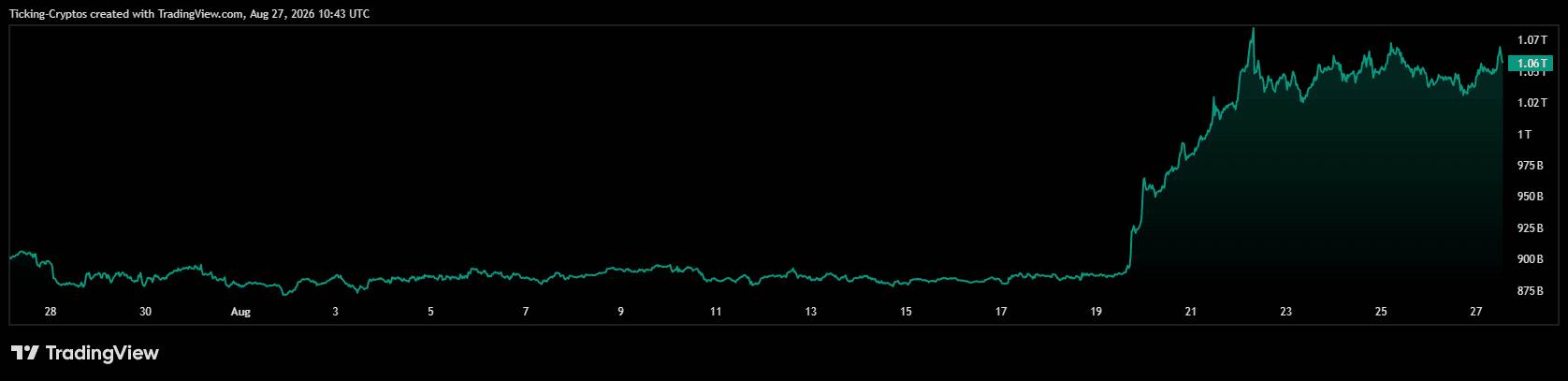
(Total market value in US dollar-denominated terms excluding BTC)
So, altcoins are participating. But they did not lead the market. Bitcoin dominance climbed to about 61% during the week before falling back to about 59%, near its highest level for the year. In true capital rotation, dominance declines as capital moves down the risk curve. And here it goes up. CoinMarketCap's altcoin seasonal index is currently in a median of more than 40 points, a sharp increase from 33 points a week ago, but still well below the 75-point threshold that defines a true altcoin season.
As a result, the market presents a scene of fierce gains in a few currencies and no movement in the rest. In the seven days ending August 25, XRP rose 43.7%, Ethereum rose 28.6%, and Solana rose 25.6%, both outperforming Bitcoin by 22.6%. Chainlink rose more than 30%. Zcash rose about 75%, and Aave rose more than 60%. Below these top currencies, many mature projects recorded only single-digit weekly gains.
How were these five altcoins selected?
Each token has underperformed Bitcoin in the past week, past month, or both, and each token has a clear catalyst, not just an oversold chart.
Three filters were applied:
Significant underperformance : a 22.6% weekly gain, a 28% monthly gain, or both against Bitcoin.
There are real reasons for repricing : such as announced upgrades, regulatory changes, structural supply changes, or measurable business growth.
Have sufficient liquidity : Be able to smoothly enter and exit without affecting the market.
Excludes Memecoin and projects without independent development activities. The list is arranged by market value rather than based on personal judgment.
Why is BNB still lagging behind Bitcoin as the largest altcoin?
BNB rose 15.4% this week, while Bitcoin rose 22.6%, making it the only currency among the top five assets to significantly underperform in this round of gains.
BNB is trading at close to US$700. All other major currencies-including Ethereum, XRP and Solana-outperformed Bitcoin in the same week. But BNB didn't, and it did it with one of the clearest fundamentals in the field.
The bullish logic lies in structure. BNB's quarterly destruction mechanism reduces supply on a fixed schedule regardless of market sentiment, which is rare in most asset classes where most tokens are under pressure to unlock rather than shrinking supply. BNB Chain continues to maintain high transaction throughput, and the token has direct utility in the largest exchange ecosystem for cryptocurrencies.
The bearish logic is a concentration risk, and this is no small problem. The value of BNB is closely linked to the fate of the single exchange operator and the subsequent regulatory stance taken by the United States and the European Union against it. This connection goes both ways. It has pushed the token through past cycles, and it is it that has made some institutional allocators stay away from it.
For September positions, BNB is the least volatile currency on this list. It is unlikely to triple and is the one with the lowest chance of returning to zero.
Can Hedera (HBAR) translate corporate adoption into actual price increases?
HBAR is trading at approximately US$0.068 and has a market value of nearly US$3 billion. Despite regulatory clarity and the launch of a U.S. spot ETF, its price is still approximately 22% below the 200-day index moving average.
The gap between Hedera's institutional layout and its price chart is the largest of any asset in this list.
In terms of adoption, Hedera's management committee has grown to 31 members, including FedEx, Google, IBM, Boeing, Standard Bank, Nvidia and ServiceNow. Each member operates one node. Arax has facilitated tokenized British gilts and money market funds on Hedera, and Lloyds Banking Group has used tokenized Hedera assets as foreign exchange collateral.
In terms of regulation, in March 2026, the U.S. Securities and Exchange Commission (SEC) and the Commodity Futures Trading Commission (CFTC) jointly issued explanatory rules formally classifying HBAR and 16 other major crypto assets as digital commodities, exempting them from stricter securities regulations. The Canary HBAR ETF will be listed on Nasdaq in October 2025, making HBAR the third cryptocurrency to gain U.S. spot ETF status, and there has been a continuous net inflow of funds since its listing. Hedera also added full Ethereum Virtual Machine (EVM) compatibility in July 2026, allowing developers to develop using standard Ethereum tools.
So why are prices stagnant? Two reasons. The scheduled treasury release brings continued dilution pressure and absorbs demand that should be reflected in price. In addition, Hedera has a long track record of announcing corporate partnerships that have failed to translate into continued token demand. HBAR broke through the daily downtrend line with strong trading volume on August 21, but the structure would really change only if the decisive closing price was above $0.082.
Is Avalanche (AVAX) cheap enough that discounts are attractive?
AVAX is trading at about $7.50, down about 70% in the past year and more than 90% from its 2021 high, while its DeFi ecosystem continues to expand.
AVAX is the currency with the deepest decline on this list, but the decline in itself has never been a reason for investment. The reason AVAX is noteworthy in September is that ecosystem activity has diverged from price trends.
Aave deployed its V4 version on Avalanche and launched the Stable Vaults product, which allows fintech companies to provide stablecoin benefits without building their own DeFi infrastructure. This is important because it directs institutional-level funding flows to Avalanche rather than detour. The chain's subnet architecture also remains one of the more credible solutions to the tokenized real-world asset (RWA) problem, which will exceed US$36 billion on the chain in 2026.
The opposing argument is straightforward and has been correct for the past two years. Avalanche has repeatedly attracted high-quality integrations, but has failed to turn it into token demand because subnets can use technology but bring limited value to AVAX holders. This is the same value capture problem that has caused the value of multiple Layer-1 tokens to shrink, and there is currently no decisive solution.
treats AVAX as a bet: a bet that the RWA narrative will ultimately repay those chains that are actually doing things. This is investment logic, not certainty.
Does Uniswap (UNI) finally have a story worth capturing?
UNI has been one of the weakest performing large DeFi tokens this summer, falling 18.5% in the week ended August 18, while the sector rose overall.
Uniswap remains the dominant decentralized exchange in terms of transaction volume, while UNI has historically been a token from which little value has been captured. This is the most discussed value capture issue in the DeFi field.
The reason for focusing on it now is that the debate over allocating routing protocol fees to token holders has shifted from year-round forum discussions to something closer to actual governance issues, thanks to the fact that the U.S. regulatory environment is friendlier than when the issue was frozen for years. If the fee mechanism is ultimately approved, the repricing will be mechanical rather than narrative driven.
The reason for caution is that this has been a bullish reason for UNI since 2021, but it has not yet materialized. Governance tokens that may one day capture revenue trade at a sustained discount to tokens that have already done so, and this discount is reasonable. Uniswap is also facing real competitive pressure from new trading platforms and perpetual contract platforms, which already account for a portion of the chain's trading volume.
UNI deserves to be included in this list because the results are either or and the market is currently pricing only one possibility. This also makes it most likely to continue standing where it is.
Why is Polkadot (DOT) still lagging behind after launching so many results?
DOT is trading well below its cyclical highs, despite its ambitious architectural roadmap, making it the most contrarian option on this list.
Polkadot's problems were never engineering outputs. The problem is that the project output does not benefit the token itself.
The bullish logic for the future revolves around the JAM upgrade, a plan to re-architecture relay chains into a more generic computing environment, along with ongoing work to reduce the cost and capital intensity of parallel chain deployments, making it superior to the original auction model. If Polkadot succeeds in becoming an infrastructure leased by other chains, DOT's role will shift from pledging and managing assets to something with ongoing demand.
The reasons for being bearish are the same ones that have existed for three years. Inflation continues, parallel chain demand is well below early expectations, and developers can use Substrate for development without the need for DOT at all. Polkadot has consistently been among the top in development activity but at the bottom in price performance, indicating that the market is not currently paying for it.
DOT is included only if it is accepted that this is a bet on token economics and market execution capabilities (not technology). Technology has never been a bottleneck.
Which of the five altcoins is the most risky?
All five have significantly higher risks than Bitcoin, and buying backward currencies is an investment strategy with a probability of failure at least equal to the probability of success.
Currencies-Approximate Prices-Overview-Major Risks
BNB - ~ US$700-lowest volatility, structural destruction-single entity and regulatory concentration
Hedera (HBAR) - ~ US$0.068-corporate adoption, online ETF -treasury dilution, previous adoption not converted to price
Avalanche (AVAX) - ~ US$7.50-deep correction, RWA exposure-subnet capture value, Tokens may not benefit
Uniswap (UNI) - ~ US$3.30-binary fee switching results-Value capture issues unresolved since 2021
Polkadot (DOT) - ~ US$2.40-High development activities, The JAM Roadmap-Inflation and Weak Parallel Chain Demand
has a specific trap in investing in backward currencies that deserves to be clearly pointed out. A currency may fall behind because the market has not yet touched it, or it may be because the market has looked at it and concluded that it is not worth more money. Before the results are announced, ambushing too early and misjudgment look exactly the same. Uniswap and Polkadot, in particular, have looked like bargains for years.
In September, the entire list faced three risks. First, this funding round has not yet been confirmed: the altcoin seasonal index is in the middle of more than 40 points, but it is not a signal. Second, Bitcoin needs to hold on to the US$75,000 to US$76,000 range. If it falls below, altcoins with high funding rates and overbought states will unlock faster than Bitcoin. Third, the macro calendar is very intensive. Federal Reserve Chairman Kevin Walsh will deliver his first Jackson Hole keynote speech since taking office on August 28. Since taking office in May, his guidance has been deliberately sparse, leaving considerable room for surprises in any direction.
Last tip about operations rather than markets. Rapid price increases create the conditions for people to make the worst safety decisions. When attention returns to the realm of cryptocurrencies, fake wallet promotion and mnemonic phishing can become extremely effective. If you are transferring large amounts of money, please proceed with caution.