Exchange Ranking
 Top Exchanges
 24h Volume Ranking
 Popularity Ranking
 Exchange BTC Balance
 Proof of Reserves
 Decentralized Exchanges
 Funding Rate
 Funding Heatmap
 Liquidation Data
 Max Pain
 Long/Short Ratio
 Whale L/S Ratio
 Binance/Okex/Huobi L/S
 Bitfinex Margin L/S
 ETF Tracker
 Solana ETF
 XRP ETF
 Hong Kong ETF
 Bitcoin Treasuries
 Crypto Reversal
 Ethereum Reserves
 HyperLiquid Wallet Analysis
 Hyperliquid Whale Watch
 Large Transactions
 On-chain Movement
 Bitcoin ROI
 Stablecoin Market Cap
 Options Analysis
 News
 Articles
 Economic Calendar
 Features
 Wallet
 Contract Calculator


 Security
 Collections
 Watchlist
 Following
 BTC
 ETH
iPower Quarterly Financial Analysis: Sell Ethereum, Focus on AI Infrastructure
In the quarter ending on 30 September, NASDAQ’s home and gardener iPower sold its holdings of Etheleum (Ether) and its yield-based digital assets linked to AI. This made Bitcoin the company’s only digital asset retained at the end of the season. The company earned $1.57 million through a transaction on 14 August, and still held 15.12 Bitcoin worth $1.26 million as of 30 September.
Encrypted assets are not the main cause of loss
While its digital assets generated a gain of $472,040, the net loss of iPower was recorded by $2.78 million as a result of a significant decline in core business sales and Maori. It should be noted that the sale of the above-mentioned encrypted assets occurred during the latest reporting quarter rather than in the recent past. iPower has disclosed these transactions in its annual report of 2 October and has not completely withdrawn from the encryption field.
Asset allocation and adjustment policy
The iPower adopted the digital treasury strategy in June 2025, and began buying it in December of the same year. The strategy refers to companies using their own funds to hold cryptocurrency, rather than to generate income only through the sale of products or services. The first purchases included 15.1 Bitcoin, valued at approximately $1.33 million, and about 301.1 Ethereum (Ether is a cryptocurrency used by the Ethereum network, which is different from Bitcoin ' s blockchain).
In June 2026, iPower added about US$ 1 million to USDai and converted it to or staking as USDai. Unlike Bitcoin, this position is intended to receive returns related to AI infrastructure financing. However, as of 14 August, the company had sold all Ethereum and sUSDai. The latest quarterly documents show that the total cash income from these sales was US$ 1,565,771 and the recognized proceeds were US$ 93,249.
The digital asset portfolio tends to be streamlined
This leaves a smaller and simpler encrypted portfolio. As at 30 September, the $1.26 million of digital assets in the report were all Bitcoin, compared to a total of $2.36 million three months ago.
Of the total of $472,040 in quarterly digital asset gains, $378,791 resulted from a change in the fair value of Bitcoin (based on the accounting value of market prices). This part of the proceeds was realized without the need to sell Bitcoin or to collect cash.
Downsizing of core business
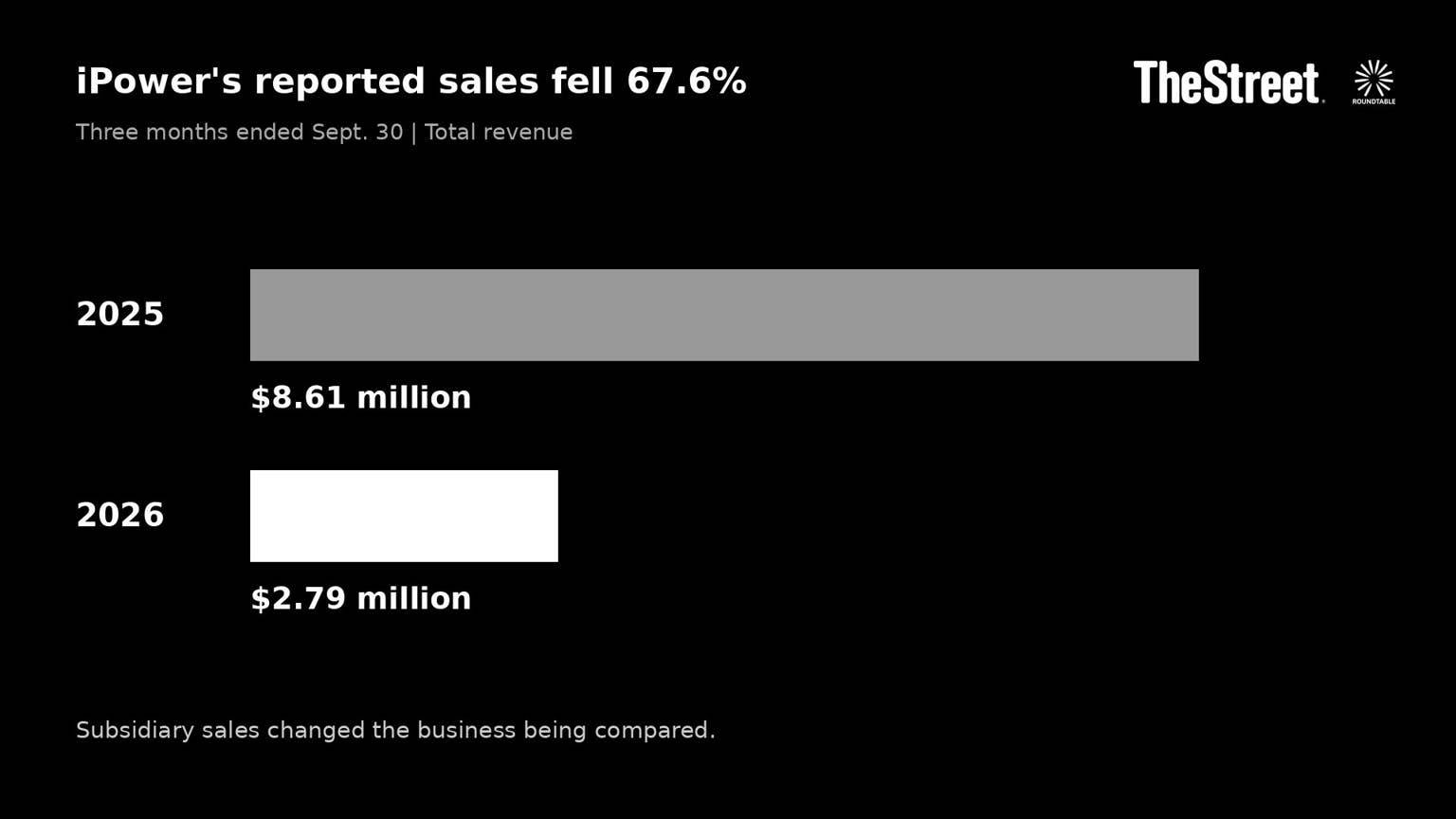
The same quarterly report showed that total income was $2.79 million, down from $8.61 million a year ago. Even with proceeds from encrypted assets, the net loss increased from $533,648 to $2.78 million. A significant part of the decrease in income reflects a change in the scope of operations of the comparative benchmark. On 1 February, iPower sold its interest in global product marketing and its affiliated entities to ETTS AI Investment in exchange for a promissory note with a face value of $2.3 million, rather than an instant cash payment.
The decline in product sales was largely attributed to this divestment. Product income declined from $7.08 million to $2.79 million, and service income from $1.53 million to zero. When missing service income was included, total income fell by 67.6 per cent, based on comparative data from the reporting company, which did not prove that a customer in a changing home and horticulture business had purchased 68 per cent less.
The Māori rate (the remaining profit after the direct cost of sales) fell from $3.14 million to $303,735. The overall Māori rate decreased from 36.4 per cent to 10.9 per cent, meaning that only about 11 cents remained per dollar of income before the operating costs were paid. Operating costs decreased by 33.6 per cent to $3.51 million, but savings were not sufficient to offset the Māori decline. The operating losses increased from $2.15 million to $3.21 million.
Strategic focus shifted to AI services
The management stated that it was currently reducing the exposure to certain digital assets and giving priority to direct AI infrastructure and related operational opportunities. Holding a token linked to AI financing was a different activity from operating AI Service, which the iPower was pursuing while retaining Bitcoin.
On October 15, iPower AI announced that it had signed a binding letter of intent with its client to establish a five-year equipment service and management relationship. The client identified 48 initial computing units and plans to expand to approximately 396 units by 2027.
Based on the proposed cost of $4,608 per unit per month, a full expansion would represent a service cost of up to $21.9 million per year. The initial 48 units would be approximately $2.65 million on the same year-on-year basis. The company made it clear that these were not committed income, backlog orders, profits or revenue guidelines for 2027, and that the final commercial terms would still require certainty.
For shareholders, the next test is whether the proposal has been transformed into a legally binding protocol, leading to the deployment of the project that is actually paid for. The potential annual cost cannot be considered as the income that the enterprise has earned.
Cash flows and financing needs
The iPower cash for operating activities in the quarter of September was $2.45 million, compared to $1.69 million generated during the same period last year. At the end of the season, the company held $1.59 million in cash and cash equivalents. In addition, the company reported $4.82 million in restricted cash, which is not interchangeable with unrestricted operating cash. Its financing arrangements also place collateral on the assets in the assigned account.
Management indicated that, based on its business plan, cash, expected cash flows and financing, sufficient liquidity was expected to meet its obligations and fund operations for at least 12 months. The report did not indicate that management considered that there were significant doubts about the company ' s ability to continue.
After the quarter was closed, financing was also made. The disclosure on 16 November showed that the iPower issued $2 million in advanced guarantee convertible instruments, which actually received approximately $1.66 million after deduction of installation and other transaction costs. Convertible instruments can be converted to equity obligations. They bring cash, but conversions will increase the number of liquidity units, thus diluting the shareholding ratio of existing holders.
For shareholders, there are two separate issues that require attention: firstly, how much of management retains a secure asset exposure under the financing arrangement; and secondly, whether its proposed AI service business can be converted into actual paid work while the company as a whole is still at a loss.