Exchange Ranking
 Top Exchanges
 24h Volume Ranking
 Popularity Ranking
 Exchange BTC Balance
 Proof of Reserves
 Decentralized Exchanges
 Funding Rate
 Funding Heatmap
 Liquidation Data
 Max Pain
 Long/Short Ratio
 Whale L/S Ratio
 Binance/Okex/Huobi L/S
 Bitfinex Margin L/S
 ETF Tracker
 Solana ETF
 XRP ETF
 Hong Kong ETF
 Bitcoin Treasuries
 Crypto Reversal
 Ethereum Reserves
 HyperLiquid Wallet Analysis
 Hyperliquid Whale Watch
 Large Transactions
 On-chain Movement
 Bitcoin ROI
 Stablecoin Market Cap
 Options Analysis
 News
 Articles
 Economic Calendar
 Features
 Wallet
 Contract Calculator


 Security
 Collections
 Watchlist
 Following
 ETH
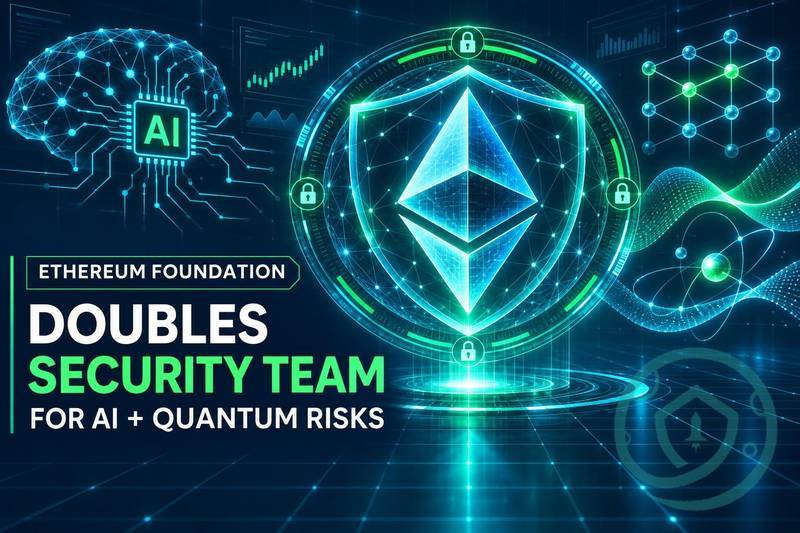
The Ethereum Foundation doubles the size of the security team and works on the dual threat of AI and quantum calculations.
The Ethereum Foundation has doubled its program security team to accelerate the enhancement of network security against two growing threats: a gap discovered by artificial intelligence at an accelerated rate, and the long-term encryption risks associated with quantum computing. The project, known as PQAI, is to be completed by December 2028, and has an impact that covers all levels of the Ethereum program, from the certifier's signature to the Wallet authorization, to the Rollup data commitments.
Public articulation and urgency of the PQAI plan
On November 23, 2026, Ethelum researcher Kev Wedderburn publicly presented the plan for the first time in his blog post-PQAI #0: Preparing Etheneum for Post-Quantities, Post-AI Ages. The tone of the article was so clear: Wedderburn noted that the upgrade was “more difficult and time-critical than `merge'” and added that “quick push is easy to introduce Bug, so formalization certification and security must keep pace with protocol development”.
This sense of urgency stems in part from the actual impact of artificial intelligence tools on the security landscape. The Etheleum blog article describes the AI model as one that can detect holes faster than humans can do, using thousands of holes found in the Linux kernel as a reference point. According to the blog, the Ethereum program security team has begun to deploy the A.A.A. Direct Audit program code, which reveals a critical denial service (DoS) gap on the goosipsub level of libp2p (Ethereum client's core point-to-point library).
Given AI’s dual attributes of a threat accelerator and security tools, Etheleum has chosen to reorganize its security capabilities rather than simply increase its staff. The Foundation reportedly doubled the size of the Protocol security team, which was reconfigured rather than purely recruitment expansion, with about 20% of the overall staff reduction.
Reconstructing the three protocol tiers
The PQAI adaptation involves three different technical dimensions:
Consensus level:The Etheium plan is to replace these keys with a Hashi-based signature key, which requires rewriting the BLS tool chain that is being implemented by all clients. According to Coin Telegraph, Ethereum researcher Justin Drake set the goal of completing the transition by December 2028, a year ahead of the Foundation’s previous planning schedule.
User account level:The vast majority of the Ethereum addresses currently use an elliptical curve-based walklet, which needs to be migrated to a later quantum replacement. Pre-quantifications (including the abstract realization of deployed accounts) also need to be updated. There are reports that some 15,000 smart profiles may be at risk due to the interaction between the PQAI change and the upcoming Glamsterdam upgrade, but the figure appears in secondary coverage only and should be regarded as unverified.
Data Layer:Blob, which validates the Rollup data, will switch from the KZG commitment based on the elliptical curve to the Hashi-based commitment. This has a direct impact on all Layer 2 networks that publish data to the Ethereum data availability layer, meaning that the impact of this upgrade will spread out to the wider Rollup ecothem system, not just the basic protocol.
According to the Etheium blog article, the process of assessing candidate signature options continued for more than a year before selecting a password based on Hashi. This choice reflects a considered trade-off: under the current theoretical model, Hashi-based signatures are considered to be resistant to quantums, but they generate a larger load of signatures than an elliptical curve alternative. A larger certifier's signature would put additional bandwidth and storage pressure on family certifier hardware, which is directly related to Etheleum's goal of decentrazed, because the upgrading of nodal hardware requirements often leads to a concentration of authentication work with large operators.
Auxiliary audit acceleration schedule
According to the Ethereum blog article, the first post-quant consensus layer testnet (devnet) has been launched, which indicates that the encryption migration has passed the design stage to an active implementation test. Vitalik Buterin, in his updated protocol road map statement, stated that quantum security is “higher priority” and aligns the PQAI timetable with the overall direction of the Etheleum leadership.
Formalized certification (i.e., proof of protocol ' s correctness through mathematics, rather than relying on testing alone) is now a well-established requirement to keep the pace of development. Protocol security teams are doubling in size, specifically designed to maintain the coverage of formalized certification to respond to the speed of change in the coding that has never occurred since the "merger" of the coding. Wedderburn's article provides a direct overview of this: "Protocol and ecosystem systems need to be adapted to a reality, that is, to strengthen protocol is now our highest priority."
The combination of the AI-driven audit tool and the antiquantified cryptographic work represents a substantial change in the staffing and scope of the blockchain security infrastructure. At the same time, the AI-agent trend, which operates along the chain, has also developed in parallel, such as the recent addition of the hosting model to the NEAR AI Cloud in its proxy infrastructure stack.
Market context and challenges
At the time of writing on 24 November 2026, the ETH transaction price was US$ 1,704.92, down 0.24 per cent in 24 hours and down by 5.98 per cent in seven days (according to CoinGecko). According to Alternative.me, broader market fears and greed index are at 11 points in the “extreme fear” area.
The December 2028 target is extremely challenging in relation to the scope of work. The real problem after the testnet phase is how to coordinate the movement of client teams, Wallet developers, Layer 2 operators and smart writers to avoid network fragmentation. In some respects, this coordination challenge exceeds even the workload required for “mergering.”
"This upgrade is more difficult than `merger' and we have less time. Rapid push is easy to introduce Bug, so formalization certification and security must keep pace with protocol."
— Kev Wedderburn, Ethereum Foundation, PQAI #0, blog post, 23 November 2026