
 Exchange Ranking
 Top Exchanges
 24h Volume Ranking
 Popularity Ranking
 Exchange BTC Balance
 Proof of Reserves
 Decentralized Exchanges
 Funding Rate
 Funding Heatmap
 Liquidation Data
 Max Pain
 Long/Short Ratio
 Whale L/S Ratio
 Binance/Okex/Huobi L/S
 Bitfinex Margin L/S
 ETF Tracker
 Solana ETF
 XRP ETF
 Hong Kong ETF
 Bitcoin Treasuries
 Crypto Reversal
 Ethereum Reserves
 HyperLiquid Wallet Analysis
 Hyperliquid Whale Watch
 Large Transactions
 On-chain Movement
 Bitcoin ROI
 Stablecoin Market Cap
 Options Analysis
 News
News Articles
 Economic Calendar
 Features
 Wallet
 Contract Calculator


 Security
 Collections
 Watchlist
 Following
 ETH
ETH The U.S. spot Ethereum ETF inflows were US$105 million a week, hitting a four-month high.
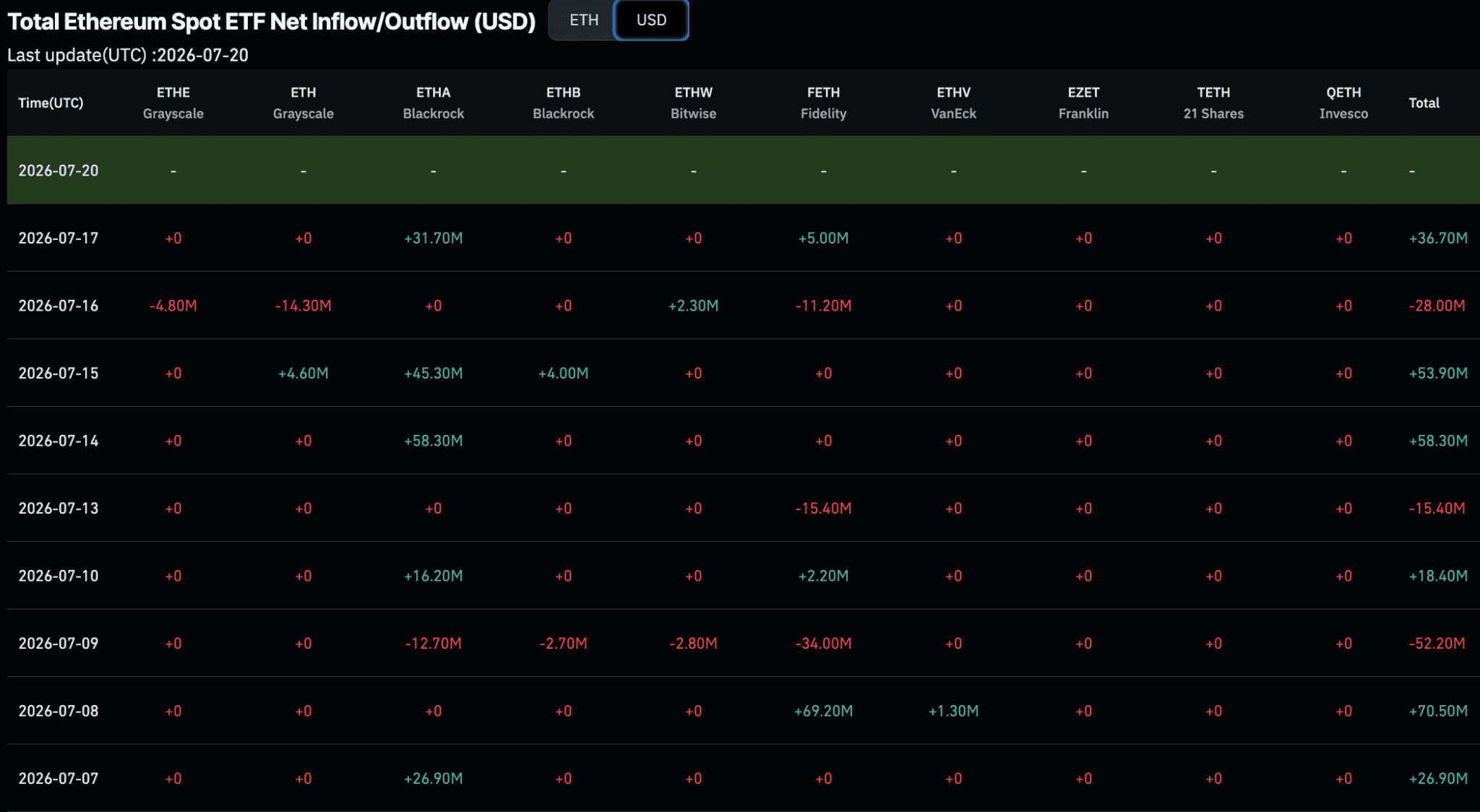
In the week that just ended, the U.S. spot Ethereum ETF attracted a net inflow of US$105 million, the strongest week since April this year. The previous weekly inflow of $84 million ended an eight-week wave of redemptions and suggested investors may be cautiously rebuilding their exposure to the second-largest cryptocurrency.
BlackRock's iShares Ethereum Trust (ETHA) continues to account for the vast majority of the incoming inflows into the spot Ethereum ETF market. Although two consecutive weeks of inflows have not yet confirmed a trend reversal, it seems that institutional investors have not given up on Ethereum after months of capital outflows.
BlackRock continues to dominate Ethereum ETF demand
According to the latest ETF data, institutional demand seems to have become more concentrated. BlackRock's ETHA has been attracting most of the new capital entering the spot Ethereum ETF market and is also a benchmark product for traditional investors seeking exposure to Ethereum. During the trading week of July 13 - 17, ETHA once again contributed a major portion of industry inflows, pushing total weekly net subscriptions to approximately US$105 million.
Since the launch of the U.S. spot Ethereum ETF in July 2024, the cumulative net inflow has exceeded US$11 billion, and the cumulative contribution of BlackRock funds alone is even greater-this is mainly due to the continued outflow of funds from other competing products. Investors seem increasingly picky, preferring mature asset managers with extensive distribution networks to smaller competitors.
Concentration of funds on a single asset is both an advantage and a vulnerability. The strong inflow of ETHA has provided continued buying pressure on Ethereum, but has also left the ETF ecosystem heavily dependent on a single product. If ETHA's momentum slows, inflows across the industry could fade quickly.
Ethereum ETF Inflows: Why the $1800 level is more than just technical analysis
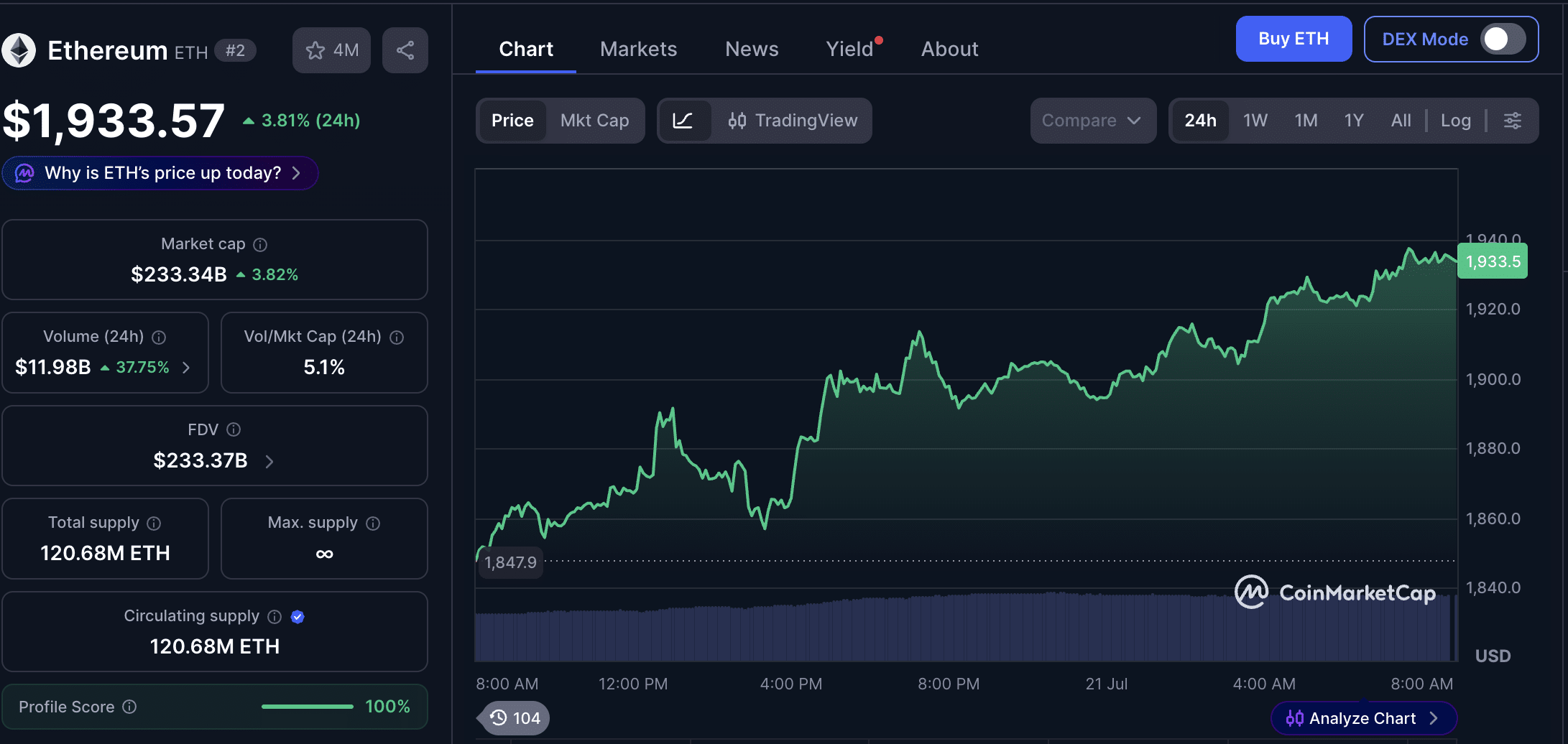
During the reporting week, Ethereum traded at approximately $1845, leaving the much-watched $1800 support level intact. This level is important because ETF subscriptions translate into real spot purchases. When new shares are issued, fund managers must buy Ethereum, creating stable demand independent of short-term speculative trading.
This "mechanical buying" was basically absent during the ETF redemption period in the first two months. Today, weekly inflows of $80 million to $105 million are helping to offset selling pressure and provide support around current prices. From a technical perspective, maintaining the US$1800 to US$1900 range puts Ethereum in a constructive organized form. A break below this zone is likely to mean a weakening of institutional buying or ETF funds turn negative again. Instead, continued positive subscriptions may lay the foundation for challenging higher resistance levels again.
Recent daily ETF data also suggests that the recovery momentum is continuing. On July 20, the U.S. spot Ethereum ETF once again recorded a net inflow of US$38 million, of which BlackRock's ETHA contributed more than US$34 million, extending the positive trend beyond the weekly cycle.
Recovery is encouraging, but has not yet fully returned to institutional perspective
Despite the significant improvement in ETF funding flows, it is still too early to announce the institution's full return to Ethereum. The latest inflow was the strongest week in three months, but remained below the unusually strong buying period that occurred after the launch of the spot Ethereum ETF and during the previous market rally. What is encouraging is the persistence of recent inflows, not the scale. After eight consecutive weeks of withdrawal of funds, institutions have increased capital for two consecutive weeks despite macroeconomic uncertainty. Analysts believe that configurators may be waiting for more attractive valuations and improved market conditions rather than abandoning Ethereum. [TAG
Ethereum has also outperformed multiple large-cap digital assets over the past week, as the recovery in ETF demand coincides with improved network activity and heightened optimism surrounding the Ethereum ecosystem. If weekly inflows consistently exceed $80 million and ETHA maintains its lead, confidence in the true accumulation phase will rise significantly. [TAG
Analysts 'expectations for Ethereum in the coming weeks
The turnaround in ETF funding flows prompted analysts to take a cautiously optimistic stance on Ethereum, but most did not assert an immediate breakout. An algorithmic forecast compiled by CoinCodex shows that Ethereum may trade around $1930 to $1955 in the coming week, and then enters consolidation, indicating that the market expects recent institutional buying to continue to support prices in the short term.
Other analysts are also cautious in their recent outlook. Its July forecast puts the average trading price of Ethereum at around $1875 and a forecast range of $1845 to $1905, indicating that analysts expect Ethereum to remain near the current trading range unless a stronger catalyst emerges. Long-term forecasts are more optimistic. Several institutions pointed out that many analysts expect Ethereum to return to the US$2400 to US$2800 range in the second half of 2026 if ETF inflows continue, the macroeconomic environment remains favorable and network activity strengthens.
Despite this, institutional researchers emphasize that ETF demand is only one factor. Continued ETF inflows, expanded adoption of stablecoins and continued growth in the ecosystem are major factors for a more sustained recovery, while weakening network revenue or slowing capital inflows may limit upside. Therefore, investors should focus on three closely related indicators: the weekly ETF flow report, the daily subscription status of ETHA, and Ethereum's ability to remain above the $1800 support level.
Ethereum ETF inflows: Conclusion
Since April, Ethereum ETF inflows have shown signs of recovery, with two consecutive weeks of positive inflows breaking eight consecutive weeks of capital outflows. BlackRock's ETHA remains the main driving force behind this shift, highlighting its dominance and the concentration of institutional demand in the ETF market. While it is too early to announce a full return of institutions, continued inflows and Ethereum's support above $1800 will strengthen the view that long-term investors are gradually rebuilding Ethereum's exposure rather than just buying into short-term downturns.
Glossary
Spot ETF: Exchange-traded funds that directly hold cryptocurrencies.
Net inflow: The amount of new investor capital that enters the fund after deducting redemption.
ETHA: BlackRock iShares Ethereum Trust, the largest spot Ethereum ETF in the United States based on cumulative inflows.
Redemption: The process by which investors withdraw funds from ETFs usually requires the fund to reduce its holdings.
Support: A price area where buying demand has historically prevented further declines.
FAQs about Ethereum ETFs
Why is Ethereum ETF inflows important? Positive ETF inflows require fund managers to buy Ethereum, creating additional spot market demand that helps support prices.
Why does BlackRock's ETHA lead the market? BlackRock benefits from strong institutional relationships, extensive distribution network and investor confidence, making ETHA the tool of choice for many professional investors.
Have institutional needs fully returned? Not yet. Two weeks of inflows represent a meaningful improvement, but a sustained trend will require more weeks of continuous buying activity to be confirmed.
























