
 Exchange Ranking
 Top Exchanges
 24h Volume Ranking
 Popularity Ranking
 Exchange BTC Balance
 Proof of Reserves
 Decentralized Exchanges
 Funding Rate
 Funding Heatmap
 Liquidation Data
 Max Pain
 Long/Short Ratio
 Whale L/S Ratio
 Binance/Okex/Huobi L/S
 Bitfinex Margin L/S
 ETF Tracker
 Solana ETF
 XRP ETF
 Hong Kong ETF
 Bitcoin Treasuries
 Crypto Reversal
 Ethereum Reserves
 HyperLiquid Wallet Analysis
 Hyperliquid Whale Watch
 Large Transactions
 On-chain Movement
 Bitcoin ROI
 Stablecoin Market Cap
 Options Analysis
 News
News Articles
 Economic Calendar
 Features
 Wallet
 Contract Calculator


 Security
 Collections
 Watchlist
 Following
 BNB
BNB  BTC
BTC  ETH
ETH  SOL
SOL  TRX
TRX  XRP
XRP Key insights:
The S & P Pantera Cryptocurrency Index ranks blockchain networks based on fundamental indicators for the first time.
BTC and XRP are excluded from the index because they do not generate negotiated revenue, which is a requirement of the index's methodology.
Standard & Poor's, the world's most well-known index provider, has sent a positive signal to the market through its newly launched cryptocurrency index. The index ranks blockchain networks based on revenue, just like stock analysts rank listed companies.
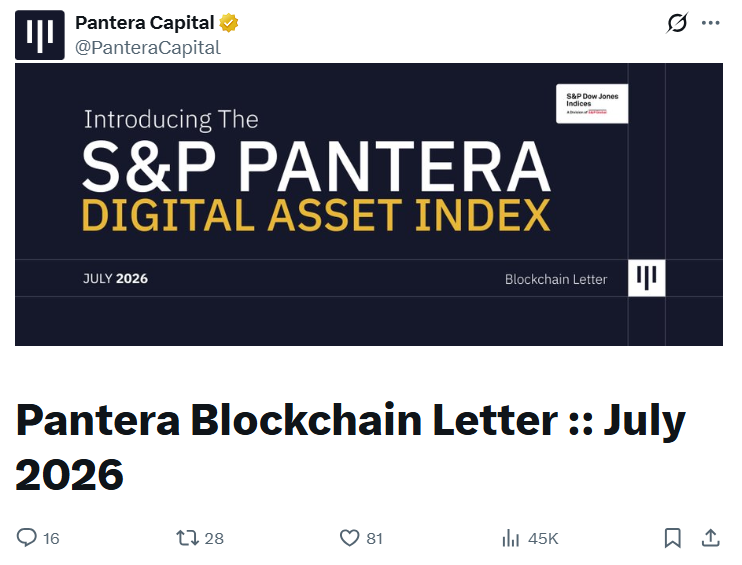
On July 20, 2026, S & P Dow Jones Indices and Pantera Capital jointly launched the S & P Pantera Digital Assets Index. The index selects and weights component assets based on negotiated revenue. These incomes come from their actual economic activities rather than market value or price momentum.
The index currently contains 18 component assets and is specifically designed for institutional capital allocation. Investment products including ETFs and index funds can be supported in the future.
What does this cryptocurrency index actually measure?
Most cryptocurrency indices weight component assets by market value, giving higher weights to tokens with larger market capitalizations. This means that price movements and popularity are sometimes more important than actual fundamentals. This would put memin and real infrastructure projects in the same index.
The S & P Pantera Digital Assets Index raises a unique question: Which blockchain networks are generating real economic activity? According to the methodology document, to be included in the index, the minimum market value of new component assets must reach US$500 million (the threshold for existing component assets is US$250 million) and the liquidity ratio must be higher than 0.5.
Eligible assets will be ranked based on the agreed revenue they generated in the past two quarters. No single asset can be weighted more than 35% in the index, while most other assets can be weighted up to 20%. The index is rebalanced quarterly using Artemis Analytics revenue data and Lukka pricing data.
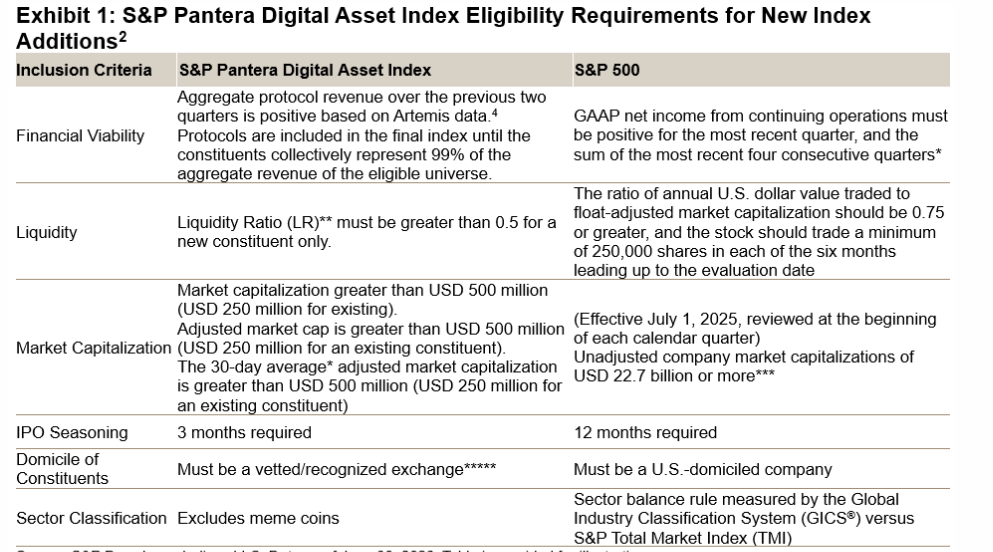
According to the Indexology blog of S & P Dow Jones Indices, the five largest component assets currently are Ether, BNB, Solana, TRON and Hyperliquid. On the other hand, two major assets in the broader crypto ecosystem-Bitcoin and XRP-are not included in the index.
These two crypto assets do not meet the methodological standards of the index. Therefore, this exclusion does not represent any negative impact on its long-term value.
The "S & P 500 moment" for cryptocurrency fundamentals
Institutional investors view the S & P 500 as a global benchmark because of its consistent and rules-based methodology. The index does not rank stocks based on price performance, but is selected based on factors such as market value, profitability and liquidity.
The S & P Pantera Cryptocurrency Index applies the same rules-based approach to blockchain networks for the first time.
Research by JPMorgan Private Bank shows that 89% of family offices currently have no access to digital assets at all. Ernst & Young data also shows that 81% of institutions prefer to invest through registered investment vehicles (such as ETFs) rather than directly through exchange channels or on-chain positions. These two numbers highlight the product gap, and the index will help close the gap.
What does the backtest show and what does not show?
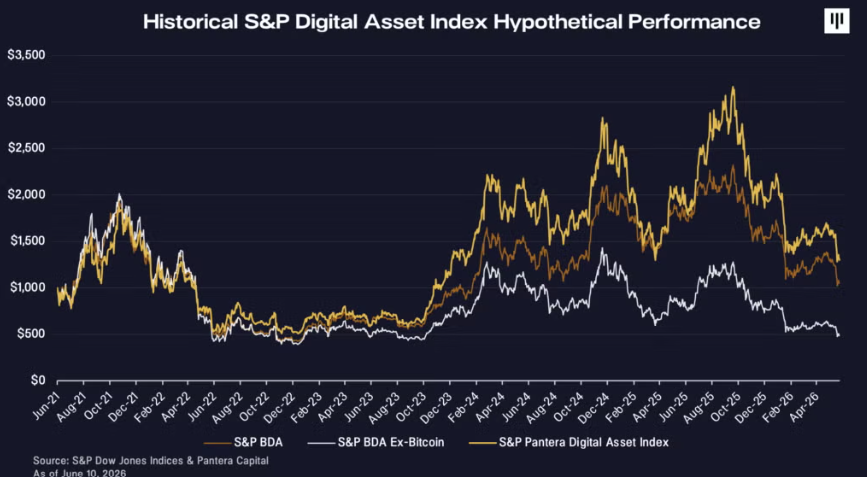
Pantera's blockchain letter also includes backtest results, showing that this methodology based on income screening outperformed the S & P Broad Digital Assets Index over a five-year period, whether or not Bitcoin was included in the comparison.
However, backtesting only shows how the index would have performed if it existed in the past. They are not actual results; the real test is whether the index can continue to perform well in the future.
Critics have raised a legitimate concern about the methodology: strong agreement revenue does not always guarantee higher returns or token prices. A blockchain may generate considerable fees or revenue, but its tokens perform poorly. Therefore, a revenue-based approach may favor agreements with active chain activity.
It may ignore assets whose value is driven by factors such as network effects, security, or currency characteristics. Bitcoin and XRP are examples of such assets that, despite their importance in the cryptocurrency market, are still excluded from the current index.
What is the next step for this cryptocurrency index?
The S & P Pantera Digital Assets Index is seen as a benchmark for future investment products and a performance criterion for institutional digital asset funds, just as the S & P 500 is for the stock market.
The cryptocurrency index space seems to be moving towards standards similar to those of the stock market. The S & P brand provides institutional credibility that most cryptocurrency index providers fail to gain.
Whether this credibility translates into actual adoption, spawning new investment products and attracting more capital inflows will depend on how well the index performs in real markets. Although the backtest results are encouraging, its actual performance will still take time to test.
























