
 Exchange Ranking
 Top Exchanges
 24h Volume Ranking
 Popularity Ranking
 Exchange BTC Balance
 Proof of Reserves
 Decentralized Exchanges
 Funding Rate
 Funding Heatmap
 Liquidation Data
 Max Pain
 Long/Short Ratio
 Whale L/S Ratio
 Binance/Okex/Huobi L/S
 Bitfinex Margin L/S
 ETF Tracker
 Solana ETF
 XRP ETF
 Hong Kong ETF
 Bitcoin Treasuries
 Crypto Reversal
 Ethereum Reserves
 HyperLiquid Wallet Analysis
 Hyperliquid Whale Watch
 Large Transactions
 On-chain Movement
 Bitcoin ROI
 Stablecoin Market Cap
 Options Analysis
 News
News Articles
 Economic Calendar
 Features
 Wallet
 Contract Calculator


 Security
 Collections
 Watchlist
 Following
 BTC
BTC  ETH
ETH Key Insights
The Ethereum price forecast target points to US$2000, but downside risks still exist. ETH/BTC needs to continue to exceed 0.03. Realized price data shows that most holders are still at a loss.
Ethereum price forecast tracks the US$2000 mark
On July 26, Ethereum traders were concerned that the price might exceed US$2000. Regulatory expectations support risk appetite in the broader cryptocurrency market. This Ethereum price forecast remains conditional because spot prices are below the average network holder cost.
This background is significant because ether has begun to rebound against Bitcoin after a long period of relative weakness. Ethereum's official website identifies Ethereum as a network asset used in Ethereum applications and infrastructure.
Exchange data showed that the price of ether on July 26 was approximately US$1874, with a 24-hour range of US$1859 to US$1931. Although the increase reached 2.76% in the past seven days, it still recorded a daily decline of 2% that day. Other data sources showed that Ethereum approached US$1913 later that day, reflecting time differences in market quotes. Another quote showed the asset at approximately $1912, up approximately 1.7% in 24 hours.
These readings left $2000 still reachable, but did not confirm a decisive breakthrough. Ethereum prices need to continue to buy beyond recent intraday highs before traders can verify stronger momentum.
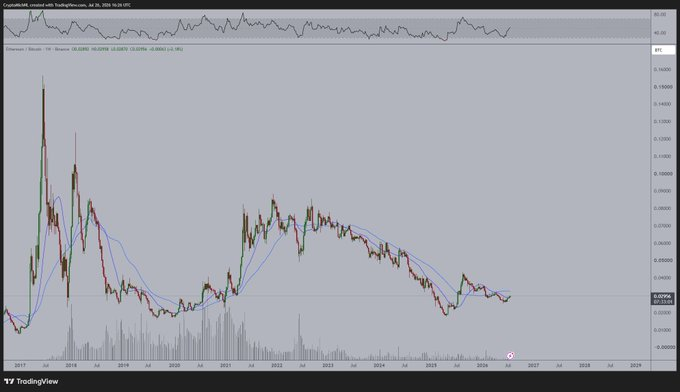
Michaël van de Poppe said that ether may exceed $2000 after two months of consolidation. His outlook depends in part on the renewed strength of ether versus Bitcoin and the broader business cycle.
Ethereum price forecast faces ETH/BTC resistance
Daan Crypto Trades points out that an ETH/BTC ratio of 0.03 is an instant confirmation level. He also mentioned a declining channel and a daily 200-cycle moving average.
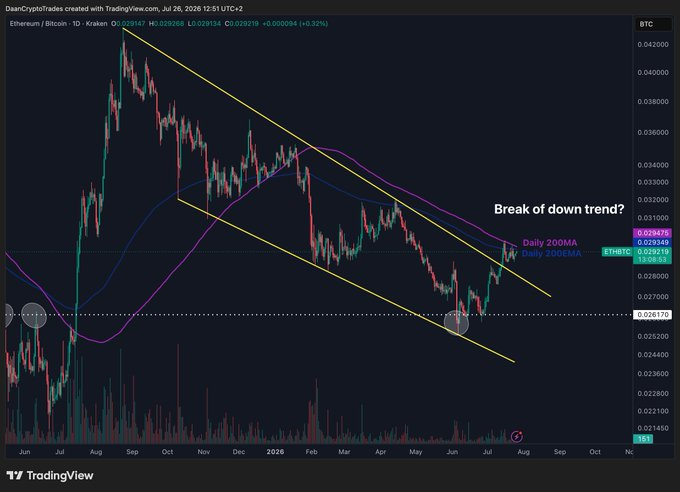
Data shows that ETH/BTC has been deeply weak for a longer period of time. The pair fell by about 24% in six months and nearly 60% in five years.
This historical background makes the confirmation of a breakthrough of 0.03 more relevant than a brief intraday surge. Continued relative strength will signal a shift in funds away from Bitcoin to Ethereum and Ethereum-based assets.
Ali Martinez said Ethereum has risen more than 20% after testing multi-year support near $1580. This rebound established this lower level as short-term structural support rather than a confirmed bottom of the cycle.
If it fails to break through US$2000 and falls back, it may divert attention back to US$1580. A deeper decline would expose $1500, which is consistent with the scenario mentioned by traders Ted Pillows and Kalshi.
On-chain data makes Ethereum price outlook mixed.
Data shows that the aggregate realized price of Ethereum on July 25 was approximately US$2240. The realization price tracks the tokens in circulation based on the price of each token's most recent on-chain movement.
As a result, spot prices are still about 16% lower than the overall network holder costs. The gap suggests that despite prices recovering from July lows, overall unrealized losses remain.
The data also shows that the cost base of different wallet groups is uneven. For addresses holding more than 100,000 Ethereum, the realized price was approximately US$2421 on July 20. Smaller groups have a lower cost base, but most are still above spot prices. The cost to the group holding 100 to 1000 ether is the closest, with an average of approximately $1937.
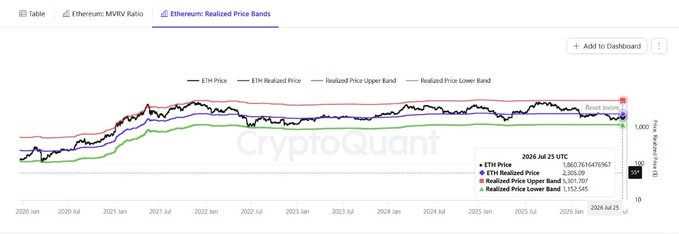
Crypto Patel believes that long-term trading below realized prices may expose a lower valuation range. He mentioned about $1150 as a deeper downside reference point.
This level remains a scenario, not a confirmed goal. Prices first face established support around $1580 and the above-mentioned $1500 liquidity area.
Ethereum price forecasts depend on the Digital Asset Market Clarification Act
Senator Cynthia Lummis released an updated version of the Digital Asset Market Clarification Act text on July 22. His office said the draft incorporates the work of the Senate Banking and Agriculture Committees.
On July 17, 2025, the House of Representatives approved the H.R. Bill 3633. House clerk records show 294 votes in favor, 134 votes against, and four members did not vote.
The bill divides the regulatory authority for digital assets between two federal market regulators, the Securities and Exchange Commission and the Commodity Futures Trading Commission. The revised text also addresses restrictions on central bank digital currencies and establishes proposed rules covering the issuance, sale and trading of regulated digital goods.
The Senate Banking Committee reportedly advanced its version on May 14. Republicans and two Democrats supported the committee's action, but the full vote remains uncertain.
Regulatory progress may improve market expectations for Ethereum-related companies and decentralized financial platforms. However, legislation alone cannot confirm a breakthrough in Ethereum or eliminate broader liquidity risks.
Traders currently face $2000 as the next visible resistance and $1580 as initial support. The Senate's next procedural action remains the clearest policy catalyst for this Ethereum price forecast.
























