
 Exchange Ranking
 Top Exchanges
 24h Volume Ranking
 Popularity Ranking
 Exchange BTC Balance
 Proof of Reserves
 Decentralized Exchanges
 Funding Rate
 Funding Heatmap
 Liquidation Data
 Max Pain
 Long/Short Ratio
 Whale L/S Ratio
 Binance/Okex/Huobi L/S
 Bitfinex Margin L/S
 ETF Tracker
 Solana ETF
 XRP ETF
 Hong Kong ETF
 Bitcoin Treasuries
 Crypto Reversal
 Ethereum Reserves
 HyperLiquid Wallet Analysis
 Hyperliquid Whale Watch
 Large Transactions
 On-chain Movement
 Bitcoin ROI
 Stablecoin Market Cap
 Options Analysis
 News
News Articles
 Economic Calendar
 Features
 Wallet
 Contract Calculator


 Security
 Collections
 Watchlist
 Following
 BTC
BTC  XRP
XRP The U.S. Securities and Exchange Commission and Congress are playing a game over crypto-token regulation
The U.S. Securities and Exchange Commission is developing a rule framework for crypto-token issuance based on its existing authority. Congress is trying to enact longer-term regulations through the Digital Asset Markets Clarification Act to permanently resolve jurisdictional disputes. At present, neither of the two efforts has reached a final conclusion, and the amount thresholds set by each are far from each other. If both ultimately take effect, crypto issuers will face a choice that will directly affect the regulatory path they rely on.
The public meeting on the "crypto regulatory" framework originally scheduled for August 14 was cancelled the day before the meeting and no alternative date was announced. This is the clearest sign in recent times of a pattern in which agency-level efforts continue to advance in outline but delay in implementation, while parallel legislative efforts continue to lose in the Senate.
Institutional interest in crypto ETFs is also evident in Canada. The National Bank of Canada recently disclosed its holdings of Ripple and Bitcoin ETFs, further expanding the footprint of traditional financial institutions in regulated crypto investment products.
Securities and Exchange Commission Framework and Failed Meetings
The U.S. Securities and Exchange Commission's efforts date back to March 17, 2026, and Chairman Paul Atkins elaborated on some indicative figures in his speech. The start-up exemption clause allows early projects to raise "no more than a specified amount (e.g.,$5 million)" for up to four years, simply submitting notification-based documents rather than full registration. Another separate large-scale financing exemption clause allows issuers to "raise no more than a specified amount (e.g., US$75 million) in any 12 months" and requires audited financial statements and semi-annual reports, broadly based on existing Regulation A+ issuance models. The third clause allows tokens to withdraw from securities treatment after the issuer completes or permanently ceases the "key management efforts" it has committed to buyers, at which time transfer restrictions and exchange registration requirements will be lifted, but anti-fraud rules will still apply.
The Securities and Exchange Commission's own Sunshine Act notice and the August 14 meeting agenda describe the matter more narrowly: the committee will "consider whether to issue a proposal to develop a customized issuance system for specific investment contracts involving crypto assets."
 Exclusive: According to people familiar with the matter,@SECGov's tokenized innovation exemption has been "further postponed" and details are expected to be kept secret for the time being. I was told that part of the reason may be the tokenization part of the Clarification Act... --Eleanor Terrett (@EleanorTerrett) August 13, 2026
Delays are not limited to "crypto supervision". On August 13, Eleanor Trett reported that the Securities and Exchange Commission's further postponement of the tokenization innovation exemption may stem from negotiations related to Section 10505 of the Clarification Act.
The figures of $5 million and $75 million were proposed by Atkins in his speech and are attached to an unrealized rule-making step. Formal SEC rules have legal force once they are adopted, but their introduction process is slower and more reversible than regulations. It requires notification and comment on the rule-making process, may be challenged by courts, and may be revised or revoked by future committees without congressional approval. Atkins himself acknowledged this limitation, calling his framework "merely a first-mover advantage in legislation" and saying "only Congress can ensure that regulation in this area will withstand future tests."
Difficult path for Congress
The Clarification Act is designed to provide a more lasting solution, but currently has support below the threshold needed to advance. Senate Majority Leader John Thun proposed a closing debate motion on August 8. The Senate has set September 15 as the date for the first procedural vote, when members will return from recess. The vote requires 60 votes in favor, which means Republicans typically need to gain the support of about ten Democratic lawmakers outside their caucus. Passage of the bill still needs to resolve ethical disputes over illegal financial protection, stablecoin provisions and personal crypto asset holdings by senior officials.
 Clarity Act faces uncertain voting prospects
Galaxy Research, the research arm of Galaxy Digital, lowered its forecast for the bill to pass in 2026 twice this summer: from a high of nearly 75% after an early bipartisan Senate Banking Committee vote, first to 50%, and then to 30% on July 24. Galaxy's Alex Thorne attributed the latest downgrade to a shortened legislative calendar, writing: "The calendar is no longer just an obstacle." 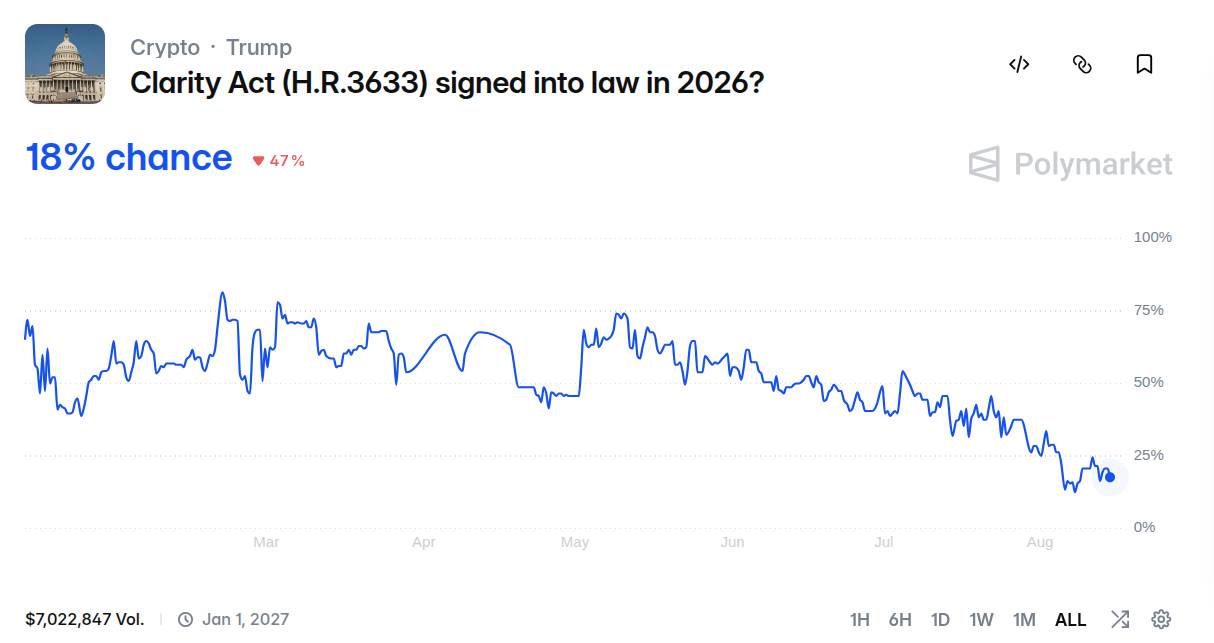 Clarification Act-Polymarket
Polymarket traders set the probability that the Clarification Act will become law in 2026 at 18%(as of August 14). On Polymarket, traders made direct bets on whether the bill would be signed into law in 2026, with the contract price trading at 21% on August 14, down from a peak of nearly 82% in February and below the 16% level a week ago on August 7.
Differences between the two paths
Comparing the US Securities and Exchange Commission's schematic figures with the legal figures of the Clarification Act, it can be seen that the two paths treat the same crypto issuer are very different.
U.S. Securities and Exchange Commission's "Crypto Regulation"(indicative, not adopted):
Smaller early-stage financings: approximately US$5 million, up to four years
Larger-scale financings: approximately US$75 million, within any 12-month period
Legal form: Chairman's Outline, No Adopted Rule Text
"Clear Bill"(Proposed Version):
Smaller early stage financings: US$50 million per year for a maximum of four years, or 10% of the value of outstanding ancillary assets, whichever is higher
Larger-scale financings: US$200 million cumulative lifetime cap
Legal form: Statutory text, pending Senate approval
The SEC's approach is more conservative in scale, but theoretically it can be advanced without a legislative super majority. Congress's approach is more generous in size, but must overcome the current 60-vote threshold that is unfavorable to it.
February 2026: Polymarket's Bill of Clarification contract prices are near a peak of 82%.
March 17, 2026: Securities and Exchange Commission Chairman Paul Atkins outlines the concept of "crypto regulation", including $5 million and $75 million figures.
July 24, 2026: Galaxy Research reduced the probability of passing the Clarification Act from 50% to 30%.
August 7, 2026: Polymarket's Bill of Clarification contract price is 16%.
August 8, 2026: Senate Majority Leader John Thune submits a motion for closing debate on the Clarification Act.
August 11, 2026: The U.S. Securities and Exchange Commission set a public meeting on August 14 to consider proposing "crypto regulation."
August 13, 2026: The U.S. Securities and Exchange Commission canceled its August 14 meeting, citing scheduling issues.
August 14, 2026: Polymarket's Bill of Clarification contract price is 21%.
August 20, 2026: The Commodity Futures Trading Commission's first Innovation Advisory Committee meeting, the agenda includes crypto asset regulation.
September 15, 2026: The Senate plans to hold a closing debate vote on the Clarification Act.
November 2026: Hurst Pierce plans to leave the U.S. Securities and Exchange Commission.
Leaving brings new time pressure
Hearst Pierce, commissioner of the U.S. Securities and Exchange Commission, who has been promoting the concept of crypto-safe harbor since it was first proposed in 2020, plans to leave in November 2026 and teach at the Law School of Rekin University. One of the framework's strongest internal advocates may leave the committee during the same period as the rescheduling vote, adding to uncertainty about who is pushing the framework within the agency.
The Commodity Futures Trading Commission is also building its own trajectory
The Commodity Futures Trading Commission will hold the first meeting of the newly established Innovation Advisory Committee on August 20, with an agenda that clearly includes crypto asset regulation, as well as artificial intelligence and forecasting markets. The Commodity Futures Trading Commission currently lacks the day-to-day jurisdiction over the crypto spot market that the Clarification Act would give it, so convening advisory bodies is one of its few tools currently available. This confirms that federal encryption policy is advancing simultaneously in multiple agencies.
Why the difference between rule-making and legislation matters
Delays and stagnation are common phenomena and rarely merit close attention in themselves. But what deserves attention at this moment is the fundamental question behind the two: Will U.S. encryption regulation ultimately be built mainly through institutional rulemaking, mainly through congressional legislation, or will it be built through a combination of the two to fill in their respective gaps? This difference has profound implications for the encryption industry.
Rules set solely by the U.S. Securities and Exchange Commission may change when the committee's composition changes, which is a weak foundation for companies planning multi-year token offerings. Companies currently deciding how to structure financing are actually choosing between a faster but less durable path and a slower, uncertain but more durable path, the final shape of which is unknown.
Congress has the Clarity Act, which is closer to voting on market structure than it has been in years, and has the ability to draw permanent jurisdictional boundaries between the Securities and Exchange Commission and the Commodity Futures Trading Commission that no institutional rule can guarantee. But the bill is still short of the required 60 votes, and two independent measures show its probability of passage is declining.
Five flags will show which track actually comes first: whether the Securities and Exchange Commission will announce a new date for its "Crypto Regulation" meeting; how the Commodity Futures Trading Commission's Innovation Advisory Committee will define crypto policy when it meets on August 20; whether the Senate can find 60 votes on September 15; who within the Securities and Exchange Commission will continue to advance the Safe Harbor argument after Hearst Pierce leaves office in November; And in the long run, whether Congress will eventually pass a regulation that replaces, absorbs or collides with the rules already established by the U.S. Securities and Exchange Commission. None of these results are determined, and how they are implemented will determine which set of rules the encryption industry must abide by.
























