
 Exchange Ranking
 Top Exchanges
 24h Volume Ranking
 Popularity Ranking
 Exchange BTC Balance
 Proof of Reserves
 Decentralized Exchanges
 Funding Rate
 Funding Heatmap
 Liquidation Data
 Max Pain
 Long/Short Ratio
 Whale L/S Ratio
 Binance/Okex/Huobi L/S
 Bitfinex Margin L/S
 ETF Tracker
 Solana ETF
 XRP ETF
 Hong Kong ETF
 Bitcoin Treasuries
 Crypto Reversal
 Ethereum Reserves
 HyperLiquid Wallet Analysis
 Hyperliquid Whale Watch
 Large Transactions
 On-chain Movement
 Bitcoin ROI
 Stablecoin Market Cap
 Options Analysis
 News
News Articles
 Economic Calendar
 Features
 Wallet
 Contract Calculator


 Security
 Collections
 Watchlist
 Following
The following is the HTML code after typesetting the original content, using only the
,
, and tags, and retaining all the original tags and content: YeBlock's YBT token economy reveals what its future will
YeBlock's YBT token economy reveals what its future will
YeBlock's white paper released in 2026 sets a fixed supply of YBT, divides it into eight allocation categories, and attaches an unlocking schedule for the largest internal holders. This paper decomposes the model: total supply, allocation, unlocking, circulating supply, token utility, and related roadmap. Unless otherwise noted, all data below are from YeBlock YBT token economy. Readers should view early data as a published plan for the project rather than as a guarantee.
What is YBT and how does it work in YeBlock?
YBT is a native token for YeBlock, a decentralized AI network that integrates idle computing power, storage and fine-tuned AI models into one protocol. In this network, YBT is more than just a tradable asset. It is the unit used to pay AI inference calls, reward node operators, and ultimately vote on protocol decisions through the DAO. That's why token economy design is more important here than ever-it tells you who will be paid to build the network YeBlock describes, and on what terms.
Overview of YBT Token Economy
Indicators: Details
Tokens: YBT
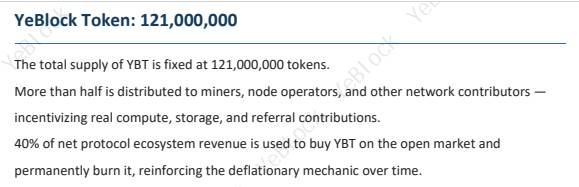
Total Supply: 121,000,000 (Fixed)
Status: In front of the main network; As of this writing, tokens have not yet been issued
TGE (token generation event) allocation: 21,000,000 YBT (17.4%)
Maximum allocation: distributed recommended mining--30,000,000 YBT (24.9%)
Foundations and venture capital unlocking: 3 years linear unlocking, 1 year lockup period
Destruction mechanism: 40% of the agreement ecosystem's net income is used to purchase and destroy YBT
Data sources: YeBlock White Paper
What is the total supply of YBT?
According to the token economy section announced in the white paper, the fixed total supply of YeBlock YBT is 121,000,000 tokens. This is a cap-YeBlock is not designed for open inflation. On top of the cap, there is also a deflation mechanism: 40% of the agreed ecosystem's net revenue will be used to purchase YBT on the open market and destroy it permanently. The destruction mechanism will only be activated after the network begins to generate actual fee revenue. As of the time of writing, YeBlock has not yet entered the main network, and YBT itself has not yet been released. The destruction plan is a stated design goal and is not something that is currently happening.
How are YBT token allocations distributed?
The announced allocation plan divides the supply of 121 million YBT into eight categories:
Allocation category: Distributed recommended mining, number of tokens: 30,000,000, proportion: 24.79%
Allocation category: TGE (token generation event), number of tokens: 21,000,000, proportion: 17.36%
Allocation Category: YeBlock Foundation, Number of Tokens: 15,730,000, Proportion: 13.0%
Allocation Category: Venture Capital, Number of Tokens: 14,520,000, Proportion: 12.0%
Allocation Category: Node, Number of Tokens: 14,000,000, Proportion: 11.57%
Allocation Category: Pledged Mining, Number of Tokens: 12,000,000, proportion: 9.92%
Allocation category: Contribution mining, number of tokens: 9,000,000, proportion: 7.44%
Allocation category: Partnership, funding, growth, number of tokens: 4,750,000, proportion: 3.93%
Distributed recommended mining : accounting for 24.79%, which is the largest single allocation. It is designed to be gradually distributed to the network through participation, rather than being controlled by a single holder from the beginning.
TGE allocation : The 21,000,000 YBT (17.36%) reserved for token generation events cover tokens related to network initial launch events, separated from mining-based categories.
Foundation allocation : accounting for 13%, which is the second largest fixed allocation. It is also one of the only two categories with announced locking and unlocking structures, which will be described in detail below.
Venture capital allocation : Venture capital holds 12% of supply. Combined with foundation shares, internal holder allocations account for 25% of the total fixed supply.
Node allocation : Node operators receive 11.57% of the supply, rewarding the hardware side of the network-the GPUs and storage that maintain the protocol running.
Pledge mining allocation : 9.92% is used for pledge rewards, incentivizing token holders to lock in YBT to support network security and operations.
Contribution mining allocation : 7.44% is used for contribution mining, designed to reward broader network construction participation beyond the running nodes.
Partnerships, funding and growth : Minimum share, accounting for 3.93%, is used for partnerships, funding and overall ecosystem growth plans.
Taken together, the sum of nodes, pledge mining, contribution mining, and distributed recommendation mining is slightly less than 54% of the total supply-more than half of the tokens are reserved for active participants running or contributing to the network, rather than teams or investors.
YBT's unlocking schedule
The unlocking schedule determines when locked tokens can actually be sold or used. A large number of tokens unlocked at one time can shock the market and drive down prices, so schedules are as important as percentages.
Foundations and Venture Capital Unlock : According to the white paper, foundation allocation (13%) and venture capital allocation (12%) both adopt a three-year linear unlock with a one-year lockup period. No tokens were unlocked during the first year; the rest were gradually released over the following two years. The white paper also added a specific detail: The unlocked team tokens are expected to be re-pledged back to the network rather than sold. If this is not done, the white paper states that DAO voting can destroy some unused team YBT. This is stricter than the commitments announced by most projects, but as of this writing, it is still a statement of intent rather than an enforcement mechanism coded on-chain.
Mining-based token allocation : Mining-based categories-recommendations, pledges, contributions, and nodes-operate differently. The white paper does not attach the same fixed lockup period to these allocations. Based on their naming and description, they appear to be earned through continuous online activity rather than released on a fixed calendar, although the white paper does not clearly state the specific emission rate. This is a useful distinction: internal holders unlock by calendar, while network participants are assigned by activity.
TGE and circulation supply of YBT
TGE allocated 21,000,000 YBT (17.4% of supply), representing tokens related to the network token generation event (i.e., the point in time when YBT was first issued). As of the time of writing, the incident has not yet occurred. YeBlock is still in the pre-main network stage, and tokens have not been issued, which means that the current circulation supply is effectively zero. Once TGE occurs, the circulating supply will start with the portion of the TGE allocation that enters the market at launch, and then gradually increase as mining-based categories are distributed through network activities, and as foundations and venture capital allocations pass through a one-year lockup period. In addition to the above-mentioned unlocking clauses, the white paper does not publish specific circulation supply curves, so early accurate circulation data are not yet known.
What is the purpose of YBT?
According to the white paper, in addition to supply calculations, YBT is designed to perform four tasks in the network:
Online incentives-reward calculation, Storage and AI Contributors
Call fee settlement-Currency used to pay for AI inference calls on the network
Pledge-Required by node operators and LoRA (Fine Tuning AI Model) creators
Governance-Voting rights after activation of the DAO structure
Governance functions are not yet online. The white paper sets the first phase of DAO governance for the second quarter of 2027, linked to the roadmap below.
YeBlock Roadmap: Key Milestones to 2027
The project roadmap is divided into quarterly milestones, with each milestone having specific verifiable goals rather than vague commitments.
Timeline: 3rd quarter of 2026; Established milestone: Five seed nodes online; Single LoRA inference loop work; core protocol open source under Apache 2.0
Timeline: 1st quarter of 2027; Established milestone: Privacy protocol TEE (Trusted Execution Environment) channel public testing
Timeline: 2nd quarter of 2027; Established milestone: More than one million inference calls per month; at least five TEE nodes;DAO governance phase 1
timeline: fourth quarter 2027; established milestones: Within 18 months after launch, the actual call fee revenue must reach at least 50% of the node's total revenue.
YeBlock Encryption Reality Test
Just below 54% of the supply flows to the node operator, Pledges, recommenders and contributors, not teams. Foundation and venture capital tokens are unlocked within three years and have a one-year lockup period, which provides time for the network to first establish usage. Main risks:
Before tokens, before mainnet: There is currently no YBT on the chain.
Team undisclosed: Identity will be kept secret to the main network shortly before.
No confirmed partnerships: Currently only the team and an unnamed venture capital firm provide funding.
Computational verification has not yet prevented collusion.
Regulatory risk: Mixing DePIN, AI, and tokens in one protocol.
The real test: By the fourth quarter of 2027, whether call fee revenue can cover half of node revenue.
Conclusion
YeBlock's token economic model centers on a fixed supply of 121 million YBT units, a destruction mechanism linked to real income, and an unlocking timetable to avoid early sell-off by insider holders. Just under 54% of supply is reserved for network participants-recommenders, node operators, pledgers and contributors-while foundations and venture capital allocate a total of 25% and unlock over three years, with a one-year lockup period. What has not yet been verified is everything downstream of token design: whether the network can attract real computing and storage contributors, whether AI developers will route paid inference calls through it, and whether revenue milestones for the fourth quarter of 2027 can be reached on time.
Disclaimer : This article is for reference only and does not constitute financial or investment advice. Cryptographic assets, especially pre-launch and pre-mainnet tokens, carry high risks. Before making any decisions, be sure to study for yourself.
























