
 Exchange Ranking
 Top Exchanges
 24h Volume Ranking
 Popularity Ranking
 Exchange BTC Balance
 Proof of Reserves
 Decentralized Exchanges
 Funding Rate
 Funding Heatmap
 Liquidation Data
 Max Pain
 Long/Short Ratio
 Whale L/S Ratio
 Binance/Okex/Huobi L/S
 Bitfinex Margin L/S
 ETF Tracker
 Solana ETF
 XRP ETF
 Hong Kong ETF
 Bitcoin Treasuries
 Crypto Reversal
 Ethereum Reserves
 HyperLiquid Wallet Analysis
 Hyperliquid Whale Watch
 Large Transactions
 On-chain Movement
 Bitcoin ROI
 Stablecoin Market Cap
 Options Analysis
 News
News Articles
 Economic Calendar
 Features
 Wallet
 Contract Calculator


 Security
 Collections
 Watchlist
 Following
 BTC
BTC A new working paper from the Federal Reserve Bank of Cleveland provides a thought-provoking explanation for why cryptocurrencies perform so differently than traditional financial assets: Americans who buy cryptocurrencies not only have different demographics or risk preferences, but also have different expectations for future benefits from digital assets.
This finding helps explain the continued high volatility of cryptocurrencies and how rising markets attract new buyers, which may create a feedback loop-rising prices strengthen bullish expectations, which in turn attracts more investors to enter the market.
Researchers Michael Weber, Bernardo Kandia, Olivier Coibiang and Yuri Gorodnychenko conducted repeated surveys of up to 25,000 U.S. households per round and found that expectations of cryptocurrency benefits differ more significantly in explaining who owns cryptocurrency than broad demographic characteristics.
This article is titled "Lao Tie, do you play cryptocurrency? The paper in "Cryptocurrency in Home Finance" also used a random information experiment to show that simply providing people with information on the recent performance of Bitcoin (BTC) can increase the proportion of cryptocurrency they expect and prompt them to actually purchase later.
Researchers say these results reveal a potential mechanism behind speculative bubbles: Past gains can attract new investors, whose buying behavior drives up prices and may further attract more buyers.
"Positive returns attract new players, thereby driving prices up further," the authors wrote.
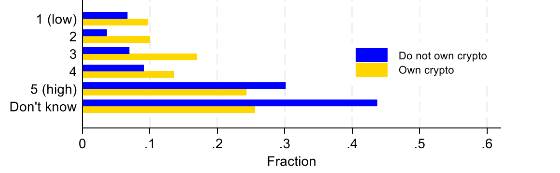
This dynamic is particularly striking because cryptocurrencies are still misunderstood by large sections of the population. In a 2021 survey by researchers, 87% of non-cryptocurrency holders said they did not know what the expected return of cryptocurrency would be in the coming year. Among cryptocurrency holders, this proportion is still as high as 54%.
Holds are correlated with double-digit earnings expectations
However, for those willing to make predictions, the gap is huge. Cryptocurrency holders expect an average return of 22% over the next year, compared with just 7% for non-holders. Holders also tend to view cryptocurrencies as less risky than non-holders.
Researchers have found that expected returns are extremely powerful in deciding whether to hold cryptocurrencies. For every 1 percentage point increase in an individual's expected return on cryptocurrency, the probability of holding cryptocurrency increases by 0.8 percentage points. Expectations of return and risk together explain a large part of the differences in cryptocurrency holdings, and their explanatory power goes far beyond observable characteristics such as age, income, and gender.
This makes cryptocurrencies an anomaly other than stocks, bonds and gold. For traditional assets, demographic and financial characteristics are often more explanatory than differences in expected returns. Cryptocurrency reverses this relationship.
Despite this, the demographic characteristics of cryptocurrency investors remain unique. After controlling for other characteristics, people under the age of 40 are 13 percentage points more likely to hold cryptocurrency than people over the age of 60. Men are about 4 percentage points more likely than women to own cryptocurrencies, while households with higher incomes and more wealth are also more likely to participate.
This experiment provides perhaps the most important finding in the paper for the cryptocurrency market.
In 2025, researchers randomly provided households with information about Bitcoin, stocks, game stations, or inflation. Participants who were shown Bitcoin's return over the past 12 months increased their expected cryptocurrency portfolio allocation by approximately 2 percentage points, an increase of approximately 47% compared to the control group's expected allocation of 4.3%. Subsequently, the proportion of actual purchases of cryptocurrency also increased by about 2.5 percentage points.
The authors describe this result as: "Providing information about Bitcoin's recent returns will prompt some households to start buying cryptocurrencies."
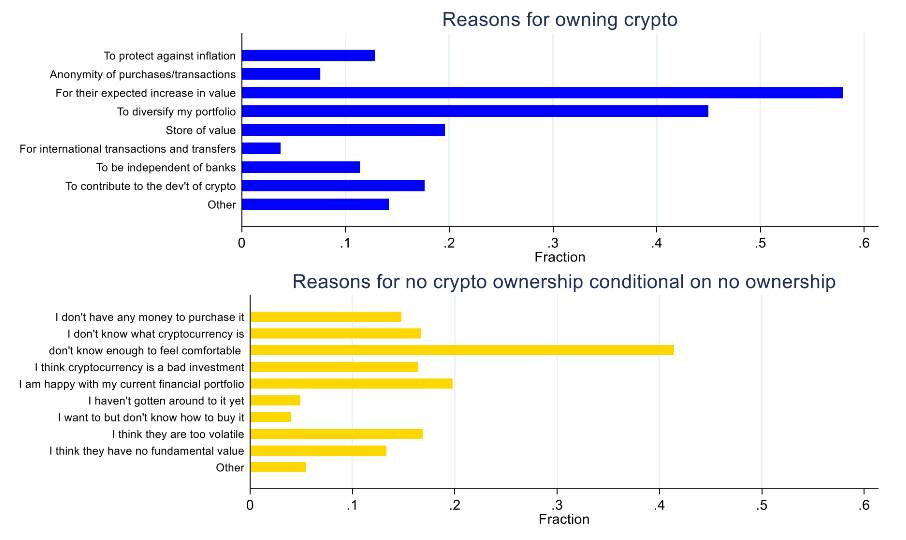
This effect is concentrated on those who say they do not hold cryptocurrencies due to lack of sufficient information. And those who already think cryptocurrencies are a bad investment often do not respond to the way this information is handled.
The paper also found that cryptocurrency wealth may spill over into household consumption. The doubling of the price of Bitcoin increases the likelihood of households whose entire financial asset portfolio is cryptocurrency to purchase durable goods by 1.4 percentage points, equivalent to an increase of approximately 7% relative to the probability of unconditional purchase. However, this effect did not last into daily consumption.
This prompted researchers to draw a sharp contrast: Cryptocurrency gains seem more like "gambling income" or lottery wins than permanent wealth growth.
The broader implications are that the volatility of cryptocurrencies may stem in part from differences and learning processes among investors, rather than just market fundamentals. The authors conclude that cryptocurrencies stand out because they are so little understood, investors form vastly different views on their prospects, and new information about past returns can change expectations and behavior.
"The lack of consensus information and belief among investors about cryptocurrencies," they wrote,"suggests that price volatility will continue to be one of the most prominent features of this new asset for the foreseeable future."
For the cryptocurrency market, this suggests a potentially troubling conclusion: the next wave of retail demand will not only depend on the price of Bitcoin, but also on what investors are told about past prices.
























