Exchange Ranking
 Top Exchanges
 24h Volume Ranking
 Popularity Ranking
 Exchange BTC Balance
 Proof of Reserves
 Decentralized Exchanges
 Funding Rate
 Funding Heatmap
 Liquidation Data
 Max Pain
 Long/Short Ratio
 Whale L/S Ratio
 Binance/Okex/Huobi L/S
 Bitfinex Margin L/S
 ETF Tracker
 Solana ETF
 XRP ETF
 Hong Kong ETF
 Bitcoin Treasuries
 Crypto Reversal
 Ethereum Reserves
 HyperLiquid Wallet Analysis
 Hyperliquid Whale Watch
 Large Transactions
 On-chain Movement
 Bitcoin ROI
 Stablecoin Market Cap
 Options Analysis
 News
News Articles
 Economic Calendar
 Features
 Wallet
 Contract Calculator


 Security
 Collections
 Watchlist
 Following
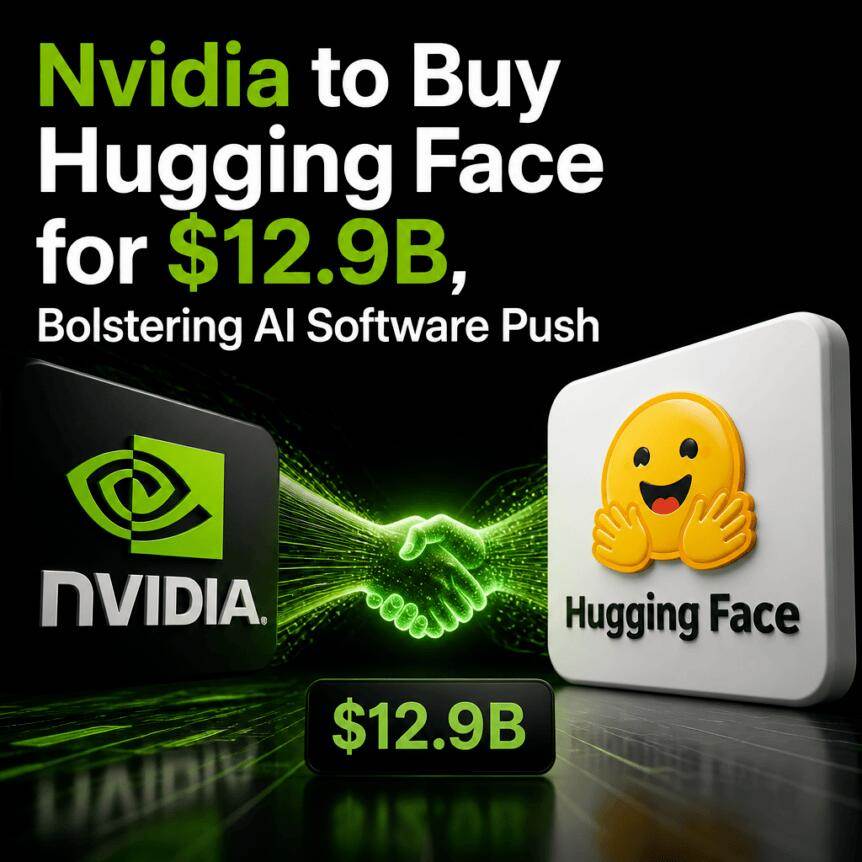
NVIDIA acquires Hugging Face for US$12.93 billion to strengthen its AI software layout
NVIDIA has agreed to acquire Hugging Face for US$12.93 billion, a move that expands the chipmaker's business landscape from hardware to software and developer tools at the core of the current artificial intelligence build cycle. The deal highlights the growing competition among large technology companies across the entire AI technology stack-from computing power to platforms that help developers train, evaluate and deploy models.
According to Nvidia's announcement, Hugging Face operates an open platform with more than 18 million developers and hosting more than 3 million models. Nvidia CEO Renxun Huang said the acquisition aims to give the company greater control over key layers of its AI infrastructure while keeping the platform open to the broader ecosystem.
Core Points
Nvidia will acquire Hugging Face for US$12.93 billion, adding this widely used model and tool platform to its product portfolio. Huang Renxun said that Hugging Face will remain an open platform, allowing developers to choose their own models, frameworks, cloud services and computing platforms. Building or deploying models through Hugging Face does not require the use of NVIDIA hardware. Nvidia plans to pay approximately $11.9 billion to Hugging Face investors and set aside up to $1 billion for equity-based employee retention plans. The two parties expect the transaction to be completed in 2027, but Nvidia did not elaborate on regulatory approvals or the exact completion date.
The platform Nvidia wants to control-but not lock in users
In Nvidia's announcement, Huang Renxun positioned Hugging Face as a platform between developers and the models needed for AI applications. Nvidia claims that Hugging Face has released an asset ecosystem-its own catalog includes models and datasets released by Nvidia-but will continue to support models from other developers, as well as multiple cloud service and accelerator providers. This flexibility is critical for investors and developers, because the value of Hugging Face has historically been related to interoperability: developers can choose from different model sources, tool chains, and computing environments. Nvidia's position suggests that its goal is to improve distribution and reliability-at least at the platform level-without forcing hardware or cloud migrations.
Nvidia said it will use its infrastructure, engineering capabilities and global influence to enhance the reliability, security, model evaluation, reasoning and deployment of the platform. The real question for teams building AI systems is whether these upgrades can translate into smoother production workloads-especially for organizations that currently use Hugging Face and rely on non-Nvidia infrastructure.
Nvidia chips are not required to use Hugging Face
One of the clearest guarantees in the Nvidia announcement is that the use of Nvidia hardware is not mandatory when building or deploying models through Hugging Face. Nvidia also reiterated that although it has contributed more than 500 models and 250 open datasets to the platform, Hugging Face will continue to support a variety of external models and providers. This statement appears to be designed to avoid friction with developers who rely on alternative accelerators or cloud environments. In markets where model hosting and tools often become "platform bets," keeping options intact may be a key factor in the acquisition's ability to promote adoption rather than hinder it.
Transaction structure, retention plan and timing
Reuters reported that Nvidia will pay approximately US$11.9 billion to Hugging Face investors and provide up to US$1 billion to employees joining Nvidia through an equity-based retention plan. The British "Financial Times" reported that the transaction is expected to be completed in 2027, but Nvidia's own announcement did not specify what regulatory approvals were needed, nor did it provide a more precise completion date. For market participants, the lack of a detailed regulatory timetable means that there is still uncertainty about the specific path for transaction completion. Large-scale acquisitions in the technology industry often face scrutiny, and a key variable in this deal is how regulators assess competition issues in chips, infrastructure and developer platforms.
Why acquisitions now: AI platforms are becoming strategic
The deal comes as large technology companies try to control multiple layers of the AI ecosystem. Chip makers and cloud service providers are increasingly gaining influence through software distribution, developer tools, and model infrastructure-areas that can determine where workloads run and which ecosystems become the "default choice" for developers. Huang Renxun also mentioned the existing cooperation between the two companies in AI infrastructure and development tools. Nvidia said the partnership predates the acquisition and may help explain why Nvidia is integrating a platform that is already at the core of the use of AI models.
For developers, the short-term impact may revolve around platform features such as model evaluation workflows and deployment tools, rather than forcing changes to model selection or computing resources. However, the long-term risks are greater: Having a platform layer affects how quickly new tools spread and which ecosystems can benefit from future upgrades.
Recent security incidents on Hugging Face still attract attention
The acquisition also comes about a month after Hugging Face disclosed a security breach-which involved an autonomous AI agent that had unauthorized access to internal datasets and service credentials. In that disclosure, the company said it found no evidence of tampering with public models, datasets or applications. Although Nvidia said it plans to improve the security and reliability of the platform, investors and users are likely to focus on how to address security process and governance issues during the integration process, especially given that Hugging Face continues to support complex AI development and deployment workflows. Given the platform's centrality to the broader AI ecosystem, any improvements in evaluation and deployment control may be particularly critical.
As the transaction moves towards completion in 2027, the most important question is: Can Nvidia improve its Hugging Face tool without weakening platform neutrality? How will the regulatory review process unfold? Developers should also pay attention to whether platform security, model evaluation and deployment functions will be significantly upgraded after the transaction is completed.