Exchange Ranking
 Top Exchanges
 24h Volume Ranking
 Popularity Ranking
 Exchange BTC Balance
 Proof of Reserves
 Decentralized Exchanges
 Funding Rate
 Funding Heatmap
 Liquidation Data
 Max Pain
 Long/Short Ratio
 Whale L/S Ratio
 Binance/Okex/Huobi L/S
 Bitfinex Margin L/S
 ETF Tracker
 Solana ETF
 XRP ETF
 Hong Kong ETF
 Bitcoin Treasuries
 Crypto Reversal
 Ethereum Reserves
 HyperLiquid Wallet Analysis
 Hyperliquid Whale Watch
 Large Transactions
 On-chain Movement
 Bitcoin ROI
 Stablecoin Market Cap
 Options Analysis
 News
News Articles
 Economic Calendar
 Features
 Wallet
 Contract Calculator


 Security
 Collections
 Watchlist
 Following
 XLM
XLM  XRP
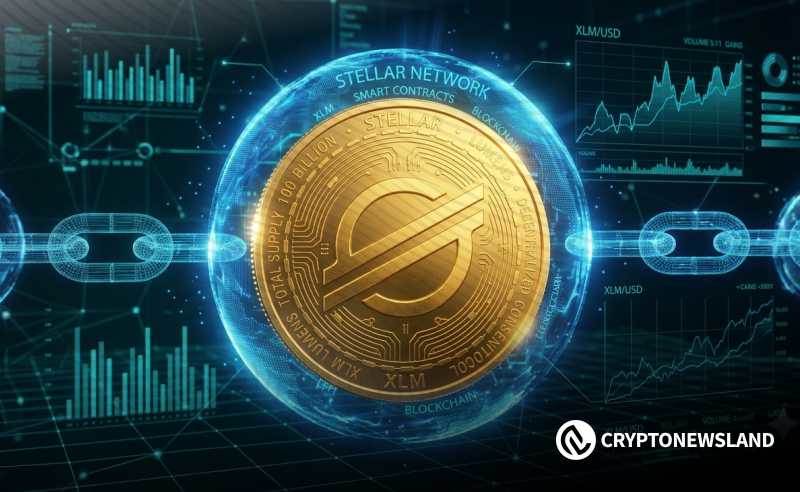
XRP Reshaping Stellar Ecosystem in 2026: Synergies between RWA, institutional participation and protocol development
In 2026, with the expansion of the real-world asset (RWA) market, the deepening of institutional participation, active stablecoin activity and the advancement of protocol development, Stellar's ecosystem is undergoing a profound reshaping. At the same time, the G20 discussions on tokenization, blockchain and faster payment methods are highly consistent with the infrastructure built by Stellar and Ripple. The upgrades of MoneyGram, tokenized funds, verifier nodes and Protocol 28 further promote the expansion of Stellar's institutions and infrastructure.
Currently, Stellar's tokenization process is receiving widespread attention as institutional activities, tokenized assets, stablecoins, and global payment initiatives increasingly converge in Stellar's expanding 2026 ecosystem.
Alignment of G20 priorities with blockchain payment infrastructure
The economic scale of the G20 provides important context for discussions around blockchain infrastructure. Its member states represent approximately 85% of the world's GDP and more than 75% of trade, and also account for approximately two-thirds of the world's population.
Recent market analysis is closely linked to XRP and XLM-related blockchain discussions, focusing on cross-border payments, tokenization, and distributed ledger technology. These areas have increasingly emerged in broader discussions on international financial modernization. Founded in the wake of the 1997-1998 Asian financial crisis, the G20 was initially designed to connect finance ministers and central bank governors from major economies, and its agenda subsequently expanded to broader economic and international policy coordination.
According to analysis, these developments have created significant infrastructure connections for blockchain networks. XRP and XLM were originally developed to achieve faster value transfer and cross-border remittances. However, policy discussions do not in themselves constitute a confirmatory adoption of any network.
Comprehensive expansion of institutional activities in the Stellar ecosystem
Scopuly's 2026 timeline describes multiple developments in Stellar's expanding financial ecosystem. Reported activities cover payments, stablecoins, tokenized funds, RWAs, and institutional infrastructure. These developments together show that multiple departments are advancing simultaneously.
Among them, tokenized real-world asset markets are one of the largest expansion areas. According to reports, Stellar's RWA market exceeded the $2 billion mark in April. By August, Scopuly pointed out that the market size was approaching about $4 billion.
In addition, Spiko and Amundi have also reportedly expanded their tokenized fund activities within the ecosystem. At the same time, the American Depository Trusts and Clearing Corporation (DTCC) selected Stellar in the public blockchain for its tokenization program. Scoply described DTCC as overseeing more than $114 trillion in U.S. capital market assets.
The development of payments and stablecoins is parallel to expanding tokenization activities. MoneyGram has reportedly launched MGUSD, bringing its dollar-denominated stablecoin to its ecosystem, adding another payment-centered component to Stellar's broader infrastructure.
Technical support for verifiers and protocol upgrades
Institutional participation also extends to Stellar's verifier infrastructure. MoneyGram, Figure Markets and Range have reportedly become Tier 1 Stellar verifiers. Their participation strengthens the network's institutional presence and verifier ecosystem.
Among the progress reported over the past year, multiple geographical regional initiatives have also emerged. The Marshall Islands has advanced a Universal Basic Income (UBI) plan based on Stellar's infrastructure; Bermuda has also chosen Stellar to realize its vision of a country on the chain economy.
According to Scopuly, EURAU has expanded on Stellar through a partnership with PricewaterhouseCoopers (PwC). The focus of the development is to push regulated euro-denominated funds further up the chain. These moves move Stellar's activities beyond traditional cryptocurrency trading.
Protocol 28 provides another technical element for the developing 2026 narrative. The "Adapter" upgrade is designed to achieve faster consensus and safer smart contract upgrades, and plans to simplify the contract migration process ahead of a scheduled vote in September.
Therefore, Stellar's tokenization is not the result of a single announcement, but is placed within a broader network expansion. Payments, RWA, stablecoins, verifiers and protocol upgrades are advancing simultaneously in different fields. The remaining question is whether these activities will continue through the rest of 2026.