Exchange Ranking
 Top Exchanges
 24h Volume Ranking
 Popularity Ranking
 Exchange BTC Balance
 Proof of Reserves
 Decentralized Exchanges
 Funding Rate
 Funding Heatmap
 Liquidation Data
 Max Pain
 Long/Short Ratio
 Whale L/S Ratio
 Binance/Okex/Huobi L/S
 Bitfinex Margin L/S
 ETF Tracker
 Solana ETF
 XRP ETF
 Hong Kong ETF
 Bitcoin Treasuries
 Crypto Reversal
 Ethereum Reserves
 HyperLiquid Wallet Analysis
 Hyperliquid Whale Watch
 Large Transactions
 On-chain Movement
 Bitcoin ROI
 Stablecoin Market Cap
 Options Analysis
 News
News Articles
 Economic Calendar
 Features
 Wallet
 Contract Calculator


 Security
 Collections
 Watchlist
 Following
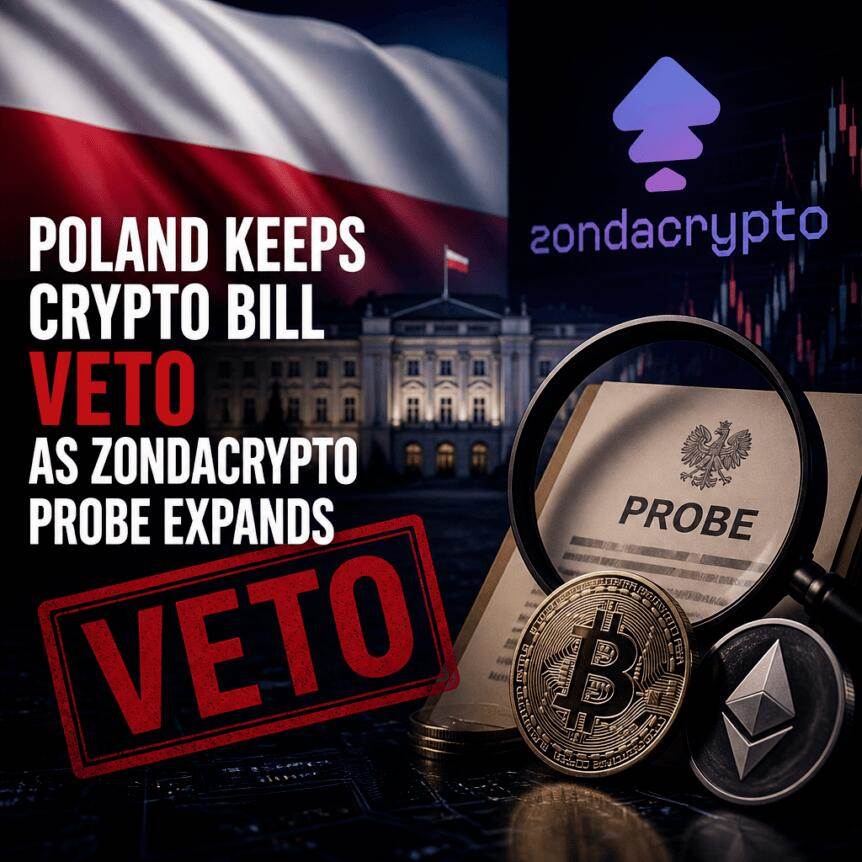
Polish lawmakers fail to override president's veto of crypto regulation bill
Polish lawmakers once again failed to obtain the super majority needed to override President Karol Nawrocki's veto. The bill aims to strengthen supervision of the country's cryptocurrency market. On Friday, the House voted 241 to 198 with 3 abstentions to override the veto, but it was still 25 votes short of the 266 votes needed to pass it.
This is Navotsky's latest attempt to push legislation forward after he separately vetoed similar encryption regulations three times. The president had previously argued that the draft would impose excessive restrictions on industry. As Prime Minister Donald Tusk highlights the expansion of criminal investigations related to the defunct exchange Zondacrypto, there is a growing sense of urgency among regulators and lawmakers to formally establish a clearer oversight framework.
Key Points
- The House vote of 241-198 confirmed support to override the president's veto, but still missed the three-fifths threshold by 25 votes. [TAG Although the EU Crypto Asset Market Regulation (MiCA) has been implemented in member states, Poland still does not have a designated national crypto asset regulator under the proposed framework. [TAG Navotsky's reasons for vetoing include concerns about regulatory overreach, including compliance costs and the power that could be used to block websites. [TAG Tusk's latest pronouncements link the regulatory debate to the ongoing Zondacrypto scandal, involving alleged political fallout and financial arrangements.
Failure to overturn leaves Poland's crypto regulation deadlocked
The core bill voted on Friday aims to establish Poland's national approach to applying the EU's Crypto Asset Markets Regulation (MiCA). The proposal would hand over supervision of the crypto asset market to the Polish Financial Supervisory Authority (KNF), giving domestic regulators clear authority to implement relevant rules.
Although MiCA has entered into force within the EU, Poland's legislative process has not yet established the required national structures. KNF said on Friday that the country still lacks an agency responsible for overseeing the crypto asset market. This gap is critical for market participants because enforcement and supervisory responsibilities must be allocated domestically and cannot be handled solely at the EU level.
KNF warns of lack of regulatory authority during MiCA's application period
KNF's statement highlights a practical issue: MiCA sets the framework, but oversight in each jurisdiction depends on the domestic rules and agencies that implement and enforce it. Without a properly designated national regulatory authority, compliance issues for companies may become more complex and regulatory clarity for users may remain incomplete.
It is this regulatory vacuum that the vetoed legislation is trying to address-by anchoring crypto oversight within the KNF. Poland still does not have a designated regulator after failing to meet the voting threshold needed to overturn Nawocsky's veto, and the market is still waiting for a clearer chain of responsibilities.
Reasons for Navotsky's continued veto: Cost and enforcement power
Navotsky repeatedly argued that the draft went too far. In earlier reports of the president's second and third vetoes, the president's concerns were described as including the regulatory costs of the industry and provisions that could give authorities the power to block websites.
On the other hand, supporters of veto overrule seem to believe that the bill is not only necessary to comply with MiCA, but also to protect consumers and improve supervision-especially after the high-profile failure of the crypto industry.
Zondacrypto crisis intensifies debate, prosecutors expand investigation
Political conflicts over crypto regulation are unfolding with the aftermath of Zondacrypto. Tusk cited what he called key witness testimony to urge greater oversight, including allegations of payments and attempts to influence Poland's former government.
In excerpts disclosed before Friday's vote, Tusk claimed witnesses described a 2 million zlotys (about US$550,000) payment arrangement involving a foundation linked to former Justice Minister Zbigniew Ziobro. Tusk also cited other testimony that an anonymous person allegedly promised to grant the president a pardon in exchange for witness convictions.
Meanwhile, prosecutors are investigating suspected fraud and money laundering related to Zondacrypto. According to Polish government disclosures cited in the report, in July this year, they will merge with the investigation into the 2022 disappearance of BitBay founder Sylwester Suszek (later renamed Zondacrypto).
Damage estimates cited by prosecutors showed no less than 350 million zlotys (approximately $95 million) in damage related to Zondacrypto, reflecting the size of the case. Regulators said this should increase the need for effective supervision.
Bankruptcy proceedings start, but political review continues
Zondacrypto's operator BB Trade Estonia was declared bankrupt by an Estonia court in August, and the first creditors meeting is scheduled for September 17. Bankruptcy adds another layer of complexity to the regulatory debate: As bankruptcy proceedings unfold, creditors and affected users often seek clearer accountability and stronger regulatory barriers to reduce the risk of similar failures.
However, the failure of the veto to overturn suggests that political consensus in Poland remains difficult to reach even in the face of escalating investigations and visible market turmoil-especially when the president argues that the proposed rules are too burdensome or grant enforcement powers that he believes are too broad.
Next, Polish lawmakers may have to decide whether to revisit the same bill with modifications to address veto concerns while still meeting the core requirement identified by the KNF: designating a domestic agency to supervise crypto assets under MiCA. Readers should focus on whether future House attempts can meet the three-fifths threshold and how the Zondacrypto investigation progress shapes the urgency of legislation.