Exchange Ranking
 Top Exchanges
 24h Volume Ranking
 Popularity Ranking
 Exchange BTC Balance
 Proof of Reserves
 Decentralized Exchanges
 Funding Rate
 Funding Heatmap
 Liquidation Data
 Max Pain
 Long/Short Ratio
 Whale L/S Ratio
 Binance/Okex/Huobi L/S
 Bitfinex Margin L/S
 ETF Tracker
 Solana ETF
 XRP ETF
 Hong Kong ETF
 Bitcoin Treasuries
 Crypto Reversal
 Ethereum Reserves
 HyperLiquid Wallet Analysis
 Hyperliquid Whale Watch
 Large Transactions
 On-chain Movement
 Bitcoin ROI
 Stablecoin Market Cap
 Options Analysis
 News
News Articles
 Economic Calendar
 Features
 Wallet
 Contract Calculator


 Security
 Collections
 Watchlist
 Following
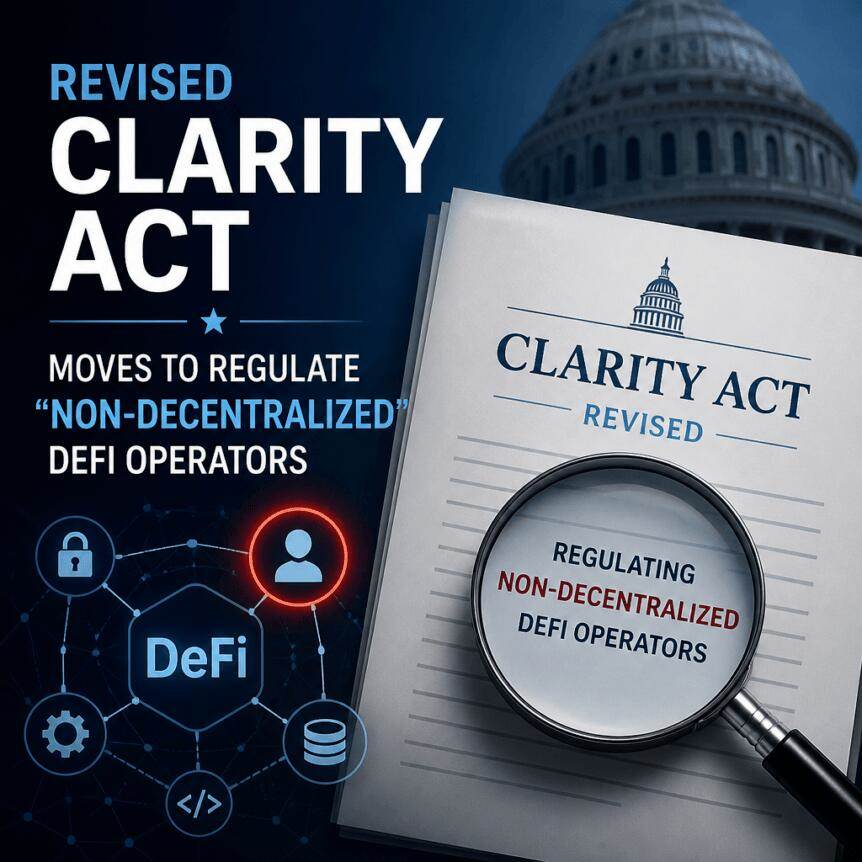
The revised U.S. Senate CLARITY Act will guide regulators to define regulatory boundaries for "non-decentralized financial transaction agreements"
The revised U.S. Senate CLARITY Act is designed to guide regulators in determining which entities with influence over "non-decentralized financial transaction agreements" must comply with securities, commodities and anti-money laundering (AML) regulations. The update, released by Sen. Cynthia Lummis, is intended to clarify how regulation applies to protocol controllers while avoiding treating the underlying software itself as an independent regulated entity.
The proposal was introduced just before a procedural Senate vote on September 15. Because the bill requires 60 votes to advance, Republicans are expected to need Democratic support-although the two sides remain divided on ethics provisions, anti-money laundering protections and elements related to stablecoin rewards.
Core Points
- Definition Standards: The revised CLARITY Act defines "decentralized financial transaction agreements" based on whether individuals or coordinating groups can materially change agreement functions, rules, or user access rights.
- Activity-based regulatory requirements: Regulators will issue activity-based requirements: the Securities and Exchange Commission (SEC) and the Commodity Futures Trading Commission (CFTC) will cover registration, codes of conduct, disclosures, record-keeping, and supervision; while the Treasury will be responsible for defining how existing Bank Secrecy Act obligations apply.
- Software exemption: The bill clearly states that software and distributed ledger systems do not need to be registered in their own name.
- Definition of control: mere participation in incident response or the Security Council does not automatically constitute "control" of the agreement.
- Legislative prospects: The measure faces procedural resistance and requires 60 votes to advance, setting a window for rapid decision-making before broader legislative momentum dissipates.
Changes to be brought about by the revised CLARITY Act
According to the revised text posted on Senator Cynthia Loomis's website, the core policy initiative is for regulators to judge whether those who control specific types of transaction agreements (specifically those that are not fully decentralized) should be considered regulated actors.
The definition of this proposal is not limited to whether the protocol has governance or management functions, but focuses on control signals that can be evaluated by regulators, including whether individuals or coordinating groups can:
- materially change the protocol's functions, operations, or rules;
- restrict user access; or
- operate a trading system that is not managed separately by transparent, predetermined codes.
The importance of this framework is that it shifts compliance issues from abstract decentralization claims to measurable governance and operational powers. The likely impact for investors and users is that enforcement boundaries will be more predictable: entities that exert meaningful influence on protocol-based ways of operating will be included in more traditional regulatory structures, while purely automated code paths will be treated differently.
Allocation of regulatory responsibilities among agencies
Under the bill, the SEC and CFTC will establish rules related to specific types of regulated activities. The text requires activity-based requirements to cover "registration, conduct, disclosure, record-keeping and supervision." At the same time, the Treasury will define how existing Bank Secrecy Act obligations apply to covered "controllers."
This division of labor is significant to market participants because it shows that the CLARITY Act attempts to map responsibilities to existing U.S. agencies rather than creating a completely new regulatory agency. For firms operating in spot trading, derivatives or cross-border custody and compliance, the guidelines by agency may be as decisive as the core definition of the bill.
The proposal also includes clarifications aimed at reducing over-regulation. It states that software and distributed ledger systems need not be registered "in their own name." In addition, it specifically states that participation in incident response or the Security Council itself does not constitute control of the agreement.
These details are particularly important to developers, security teams, and operational event coordinators, who may otherwise worry that regular cybersecurity and oversight activities will be interpreted as governance controls.
Industry response: Support the framework, but ethical issues remain
Ji Hun Kim, CEO of the Crypto Council for Innovation, said the upcoming vote represents a critical moment for digital assets and U.S. leadership. He said in a statement that the United States needs a framework that balances consumer protection with clear standards of corporate conduct.
Coinbase CEO Brian Armstrong said in an interview with CNBC that the CLARITY Act is "ready to get a yes vote." Armstrong said Coinbase's previous "necessary issues" had been resolved, while negotiations on moral restrictions were still ongoing and appeared to be close to a solution. He did not specify which terms had been changed.
Even with optimism, previous reports have pointed out that the moral component has been the main deadlock in the negotiations. The newly released text appears to retain this section largely unchanged from earlier versions, raising questions about whether the moral controversy has really shifted from disagreement to compromise.
Democratic Senator Ruben Gallego has previously warned against rushing forward before lawmakers address issues related to ethics and stablecoin gains, arguing that a quick vote may not produce the right results. This background helps explain why-despite the industry's widespread desire for a clearer regulatory path-the bill will be difficult to move forward without additional support.
Procedural mathematics and the consequences of bill stagnation
Earlier reports pointed out that the CLARITY Act requires 60 votes to advance. Given the procedural Senate vote on September 15, the updated bill must cross a high threshold-meaning Republicans still need Democratic votes despite continuing divisions.
Armstrong suggested that if legislation fails to move forward, regulators may use existing powers to seek alternative paths-such as rulemaking and innovation exemptions involving the SEC and CFTC. This is important for market participants because it frames the choice not just as a "bill or no" choice, but between "a clear legal framework and progressive regulatory action."
In practice, companies planning a compliance roadmap may be forced to decide whether to view the CLARITY Act as a short-term indicator of what can be achieved or as a politically stagnant project that may be surpassed by agency initiatives. In either case, even if the bill itself fails to advance, its definition and regulatory division of labor may still affect how companies describe decentralization, governance engagement, and operational control.
Readers should pay close attention to whether negotiators can resolve remaining ethic-related differences before a procedural vote-and what specific SEC and CFTC rulemaking efforts or exemption paths regulators will choose next if the bill fails to cross that threshold.