
 Exchange Ranking
 Top Exchanges
 24h Volume Ranking
 Popularity Ranking
 Exchange BTC Balance
 Proof of Reserves
 Decentralized Exchanges
 Funding Rate
 Funding Heatmap
 Liquidation Data
 Max Pain
 Long/Short Ratio
 Whale L/S Ratio
 Binance/Okex/Huobi L/S
 Bitfinex Margin L/S
 ETF Tracker
 Solana ETF
 XRP ETF
 Hong Kong ETF
 Bitcoin Treasuries
 Crypto Reversal
 Ethereum Reserves
 HyperLiquid Wallet Analysis
 Hyperliquid Whale Watch
 Large Transactions
 On-chain Movement
 Bitcoin ROI
 Stablecoin Market Cap
 Options Analysis
 News
News Articles
 Economic Calendar
 Features
 Wallet
 Contract Calculator


 Security
 Collections
 Watchlist
 Following
 ETH
ETH The Ethereum market has shown significant changes: exchange reserves have declined, and pledges account for more than 34%
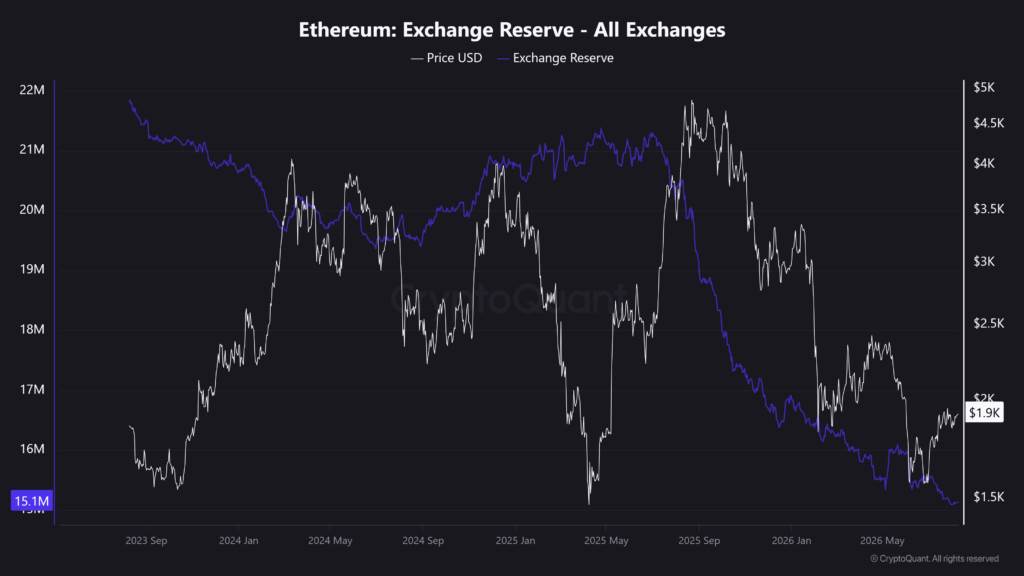
The Ethereum market has recently seen a series of noteworthy changes. Since the beginning of 2026, ETH reserves on exchanges have dropped by approximately 10%, while more than 34% of the circulating supply has been used for collateral. At the same time, spot Ethereum ETFs continue to attract capital inflows, and stablecoin liquidity is also shifting to the Ethereum network.
Despite this, Ethereum prices are still hovering around $1900. On-chain data shows that the supply side is shrinking, but spot demand in the U.S. market is not yet strong enough to drive prices up.
So why hasn't ETH increased even when the supply of ETH available for sale has decreased?
Exchange ETH reserves decreased by 10%
According to CryptoQuant, the total ETH reserves of all exchanges have dropped to 15.12 million. At the beginning of the year, this number was approximately 16.86 million. This means that the number of ETH held on the exchange has dropped by approximately 1.74 million, a drop of approximately 10% since the beginning of the year. The decline in exchange reserves may indicate that investors are withdrawing their ETH from the exchange for other purposes rather than holding it for sale. However, this data in itself does not mean that prices will inevitably rise in the future.
More than 34% of ETH supply is pledged
The reduction in the number of ETH available for sale is not limited to exchange reserves. The amount of ETH in pledge has exceeded 34% of the circulating supply, and the validator exit queue is close to zero. This indicates that a considerable number of ETH holders choose to pledge their assets. Therefore, part of the ETH supply in the market is both far away from exchanges and locked in pledge mechanisms. But the impact of this situation on prices requires sufficient demand on the other end of the market to match it.
Ethereum ETF is also absorbing market supply.
The capital inflow of spot Ethereum ETF further supports the supply-side landscape. According to SoValue, in the four weeks ending August 7, the U.S. spot Ethereum ETF attracted approximately $482 million in inflows, of which approximately $245 million came from the last week alone. Cumulative net inflows of spot Ethereum ETFs have reached approximately US$11.46 billion. This development shows that institutional investors 'interest in Ethereum has not completely subsided. However, ETF inflows have not yet formed a strong breakthrough in prices.
Ethereum network usage rises
The tightening of the supply side coincides with an increase in Ethereum network activity. The number of deployments of new smart contracts has increased significantly, with analyst Tanaka showing weekly trading activity remains above 20 million, a level near an all-time high. As a result, Ethereum has a situation in which the available supply on the exchange decreases on one hand, and network activity remains high on the other. On-chain analysis also pointed out that in similar periods, reduced exchange liquidity and increased network activity often laid the foundation for more drastic price fluctuations when demand became clear. But this structure itself does not constitute a clear signal of timing.
Stabiloin liquidity is shifting to Ethereum
Another remarkable change in the Ethereum market is the shift in the direction of staboin liquidity. According to CryptoOnchain data, in the past 14 days, the average daily net stablecoin flow to Binance was approximately US$87 million. But the real change lies in the blockchain on which liquidity relies. Binhang's wavefield-based USDT reserves fell from US$1.4 billion to US$709 million in about two weeks. The opposite trend was observed for stablecoins based on Ethereum: USDT weekly net traffic on Ethereum increased by 210%, and USDC inflows increased by 114%. This phenomenon shows that liquidity does not flow out of the market, but shifts to Ethereum. Market makers 'preferences may be influenced by deeper DeFi mobility, Ethereum's expanding market infrastructure, or expectations of potential fluctuations in ETH.
So why is ETH stuck at $1900?
This is the core problem facing Ethereum: supply is decreasing, pledges are increasing, funds are flowing into ETFs, the Ethereum network remains active, and stablecoin liquidity is shifting to Ethereum. However, ETH prices did not show a strong breakthrough. One important reason may be weak U.S. spot demand. The Coinbase Premium Index, which measures spot demand for Ethereum in the U.S. compared to other markets, has been negative since early May and is currently around-0.069. This shows that buyers in the U.S. market have not yet developed enough advantages to push up Ethereum prices. Therefore, despite tight supply, new demand growth is weak and prices may still be suppressed.
US$2000 is crucial for ETH
The price trend of Ethereum also confirms the above situation. Analyst Michaël van de Poppe pointed out that ETH fluctuates in the $1,800 - 2,000 range, with volatility close to multi-year lows. He believes that if the price breaks through the $2000 integer mark, it may open up room for a stronger rise in Ethereum. However, current data does not yet indicate that such a breakthrough has been established. Despite continued inflows of ETFs, prices failed to respond, suggesting that there was a sell-off from other suppliers in the market or that current demand was not strong enough.
What does the tight supply of Ethereum mean?
The Ethereum market has seen the intersection of several important trends: exchange ETH reserves have decreased, pledge ratios have exceeded 34%, spot ETFs have created new demand, network activity has remained high, and stablecoin liquidity has shifted to Ethereum. However, U.S. spot demand has not yet strengthened, and ETH has not been able to break through the US$1,800 - 2,000 range. Therefore, it is not correct to view the current pattern simply as a rising signal. If demand strengthens and ETH breaks through the US$2000 resistance level with a large trading volume, the impact of tight supply on prices may be more obvious. In short, the supply of Ethereum available for sale is dwindling, but the strong demand to drive prices up has not yet emerged. Supply tightening is taking shape, but triggers are still missing.
























