
 Exchange Ranking
 Top Exchanges
 24h Volume Ranking
 Popularity Ranking
 Exchange BTC Balance
 Proof of Reserves
 Decentralized Exchanges
 Funding Rate
 Funding Heatmap
 Liquidation Data
 Max Pain
 Long/Short Ratio
 Whale L/S Ratio
 Binance/Okex/Huobi L/S
 Bitfinex Margin L/S
 ETF Tracker
 Solana ETF
 XRP ETF
 Hong Kong ETF
 Bitcoin Treasuries
 Crypto Reversal
 Ethereum Reserves
 HyperLiquid Wallet Analysis
 Hyperliquid Whale Watch
 Large Transactions
 On-chain Movement
 Bitcoin ROI
 Stablecoin Market Cap
 Options Analysis
 News
News Articles
 Economic Calendar
 Features
 Wallet
 Contract Calculator


 Security
 Collections
 Watchlist
 Following
 XRP
XRP TLDR: XRP prices face resistance and book trading volumes tend to normal
XRP price forecasts set US$2.50 as a conditional boundary
XRP prices remain near US$1.04, and a 90% drop in payments reflects a return to normalization from a brief peak of 614.9 million XRP network.
USD1 support anchors short-term charts and a break below could hit recent lows of USD0.95 to USD0.97.
predicts US$2.50 as the boundary for upward recovery, but XRP must first recover US$1.10 and the main moving average to test this level.
Ripple's US$500 million financing, RLUSD expansion, and XRPL tokenization strategy provide a broader institutional context.
XRP prices are currently trading around $1.04 after XRP ledger payments fell nearly 90% from the August 7 surge. The network processed approximately 614.9 million XRPs at local peaks, and then activity quickly returned to recent baseline levels.
This contraction may seem drastic, but the underlying pattern provides important market context. In the past month, XRPL payment traffic has repeatedly jumped briefly and then reversed rapidly. This performance is different from the continued collapse of existing payment needs. At the same time, price forecasts list $2.50 as the upward recovery boundary in coming quarters. However, XRP must first hold on to parity and recover adjacent resistance levels.
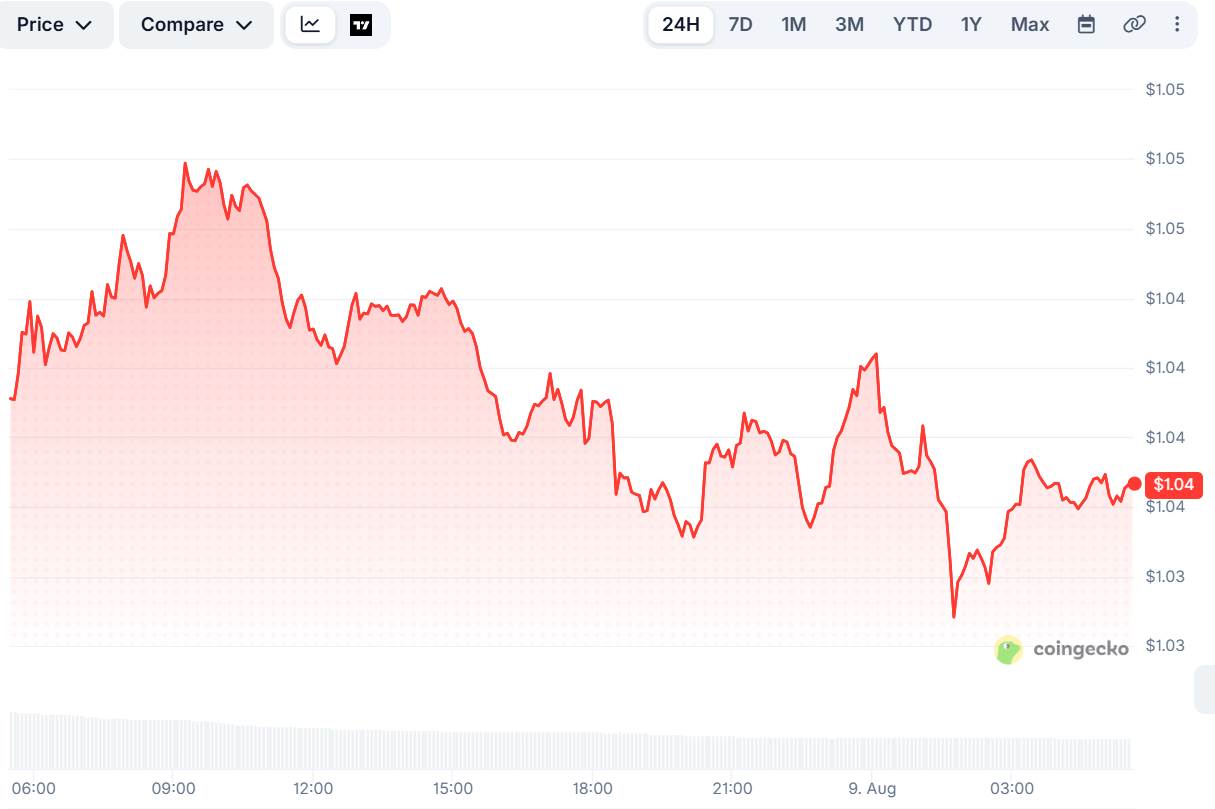
XRP price (XRP)
XRP price faces resistance, book trading volume tends to normal
XRP ledger payments measure transfers between accounts rather than exchange trading activity. A single institutional transfer, fund bank transfer or exchange reorganization can produce unusually large readings. It cannot identify the purpose behind each transfer.
The surge on August 7 fits this pattern. Payment activity climbed to approximately 614.9 million XRP, but did not form an upward trend. Trading volumes then fell sharply on August 9, resulting in headline data that fell 90% from temporary highs. Similar reversals have occurred in the history of XRPL. Payments exceeded 1 billion XRP on August 1, and then fell to nearly 100 million XRP. These outbursts make peak-to-trough comparisons seem more disruptive than the overall activity trend suggests.
Structural warnings require a longer period of sluggish payment activity. Analysts need to obtain confirmation information from the number of transactions, active accounts, exchange traffic and stablecoin transfers. A single indicator of volatility cannot establish the conclusion that the network continues to slow down.
The risks posed by the XRP price chart are more immediate. XRP traded below the moving average and sellers maintained a series of lower highs. Short-term resistance is between $1.075 and $1.087. The larger moving averages are around $1.185 and $1.377.
Lack of reversal signal for kinetic energy. The relative strength index is close to 40, indicating weak demand but not yet oversold conditions. XRP could face more selling before technical failure occurs.
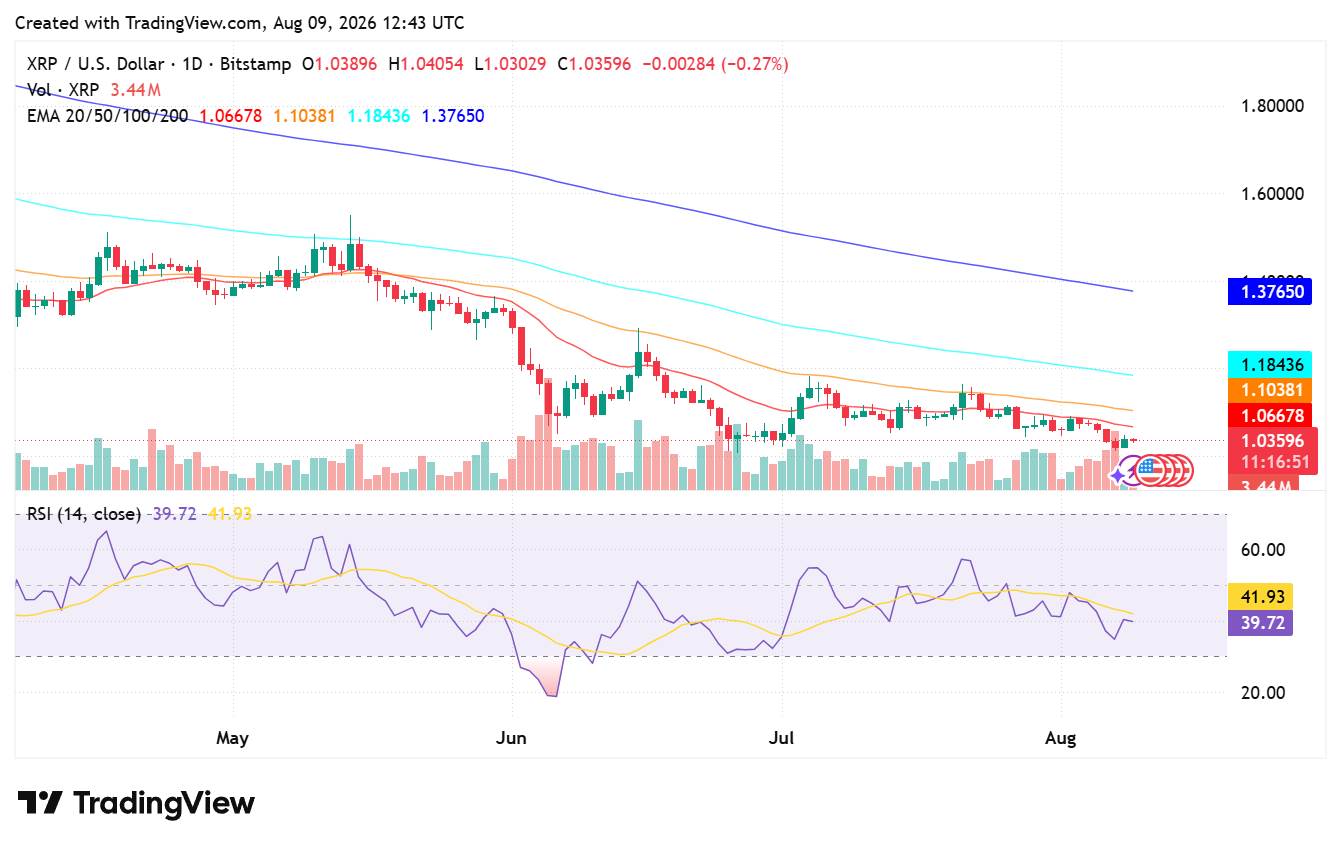
XRP/USD daily chart. Source: TradingView
XRP price forecast sets US$2.50 as conditional boundary
In addition, the $1 mark now controls the short-term XRP price structure. Holding this threshold could support consolidation and test the $1.08 to $1.10 range again. If the daily level breaks below, it will expose the recent low of US$0.95 to US$0.97.
The broader XRP price forecast range is approximately US$1.10 to US$2.50 in the next few quarters. This interval represents a scenario rather than a determined path. XRP must first regain its neighboring moving average and end its sequence of lower highs.
Ripple's business expansion provides a fundamental background. The company raised US$500 million in November 2025 at a valuation of US$40 billion. Funds managed by Fortress Investment Group and Citadel Securities affiliates led the investment.
Ripple has expanded its business beyond cross-border payments. Its product line now includes custody, stablecoin, prime brokerage and corporate treasury services. This strategy connects XRP requirements to the institutional infrastructure network.
RLUSD adds compliant dollar-denominated liquidity on XRP ledgers and Ethereum. The stablecoin can handle transfers that require low price fluctuations. XRP supports bridge mobility and cross-border routing when fast redemption is needed.
In addition, XRPL development targets tokenized assets and decentralized finance. Its EVM-compatible sidechains support Ethereum applications while connecting it to the XRP ecosystem. Native ledger functions cover token issuance, trading, custody and automated market making.
These developments do not directly guarantee an increase in XRP prices. Market demand, liquidity conditions and broader risk appetite will still determine price performance. Adoption must translate into continuous network activity rather than isolated peak payments.
The $2.50 boundary needs to recover from the current region. XRP needs to break through $1.10, recover the larger moving average, and build higher lows. Until then,$1 remains the immediate decision-making level on the chart, while $0.95 marks the next downward reference point.
























