Exchange Ranking
 Top Exchanges
 24h Volume Ranking
 Popularity Ranking
 Exchange BTC Balance
 Proof of Reserves
 Decentralized Exchanges
 Funding Rate
 Funding Heatmap
 Liquidation Data
 Max Pain
 Long/Short Ratio
 Whale L/S Ratio
 Binance/Okex/Huobi L/S
 Bitfinex Margin L/S
 ETF Tracker
 Solana ETF
 XRP ETF
 Hong Kong ETF
 Bitcoin Treasuries
 Crypto Reversal
 Ethereum Reserves
 HyperLiquid Wallet Analysis
 Hyperliquid Whale Watch
 Large Transactions
 On-chain Movement
 Bitcoin ROI
 Stablecoin Market Cap
 Options Analysis
 News
News Articles
 Economic Calendar
 Features
 Wallet
 Contract Calculator


 Security
 Collections
 Watchlist
 Following
Almost everyone follows the same order when evaluating a trading platform
First look at fees, then tradable markets, then leverage, and finally the interface. Custody issues, if indeed mentioned, are usually at the end of the list and are often just a vague guarantee of security rather than a question that requires specific answers.
The order is reversed, and enough evidence has been generated in this field to say so without hesitation. The Bank of England dedicated an issue in its Financial Stability Focus series to discuss cryptoassets and decentralized finance, with a recurring theme being that operational risks and counterparty risks in this market are often ambiguous to those who bear them. The fee is a percentage of your transaction volume. Custody is a claim on your entire balance.
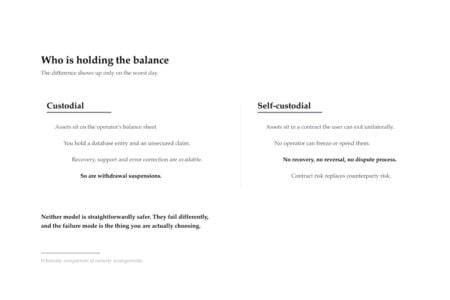
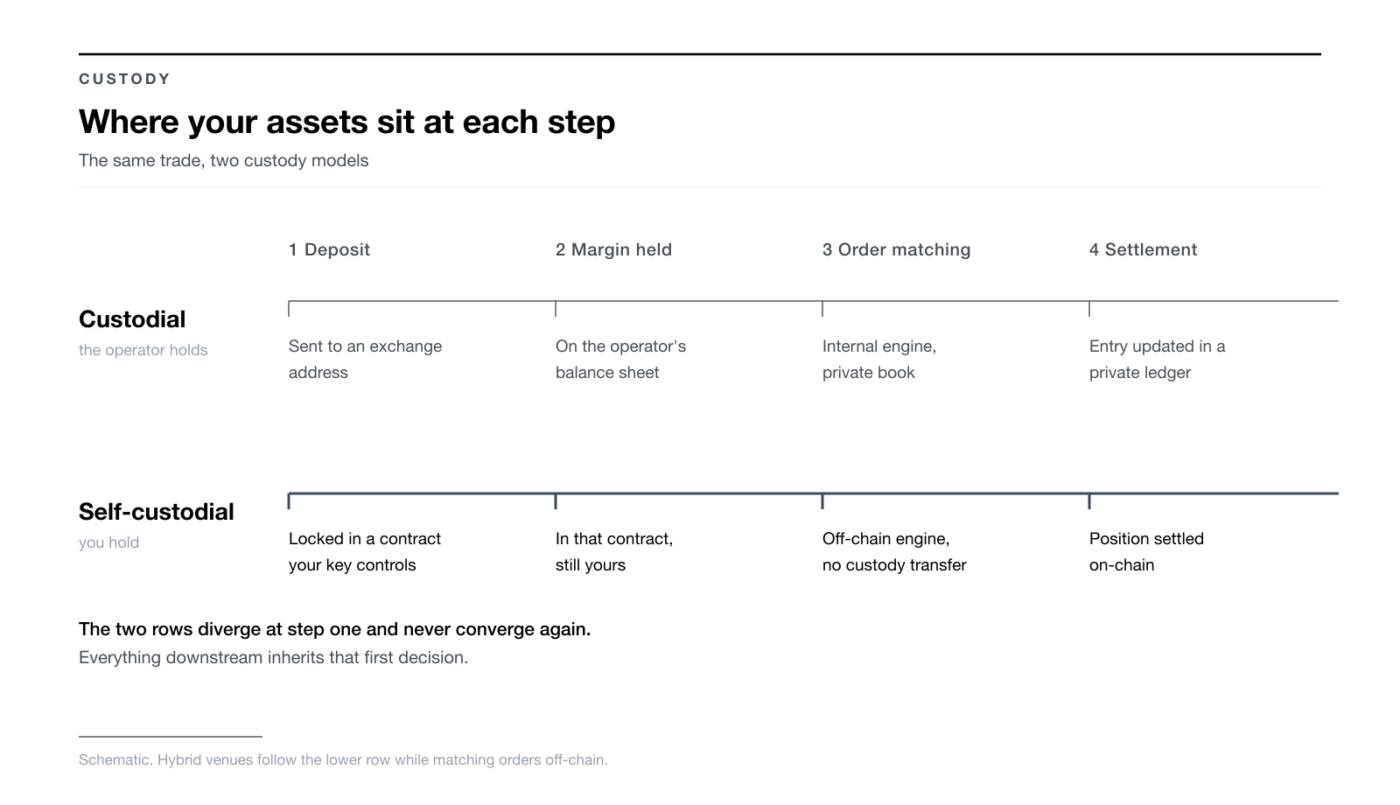
Once someone makes it clear, the difference between the two is not complicated. On an escrow platform, you deposit assets, the platform records a number next to your name, and you become an unsecured creditor of the business. On a self-managed platform, assets are stored in smart contracts or wallets you control, and the platform's role is limited to matchmaking and settlement. Trading platforms built on the second model, such as EVEDEX, place collateral in contracts that users can opt out of, rather than on the company's balance sheet, which changes what operator failure actually means to you.
1. What does "your balance" mean on a hosting platform
It means an entry in a private database. The enforceability of this entry depends on the company's solvency, integrity and whether the laws of your area can touch it.
Under normal circumstances, this is completely fine and brings real benefits: password recovery, customer support, error correction, and sometimes insurance, and a quarantine system that separates customer assets from company funds in well-regulated markets.
In abnormal cases, the situation is reversed. If the operator goes bankrupt, the customer's claim usually needs to be queued and is subject to the bankruptcy laws of the place where the company is registered, which is often not the jurisdiction where the customer lives. Withdrawal suspensions usually precede bankruptcy announcements, and it is obvious that you cannot operate during the suspension.
A disturbing historical pattern is that customers of failed crypto platforms often learn of the problem after the withdrawal button expires, rather than before.
2. What does self-custody guarantee and cannot guarantee anything
It only guarantees one thing: no third party can stop you from transferring assets because no third party holds the key. This is a real and important property right that eliminates the single largest loss category in the history of the industry.
But it also eliminates something else that honestly faces is the difference between making useful comparisons and conducting marketing campaigns.
There is no recovery mechanism. A lost key means a permanent loss of balance. Wrong transactions are irrevocable, there is no dispute resolution process, and there is no support department with authority over the ledger. Moreover, the security of assets depends on the contracts in which they are held, which means that smart contract risk replaces counterparty risk rather than eliminating risk entirely. A contract that has been audited and running for many years is very different from a new contract, but most users cannot distinguish between them.
3. The reason why the
hybrid design exists in the middle ground where most trading volume has shifted is that no pure model can meet the needs of active trading.
Full chain order books have historically had problems in terms of delays and cost. A fully managed exchange provides excellent execution efficiency, but requires you to accept creditor status in exchange. The current compromise, which carries a large amount of derivatives trading volume, is to match orders off-chain (matching speed and low cost), while simultaneously settling positions and holding collateral on-chain (users retain control).
It is necessary to state exactly what this solved and what it did not solve. It solves custody risks. It does not make the matchmaking engine transparent, does not eliminate the ability of operators to change parameters, nor does it mean that exchanges are decentralized in a governance sense. These are independent claims that require independent review.
4. Stress tests perform differently under different models
This is where theoretical differences turn into actual differences.
A briefing note by the Bank for International Settlements on DeFi lending noted that because borrowers were anonymous, overcollateralization was widespread, which created procyclicality: falling prices triggered liquidation, which led to further price declines, triggering more liquidation. The on-chain system performs liquidation mechanically, openly, and quickly.
The hosting platform has discretion. They can suspend trading, widen price ranges, suspend withdrawals or spread losses. Sometimes this discretion protects users, sometimes it protects the platform, and usually you only know which one is the day you exercise the power.
Neither is absolutely safe. They fail in different ways, and understanding which failure patterns you agree to accept is the key.
Quick comparison of three models
Custody CEX: Orders are matched off-chain and are fast; they are managed by the operator; they are settled through internal ledger; transactions are private; the main risk is the operator's bankruptcy.
Hybrid type: Orders are matched off-chain and are fast; are managed by users; settled on-chain; settlement is open; the main risks are contract risk and operator discretion.
Fully on-chain: Orders are matched on the chain and are slower; managed by users; settled on the chain; fully disclosed; the main risks are delays and extractable value.
Five questions worth answering before depositing funds
1. Where are the assets actually stored? A contract address you can check, or a balance sheet you cannot check.
2. Who is the legal entity and where is it registered? This determines your right of recourse and can usually be found in the footer.
3. Can you withdraw cash unilaterally? If the answer requires platform cooperation, then this is a dependence, no matter what marketing says.
4. What are the public policies for extreme volatility? Automatic reduction of positions, insurance funds, and social loss allocation. All three exist; each has different consequences for you.
5. Have you ever tested withdrawing large amounts of money? Not to test the number of tokens. It's on calm days, before you need it to work on bad days, to take a real withdrawal test.
Regulators are reaching a consensus on this. The Financial Stability Board's global framework on crypto asset activity includes clear disclosure of client asset isolation and custody arrangements as its core recommendation, precisely because so much damage in the past stems from the fact that these arrangements have been unclear and become important until it is too late.
Custody is not the exciting part of choosing a trading platform. It is just the part that determines whether other parts are important.