Exchange Ranking
 Top Exchanges
 24h Volume Ranking
 Popularity Ranking
 Exchange BTC Balance
 Proof of Reserves
 Decentralized Exchanges
 Funding Rate
 Funding Heatmap
 Liquidation Data
 Max Pain
 Long/Short Ratio
 Whale L/S Ratio
 Binance/Okex/Huobi L/S
 Bitfinex Margin L/S
 ETF Tracker
 Solana ETF
 XRP ETF
 Hong Kong ETF
 Bitcoin Treasuries
 Crypto Reversal
 Ethereum Reserves
 HyperLiquid Wallet Analysis
 Hyperliquid Whale Watch
 Large Transactions
 On-chain Movement
 Bitcoin ROI
 Stablecoin Market Cap
 Options Analysis
 News
News Articles
 Economic Calendar
 Features
 Wallet
 Contract Calculator


 Security
 Collections
 Watchlist
 Following
 BTC
BTC  ENA
ENA  ETH
ETH Ethena expands USDe's collateral base to equity perpetual contracts, and the first batch of exchange partners announce within weeks
Ethena will expand USDe's collateral base to equity perpetual contracts, and the first batch of exchange partners are expected to announce within weeks. At present, the open interest volume of equity perpetual contracts has exceeded US$6 billion, involving approximately 200 contracts, an increase of more than 10 times since March. Ethena said the annualized funding rate for such contracts this year averaged between 15% and 20%, while Bitcoin's funding rate was only in the low single digits.
The news came a day after Ethena disclosed that perpetual contract funding rates-once the engine of almost all of its reserves-now support only 11% of USDe. USDe supply has dropped from a peak of US$14 billion in early 2026 to the current US$4.04 billion.
Ethena said on Friday that for the first time, it has extended USDe's Delta-neutral basis trading, a mechanism that generates stablecoin gains, to equity perpetual contracts. It will follow the same "short perpetual contracts, hold spot exposure" structure as Bitcoin and Ethereum, and is expected to announce its first exchange partners within weeks. Extend USDe's support: basis trading for equity perpetual contracts. Currently, on the exchanges where Ethena already trades, the open interest volume of equity perpetual contracts is close to US$6 billion, involving approximately 200 contracts, a more than 10-fold increase since March. The average capital rate for equity perpetual contracts is 15% to 20%, which is more than 5 times that of Bitcoin...
The capital rate is 5 times that of Bitcoin
Its selling points are size and revenue. Equity perpetual contracts allow traders to leverage to go long or short stocks without holding the underlying stock. Since March, the volume of open interest in such contracts has grown from less than US$1 billion to more than US$6 billion on exchanges where Etha has traded, involving approximately 200 contracts. Ethena said that the funding rates for these contracts (fees regularly paid by long positions in perpetual contracts to short positions) have an average annualized rate of return of 15% to 20% this year, which is more than five times the bitcoin funding rates for the same period, and are almost irrelevant to cryptocurrency funding rates.
"Another interesting feature is that compared with cryptocurrencies, the capital rate distribution of equity perpetual contracts naturally shows a positive skew." Co-founder Guy Young said this points to the structural reasons for the gap: stocks have a long-term upward trend, keeping the demand for leveraged bulls and the rates of funds paid out to be positive, while the cryptocurrency market is not. Ethena described the reachable market-the global stock market exceeds $150 trillion and the cryptocurrency market is approximately $2.5 trillion-as the largest scale-up opportunity for basis trading since the launch of USDe, noting that in two and a half years, there have been no basis point impairments in more than $30 billion in coin issuance and redemption transactions, demonstrating its ability to safely run the transaction at large scale.
Reserve portfolio has been adjusted first
A day earlier, Erena disclosed a comprehensive reorganization of its USDe actual backing assets, and also announced Erena ENA repurchase plan and adjustments to token economics. Perpetual contract funding rates, which once built the stablecoin's reputation and constitute almost all of its reserve engines, now account for only 11% of the backing assets. The rest is currently held in institutional loan agreements with counterparties including Anchorage Digital, Maple Institutional and Coinbase Asset Management, real-world assets such as mortgage bonds and investment-grade corporate bonds, stablecoins and DeFi positions, and senior loans to trading companies.
This adjustment is in sync with the decline in supply-chain data confirms that the decline is continuing. USDe peaked at more than $14 billion earlier this year, but fell below $6 billion in early April and stood at $4.04 billion as of Friday. 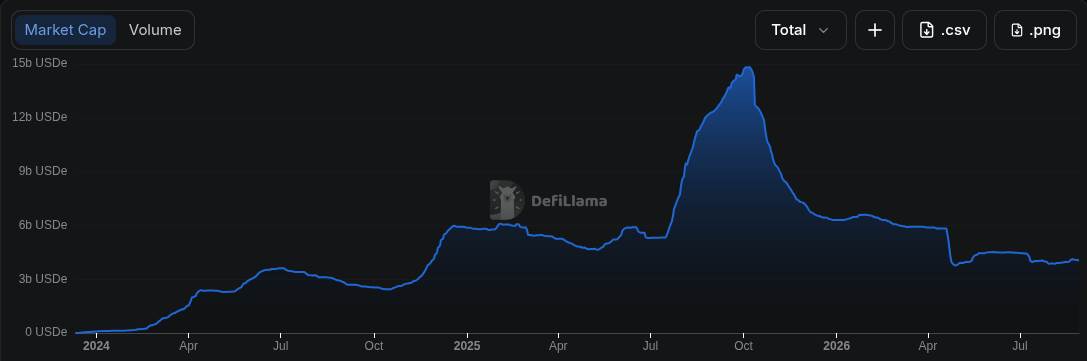 Erena USDe
In this context, the equity perpetual contract looks more like a new branch that Erena spent months stripping its reserve base from a single point of failure, including the August 19 warehousing loan arrangement with FalconX, rather than its doubling down on the original deal. The pure pursuit of higher yields does not require first cutting core transactions to one-eighth of book value.
There is a precedent for stablecoins
This strategy has been implemented before in the cryptocurrency field. In 2022, when demand for native leverage in cryptocurrencies dried up, MakerDAO shifted its collateral to U.S. Treasury bonds and corporate bonds, trading purity for durability. Ethena's version retains the basis trade rather than abandoning it, and betting on stocks can make the trade last. The surge in Erena ENA prices on August 22 also highlighted the rapid shift in investor sentiment towards the agreement in recent weeks.
Whether this bet is true can be verified. Keep an eye on the upcoming list of exchange partners in the coming weeks and whether perpetual contract funding rates (including new equity branches) will return to USDe's primary reserve status rather than just one of many components. This will show whether this is a true extension of the model or a different name for the same centralization.