Exchange Ranking
 Top Exchanges
 24h Volume Ranking
 Popularity Ranking
 Exchange BTC Balance
 Proof of Reserves
 Decentralized Exchanges
 Funding Rate
 Funding Heatmap
 Liquidation Data
 Max Pain
 Long/Short Ratio
 Whale L/S Ratio
 Binance/Okex/Huobi L/S
 Bitfinex Margin L/S
 ETF Tracker
 Solana ETF
 XRP ETF
 Hong Kong ETF
 Bitcoin Treasuries
 Crypto Reversal
 Ethereum Reserves
 HyperLiquid Wallet Analysis
 Hyperliquid Whale Watch
 Large Transactions
 On-chain Movement
 Bitcoin ROI
 Stablecoin Market Cap
 Options Analysis
 News
News Articles
 Economic Calendar
 Features
 Wallet
 Contract Calculator


 Security
 Collections
 Watchlist
 Following
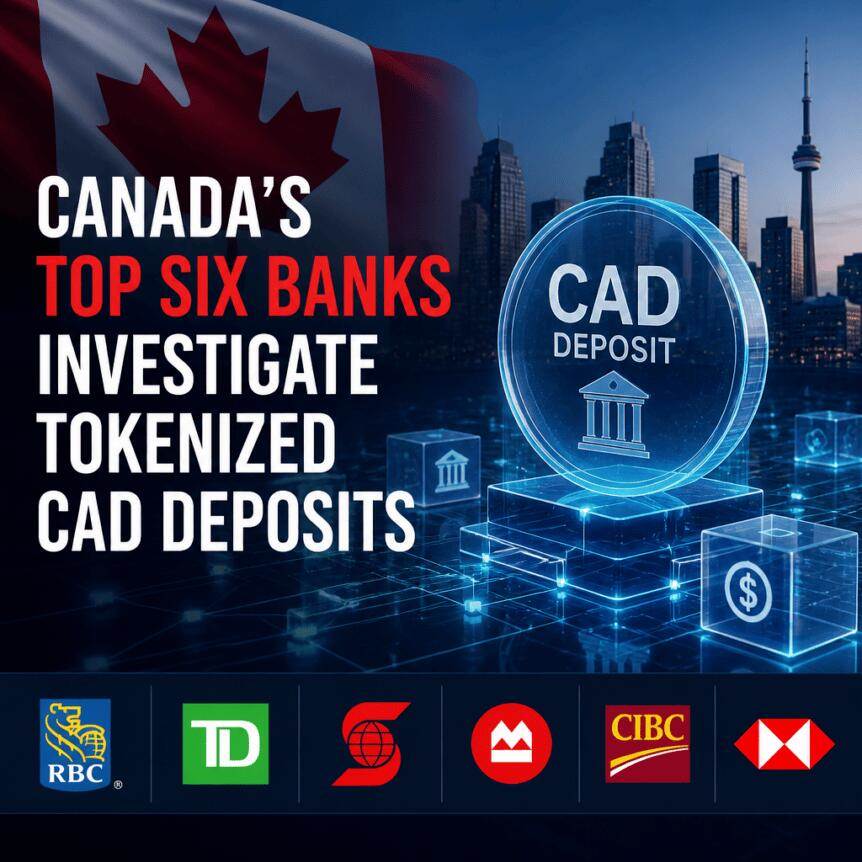
加拿大六大银行联合探索代币化加元存款跨境互操作
加拿大六大主要银行正在共同开发一种共享方案,旨在实现机构间代币化加元(CAD)存款的转移。该项目致力于在保持传统银行负债属性的前提下,提升支付速度并增强可编程性。
根据周二发布的联合公告,蒙特利尔银行(BMO)、加拿大帝国商业银行(CIBC)、加拿大国家银行、皇家银行(RBC)、丰业银行(Scotiabank)和道明银行集团(TD Bank Group)宣布,该项目将首先聚焦于在加拿大金融机构之间转移代币化存款。银行方面指出,未来的阶段可能会将连通性扩展至其他数字资产系统。
核心要点
- 定义明确:该倡议涵盖的是代币化银行存款,银行将其定义为仍属于发行银行的负债。
- 初始范围:初期仅限于受监管金融机构之间的加拿大境内存款流动,未来有望扩展至其他数字货币系统。
- 监管指引:此举紧随加拿大审慎监管局(OSFI)的指导方针,该方针明确指出代币化存款在法律上与传统存款并无二致。
- 并行框架:加拿大正在推出针对法币支持型稳定币的独立监管框架,但该规则不直接适用于银行和信用合作社。
为何代币化存款吸引银行关注
代币化存款旨在代表持有在受监管银行中的资金权益,通常利用分布式账本技术或其他类似技术来创建存款的数字表示形式。在银行的表述中,这一区分至关重要:存款仍然是银行的负债,而非独立的数字资产。
该项目声明的目标是支持更快的支付结算,并实现比传统结算路径更高的可编程性。对于投资者和市场参与者而言,其吸引力显而易见——即在不要求银行将存款视为“新型”金融工具的前提下,减少对账摩擦并缩短结算周期。
OSFI的澄清消除了法律不确定性
此次行动的时机颇具深意。在加拿大银行业监管机构——加拿大审慎监管局(OSFI)就代币化存款在加拿大法律下的处理方式提供进一步澄清后不到两周,这项银行倡议便应运而生。
OSFI在9月10日的一份声明中表示,代币化存款“在法律上与传统存款没有区别”,强调用于交付金融产品的底层技术不会改变其法律属性。这种监管立场非常重要,因为它直接解决了代币化结算模式的核心障碍之一:“数字表示”是否会改变存款的法律性质。通过明确表示不会改变,OSFI实际上降低了希望尝试新价值传输渠道的机构的合规不确定性。
Bank plans to align with Canadian stablecoin rules
Canada's tokenization of deposits is being synchronized with broader national digital currency regulatory initiatives, particularly for fiat backed stablecoins.
In March this year, Canada passed the Stability Coin Act as part of the C-15 Act, establishing a federal framework for fiat backed stablecoins issued by non-financial institutions. The system requires issuers to register with banks of Canada, maintain a highly liquid asset reserve level of at least 1:1, and provide redemption services at face value. The framework is expected to take effect in 2027.
However, the scope of the stablecoin framework is limited. The law covers fiat backed stablecoins issued by non-financial entities, but excludes banks and credit unions that are already prudently regulated. OSFI and market observers also emphasized that issuers under the stablecoin system are prohibited from expressing their stablecoins as deposits or being included in the public deposit insurance system.
This difference creates a structural contrast between efforts to tokenize bank deposits and the stablecoin market: tokenized deposits remain within the banking system, while fiat backed stablecoins face a separate set of reserve, redemption and marketing restrictions. Together, these two tracks suggest that Canada is trying to build a coherent regulatory architecture in which "legal essence" is more important than "technical appearance."
Observation focus after the start of the first phase
The bank said the first phase will focus on moving tokenized deposits between Canadian financial institutions before possible connections to other digital asset systems. While the announcement did not provide detailed technical details, this phased approach indicates a pragmatic priority: proving operational and settlement reliability within a tightly constrained network.
The key question for both users and counterparties is how the system handles typical deposit lifecycle requirements-such as custody, redemption mechanisms, reconciliation and settlement finality-without changing the underlying liability structure identified by OSFI as legally linked to traditional deposits.
For the broader industry, the next milestone to track is whether the project evolves beyond domestic interbank transfers into a model that can truly interoperate with other digital settlement networks. This is a test not only of technology, but also of regulatory boundaries-especially the boundaries surrounding when "deposit tokenization" ends and when other forms of digital assets begin.
As the first phase progresses, the most important signal may be whether banks can demonstrate faster, more programmable payment capabilities while complying with OSFI legal interpretations, and whether Canada's independent stablecoin framework will over time affect how these tokenized deposit channels connect to the broader ecosystem.