Exchange Ranking
 Top Exchanges
 24h Volume Ranking
 Popularity Ranking
 Exchange BTC Balance
 Proof of Reserves
 Decentralized Exchanges
 Funding Rate
 Funding Heatmap
 Liquidation Data
 Max Pain
 Long/Short Ratio
 Whale L/S Ratio
 Binance/Okex/Huobi L/S
 Bitfinex Margin L/S
 ETF Tracker
 Solana ETF
 XRP ETF
 Hong Kong ETF
 Bitcoin Treasuries
 Crypto Reversal
 Ethereum Reserves
 HyperLiquid Wallet Analysis
 Hyperliquid Whale Watch
 Large Transactions
 On-chain Movement
 Bitcoin ROI
 Stablecoin Market Cap
 Options Analysis
 News
 Articles
 Economic Calendar
 Features
 Wallet
 Contract Calculator


 Security
 Collections
 Watchlist
 Following
 DOGE
A year of shrinking trading volumes
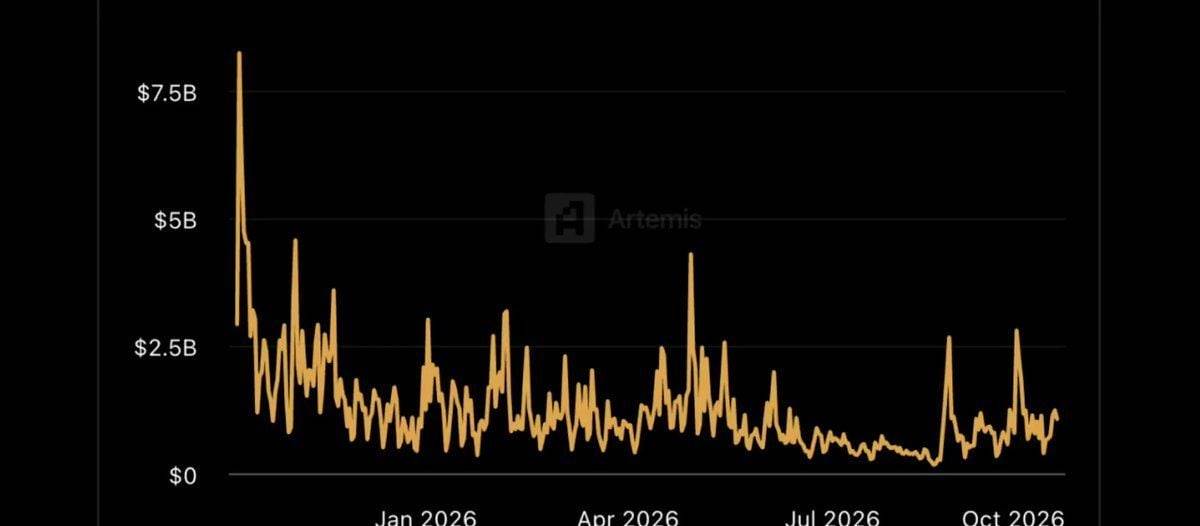
In the past 12 months, trading activity in Dogecoin has dropped sharply. According to Artemis Analytics, in November 2025, DOGE's average daily exchange volume is typically between US$1 billion and US$2 billion. However, by October 2026, this figure will be roughly halved, and the average daily transaction volume is currently only hovering in the range of US$500 million to US$1 billion.
This trend is persistent and difficult to ignore. At the beginning of 2026, the average daily trading volume of dogcoin exceeded US$1 billion on average, and then fell to below US$400 million before partially recovering to the current level. Market data shows that in mid-2026, DOGE's average daily trading activity was once as low as US$360 million to US$380 million, a drop of 64% from the average daily level of over US$1 billion at the beginning of the year. [TAG A significant outlier occurred during_5]
. In late April, as the token price exceeded US$0.10, traders returned to the large-scale memecoin field, and the trading volume of Dogecoin briefly soared to approximately US$4.3 billion. However, this growth was not sustained, and daily turnover fell steadily in May and June.
Drivers behind the decline
The decline in trading volume is not an isolated event. At the end of 2025, the average daily number of active addresses for Dogcoin is approximately 71,000. By mid-2026, Internet activity will be roughly halved, well below the peak of the previous bull market. The decrease in active users on the chain naturally led to a weak exchange turnover rate.
At the same time, AI tokens and tokenized real-world assets (RWAs) absorb most of the remaining market attention. Unlike Dogecoin, which lacks fundamental support, these new tracks provide a clear profit story and institutional engagement tied to fundamentals. As the scope of funding rotation expands, demand for traditional memes has further weakened even during the broader market recovery months.
Traders have become more cautious about meme tokens overall, preferring assets backed by clear institutional signals. This shift in sentiment, combined with a decline in raw volume data, suppressed DOGE's performance.
Despite facing a decline, Dogecoin has not been completely bearish. In its long history, DOGE has experienced multiple deep corrections of more than 50%, and has experienced a decline of more than 90% after 2021. However, after each crisis, the token remained actively traded, maintained its listing status on all major exchanges, and eventually ushered in a new round of strong performance. Whether this downturn will follow the same pattern remains to be seen.