Exchange Ranking
 Top Exchanges
 24h Volume Ranking
 Popularity Ranking
 Exchange BTC Balance
 Proof of Reserves
 Decentralized Exchanges
 Funding Rate
 Funding Heatmap
 Liquidation Data
 Max Pain
 Long/Short Ratio
 Whale L/S Ratio
 Binance/Okex/Huobi L/S
 Bitfinex Margin L/S
 ETF Tracker
 Solana ETF
 XRP ETF
 Hong Kong ETF
 Bitcoin Treasuries
 Crypto Reversal
 Ethereum Reserves
 HyperLiquid Wallet Analysis
 Hyperliquid Whale Watch
 Large Transactions
 On-chain Movement
 Bitcoin ROI
 Stablecoin Market Cap
 Options Analysis
 News
News Articles
 Economic Calendar
 Features
 Wallet
 Contract Calculator


 Security
 Collections
 Watchlist
 Following
 BTC
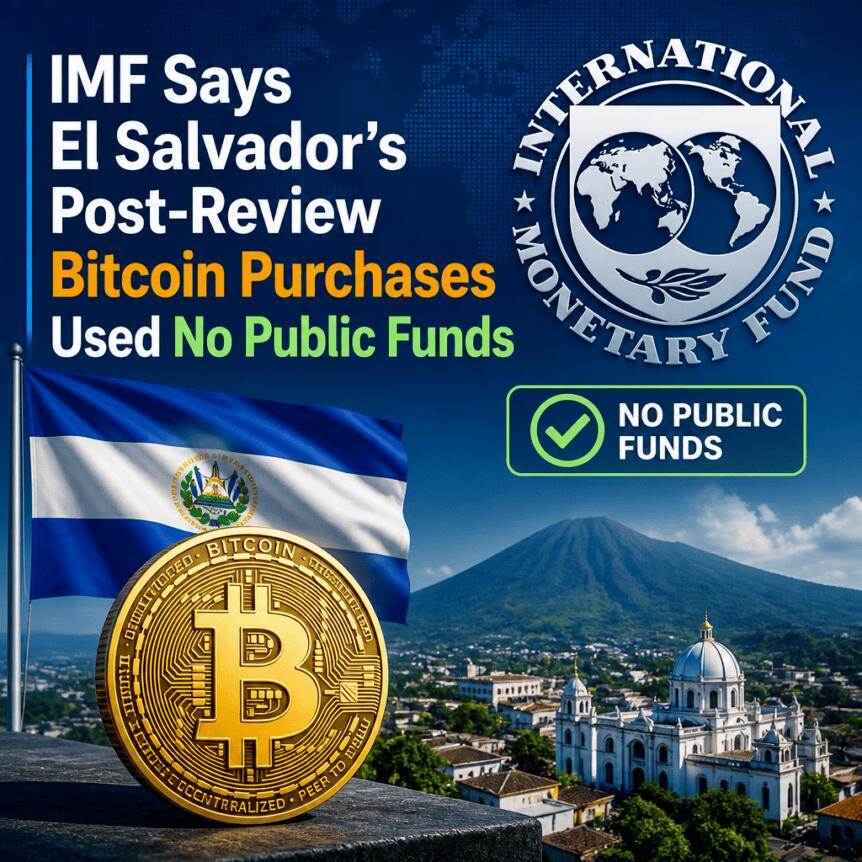
BTC The IMF confirms that the growth in El Salvador's bitcoin reserves stems from private donations and unused public funds
The International Monetary Fund (IMF) said that since the first review of the financing plan ended in June 2025, El Salvador's bitcoin reserves have increased. According to the IMF, this increase did not involve new purchases using public resources.
In filings with lenders, Salvadoran authorities attributed the increase in reserves to private donations. In a statement issued on Thursday, the IMF said it had verified this explanation through material provided by local authorities and concluded that, therefore, these additions should not be considered additional government-funded Bitcoin purchases under the terms of the project. In addition, the IMF noted that control of the Chivo wallet-the Bitcoin wallet associated with the El Salvador state-has been transferred to private operators, while the government still retains a minority stake and certain custody responsibilities.
Core Points
- The IMF said that the growth in Bitcoin reserves after June 2025 is documented to have come from private donations rather than government financing.
- Lenders do not expect further Bitcoin accumulation beyond recorded donations.
- The IMF pointed out that most ownership and operational control of the Chiewo Wallet has been transferred to private operators, with the state retaining only a minority stake and a custodian role.
- Previously, El Salvador's public announcement of continued accumulation triggered a rigorous review of its eligibility for IMF conditions.
IMF verification after June 2025 review
The IMF's latest note aims to clarify the sources of funding for the increase in Bitcoin reserves following its first review of El Salvador's supported financing arrangements. In its statement, the IMF said documents submitted by Salvadoran authorities confirmed that this accumulation did not rely on "public resources." This distinction is crucial because El Salvador's IMF agreement contains restrictions on how the public sector can engage in Bitcoin activities. When bitcoin-related activity appears to expand after key compliance checkpoints, investors and stakeholders often look to see whether the activity qualifies for the project-particularly with regard to public funds and state-led accumulation.
The IMF also defined future expectations: It said it would not exclude additional accumulations other than those that could be traced to recorded donations. This information effectively sets a compliance cap on future reserve growth, at least while the IMF continues to oversee the arrangement.
Reorganization of control of "Chiewo" wallet
In addition to the issue of donor sources, the IMF statement also addressed the governance structure of the Chiewo Wallet. According to lenders, most ownership and operational control has been transferred to private operators. At the same time, the government retains minority equity and custody responsibilities. The move is significant because early IMF commitments emphasized reducing the government's role in bitcoin-related activities. The transfer of operational control can be seen as part of a broader effort to move away from state-driven Bitcoin operations-although the exact impact this will have on users and custody arrangements depends on how private operators manage day-to-day functions.
How previous rules triggered scrutiny
El Salvador's IMF controversy over Bitcoin focuses on the boundary between government involvement and private sector activity. In December 2024, the IMF agreement required changes, including restrictions on public sector participation in Bitcoin activities under the IMF program. The arrangement also stipulates that acceptance of bitcoin by the private sector should be voluntary, requires taxes to be paid in U.S. dollars, and requires the phasing out of government participation in Chiwo.
Subsequently, in March 2025, the IMF issued a new document prohibiting the public sector from "voluntarily accumulating" bitcoin. President Nayib Bukele publicly responded that buying had "not stopped" and that El Salvador would continue to increase its holdings of at least one BTC a day. In the months that followed, tensions between El Salvador's statements about continued accumulation and the IMF's restrictions surfaced repeatedly. After the March 2025 update, the country's Bitcoin office frequently issued messages saying that El Salvador was still accumulating bitcoins, triggering a new round of questions about whether these increases were consistent with project constraints.
From explanation of private donations to reserve tracker snapshots
Previously, the IMF had commented on the issue after El Salvador made its December 2024 commitment. In July 2025, the IMF gave a preliminary explanation, saying that no new Bitcoin purchases had been detected since the agreement was signed in December. At the time, it attributed the increase in reserves to consolidation within the government purse.
However, in November 2025, El Salvador announced that it had acquired 1,090 BTC units worth US$100 million after the end of the first review timeline, bringing this issue into focus again. Reports at the time highlighted compliance concerns related to the $1.4 billion IMF program, with IMF representatives reportedly saying they would not provide "real-time comments" on the announcement but would instead assess compliance in due course.
Now, the IMF says these due diligence efforts have produced clearer results: It confirms that the accumulation after the June 2025 review came from private donations rather than new bitcoin purchases funded with government resources.
For readers who are concerned about the size of El Salvador's holdings, the National Bitcoin Office's Reserve Tracking Report shows that El Salvador holds approximately 7,764 BTC. Based on the $80,900 BTC price quoted by CoinGecko, the value of this inventory is approximately $628 million. The IMF's statement suggests that higher balances relative to earlier periods, at least for IMF monitoring purposes, should be interpreted as donation-related increases rather than new public sector purchases.
What should investors and market participants focus on next
While the IMF's latest statement provides compliance-based explanations and sets expectations for future accumulation, uncertainty remains as to whether donation documents will be independently verifiable in the future and whether future changes in reserves will be consistent with the IMF's "recorded donations only" boundary. Market participants should continue to monitor subsequent IMF reviews, as well as any updates to the Bitcoin Office in El Salvador, and be consistent with any further disclosures related to the Chivo Wallet private operator arrangements.