Exchange Ranking
 Top Exchanges
 24h Volume Ranking
 Popularity Ranking
 Exchange BTC Balance
 Proof of Reserves
 Decentralized Exchanges
 Funding Rate
 Funding Heatmap
 Liquidation Data
 Max Pain
 Long/Short Ratio
 Whale L/S Ratio
 Binance/Okex/Huobi L/S
 Bitfinex Margin L/S
 ETF Tracker
 Solana ETF
 XRP ETF
 Hong Kong ETF
 Bitcoin Treasuries
 Crypto Reversal
 Ethereum Reserves
 HyperLiquid Wallet Analysis
 Hyperliquid Whale Watch
 Large Transactions
 On-chain Movement
 Bitcoin ROI
 Stablecoin Market Cap
 Options Analysis
 News
News Articles
 Economic Calendar
 Features
 Wallet
 Contract Calculator


 Security
 Collections
 Watchlist
 Following
 BTC
BTC Mike McGlone, senior macro strategist at Bloomberg Intelligence, pointed out in new analysis that Bitcoin is rapidly fading its image as an independent "digital gold" and increasingly showing characteristics similar to high-risk stock market proxy assets.
McGron believes that Bitcoin's increased sensitivity to the trend of U.S. stocks may expose it to a new round of selling pressure. As the Fed's tightening policy brings additional pressure, the strategist predicts that Bitcoin may experience a painful decline to $10,000.
Three reasons why Bitcoin may plummet to US$10,000: McGron
A familiar market voice is back again, giving an equally familiar-and highly controversial-bearish view on Bitcoin. This time, McGron pointed out that the high correlation between Bitcoin and the S & P 500 index is one of the main concerns. Over the past five years, although Bitcoin's volatility has been almost three times that of the benchmark index, its performance has generally remained consistent with this benchmark index. From a portfolio and risk management perspective, McGron believes that if Bitcoin continues to provide equity-like returns while taking on significantly higher risks, it will become a poor investment target.
According to McGron, Bitcoin has essentially become the "beta factor"(i.e. systemic risk exposure) of the entire cryptocurrency market, and millions of other digital assets are vying for the same pool of investor funds. He warned that this close connection with the broader speculative market could amplify Bitcoin's downside risks as investors begin to reduce their holdings in riskier crypto assets.
McGron points out that U.S. stocks seem overvalued relative to their long-term trend. In particular, he emphasized that the deviation of the S & P 500 from its 200-week moving average suggested stocks could face a meaningful correction. As Bitcoin is increasingly closely linked to stock market movements, a continued decline in the stock market may have a disproportionately large impact on Bitcoin.
The Federal Reserve is another potential source of pressure for Bitcoin. McGron pointed out that federal funds futures show market expectations of interest rate hikes of about 70 basis points over the next year, a shift that could create a more severe environment for risky assets. If the Fed resumes tightening, higher interest rates could further suppress bitcoin and other speculative investments.
Strategists also shared a chart pointing to the resistance zone of Bitcoin's recent rebound to $80,000 as another warning sign. McGron recommends not viewing this recovery as confirmation of a new bull market, but rather as a temporary rebound before further declines.
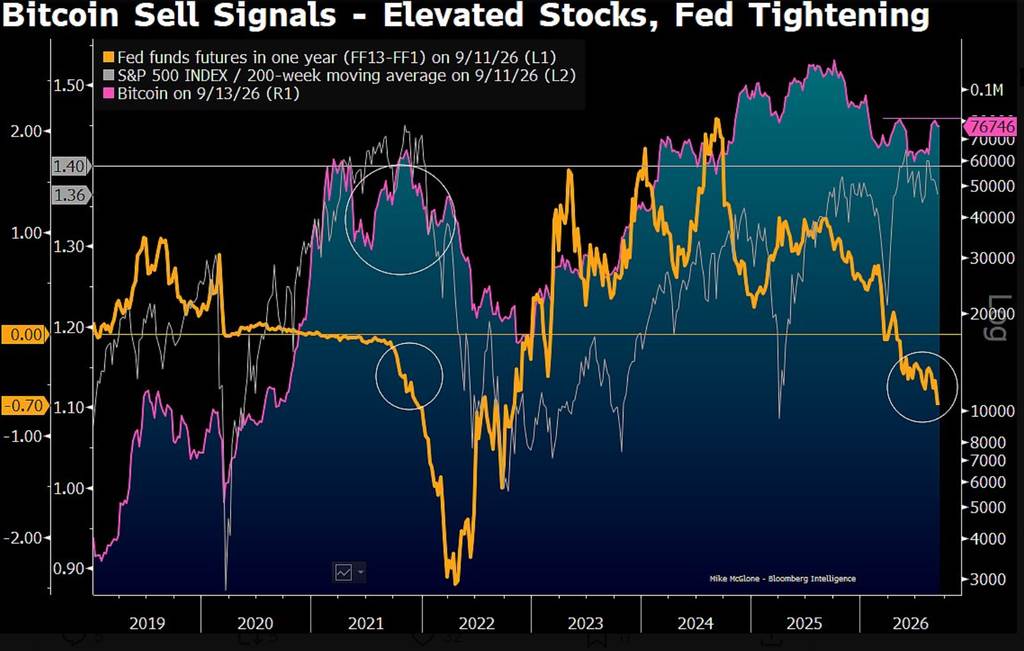
In his most pessimistic scenario, Bitcoin would follow a path towards its long-term key support level of $10,000. McGron firmly believes that based on the historical relationship between cryptocurrencies and broader risky assets, a continued 20% decline in the S & P 500 could trigger a deeper sell-off in Bitcoin.
According to CoinGecko data, Bitcoin traded at approximately US$77,300 on Sunday. To fall to $10,000, its price would have to plummet about 87%. At this price, Bitcoin's market value will fall to about $200 billion, compared with its current valuation of about $1.55 trillion. Since hitting a record high of $126,080 in October, Bitcoin has plunged about 38.6%.