Exchange Ranking
 Top Exchanges
 24h Volume Ranking
 Popularity Ranking
 Exchange BTC Balance
 Proof of Reserves
 Decentralized Exchanges
 Funding Rate
 Funding Heatmap
 Liquidation Data
 Max Pain
 Long/Short Ratio
 Whale L/S Ratio
 Binance/Okex/Huobi L/S
 Bitfinex Margin L/S
 ETF Tracker
 Solana ETF
 XRP ETF
 Hong Kong ETF
 Bitcoin Treasuries
 Crypto Reversal
 Ethereum Reserves
 HyperLiquid Wallet Analysis
 Hyperliquid Whale Watch
 Large Transactions
 On-chain Movement
 Bitcoin ROI
 Stablecoin Market Cap
 Options Analysis
 News
 Articles
 Economic Calendar
 Features
 Wallet
 Contract Calculator


 Security
 Collections
 Watchlist
 Following
 BTC
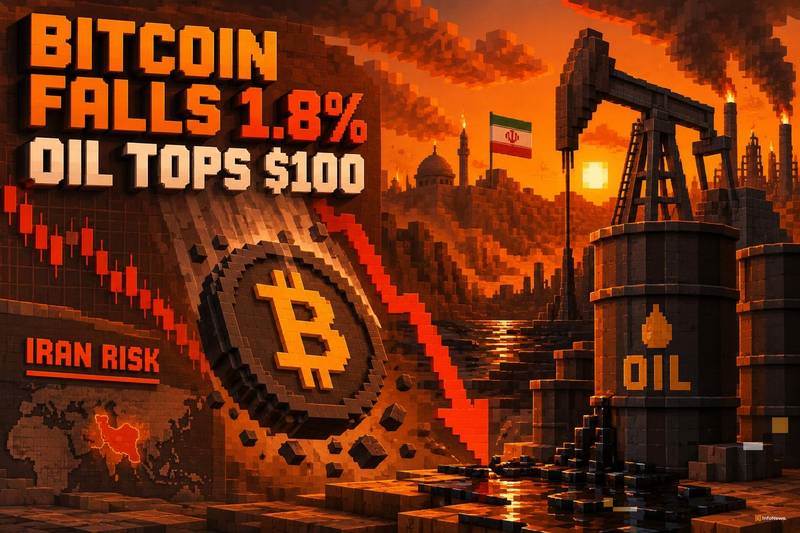
Oil prices exceeded the US$100 mark, and Iran's geopolitical risks intensified triggered a Bitcoin correction.
As international oil prices climbed above US$100 a barrel, Bitcoin prices fell by about 1.8%. Traders pointed to the escalation of geopolitical tensions related to Iran as a catalyst driving both market movements. The simultaneous decline in Bitcoin and the surge in crude oil prices highlight how macro risk events can produce a ripple effect between different asset classes, pushing up traditional commodity prices while also putting pressure on risk sentiment in the cryptocurrency market.
Linkage between oil prices exceeding the $100 mark and Bitcoin's decline
The headline combination of Bitcoin's decline and oil prices exceeding $100 reflects a common pattern when geopolitics shocks markets: investors reduce exposure to risky assets, while energy prices soar due to concerns about supply disruptions. Although Bitcoin's 1.8% decline is not significant alone, its weight cannot be ignored in the context of the sharp rise in commodities.
Oil prices exceeding $100 is a psychologically important threshold that historically has prompted caution in the broader market. When energy costs rise sharply, concerns about rising inflation and tightening monetary policy often follow. Since Bitcoin's trading performance is highly sensitive to macro liquidity conditions, it may face selling pressure. This dynamic also led to weakening demand for exchange-traded funds (ETFs) during previous periods of risk aversion.
伊朗风险如何连接石油波动与加密市场情绪
伊朗风险是此次油价飙升的直接驱动因素。中东地区的地缘政治紧张局势可能威胁供应链和生产路线,从而迅速推高原油价格。高企的油价反过来可能会加剧整个金融市场的广泛不确定性,而比特币也无法免受这种情绪转变的影响。
石油冲击与比特币之间的关系并非机械意义上的直接因果联系。相反,升高的地缘政治风险会将投资者推向被视为避险资产的领域,同时降低对波动性替代资产的偏好。历史上,比特币对与伊朗相关的油价波动的反应不一致,因此重要的是将此处的相关性视为背景信息,而非已确认的因果关系。此前在市场持续承受宏观压力期间,比特币曾跌破关键支撑位,类似的动力机制可能在当前环境中再次发挥作用。
此外值得注意的是,在剧烈的风险规避事件中,比特币的多头杠杆头寸非常脆弱。油价的快速飙升可能触发更广泛的去风险化行为,这可能会加速比特币的抛售,其幅度甚至超过仅由宏观变化本身所解释的程度。关注空头持仓活动的交易者会发现当前环境具有重要意义,因为与地缘政治事件相关的波动性激增往往会吸引投机性空头入场。
比特币观察者的关键要点
The two main signals are clear: Bitcoin has fallen by about 1.8%, and oil prices have exceeded $100, and the geopolitical background behind it is Iran risk. The figures in this report have not been independently verified by real-time market data, and readers should verify current prices through reliable channels before drawing a transaction conclusion.
The more lasting question for Bitcoin is whether the macro headwinds will persist. If oil prices remain above $100 and tensions in Iran escalate further, broader risk aversion may continue to suppress Bitcoin in the near term. Institutional capital flows-which can be tracked in part through ETF data-will be a clearer signal for whether professional buyers are entering or waiting, depending on the geopolitical situation.