Exchange Ranking
 Top Exchanges
 24h Volume Ranking
 Popularity Ranking
 Exchange BTC Balance
 Proof of Reserves
 Decentralized Exchanges
 Funding Rate
 Funding Heatmap
 Liquidation Data
 Max Pain
 Long/Short Ratio
 Whale L/S Ratio
 Binance/Okex/Huobi L/S
 Bitfinex Margin L/S
 ETF Tracker
 Solana ETF
 XRP ETF
 Hong Kong ETF
 Bitcoin Treasuries
 Crypto Reversal
 Ethereum Reserves
 HyperLiquid Wallet Analysis
 Hyperliquid Whale Watch
 Large Transactions
 On-chain Movement
 Bitcoin ROI
 Stablecoin Market Cap
 Options Analysis
 News
News Articles
 Economic Calendar
 Features
 Wallet
 Contract Calculator


 Security
 Collections
 Watchlist
 Following
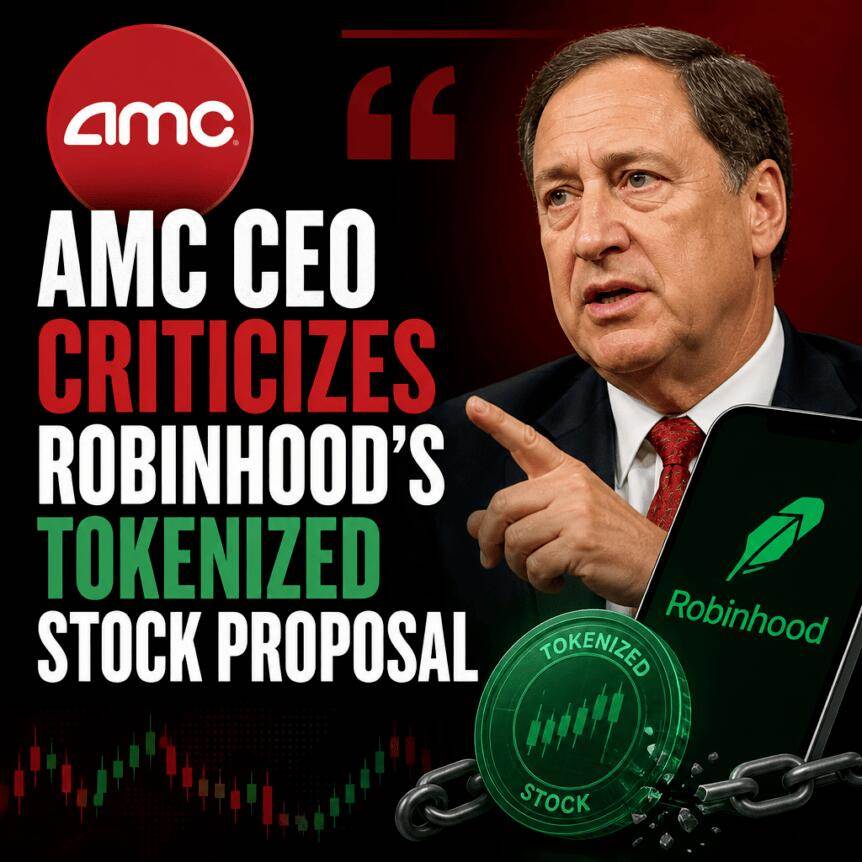
AMC CEO Adam Aron raises new questions about Robinhood's "tokenized stock" product
AMC Entertainment CEO Adam Aron recently raised new concerns about Robinhood's "tokenized stock" product. He pointed out that the products had no connection with AMC and said the company would hire external securities legal advisers to investigate the matter.
On Friday, Arón posted on Platform X (formerly Twitter), calling Robinhood's tokenized AMC exposure products "shocking" and emphasizing that Robinhood's stock tokens were not registered under U.S. securities laws. He also hinted that the products may not be available to U.S. investors and face additional restrictions in other jurisdictions such as Canada, Switzerland and the United Kingdom. The comments intensified the market's growing censorship focus on tokenized stocks-blockchain-based tools designed to track the value of traditionally listed stocks.
Core Points
- Adam Aron said Robinhood had "no connection" with AMC in its tokenized stock offering and was seeking review from external securities legal advisers.
- Arón described Robinhood's tokenized stock product as "shocking" and said it was not registered under U.S. securities laws.
- The criticism also pointed to potential cross-border distribution restrictions, naming Canada, Switzerland and the United Kingdom.
- The controversy comes amid rising tensions within the industry over tokenized stock activity, after some projects, including activities related to tokenized IPO visits, have been cancelled.
- Robinhood's tokenized stock plan has evolved from an early tokenized debt structure to an Ethereum Layer 2 ecosystem centered on Robinhood Chain.
Arón questions Robinhood's tokenized AMC exposure
Arón's comment is blunt: He told X users that Robinhood has no connection to AMC in terms of tokenized stock offerings designed to provide economic exposure to AMC stocks. He further said Robinhood would ask external securities legal advisers to conduct an investigation.
Although Arón's post did not elaborate on specific legal or operational details other than relevance and registration issues, he characterized the issue as a legal issue for investors-involving both corporate relationships and compliance with U.S. securities regulations. He also noted that these products "may not be available to U.S. investors" and are subject to regulations in multiple countries.
Robin co-founder and CEO Vlad Tenev publicly responded on the X platform, asking Arón to share his specific concerns about tokenized offerings. Robinhood reportedly did not issue a separate public statement.
What are "tokenized stocks"-Why regulators and issuers pay close attention to
Tokenized stock products are designed to provide economic exposure to traditional equity through the use of blockchain-based representation. In Robinhood's ecosystem, the company's early "stock tokens" were launched as tokenized debt securities issued by Robinhood Assets in Jersey and constructed as ERC-20 tokens.
Arón's criticism reflects a broader debate that has emerged in the tokenized asset market: Who is responsible for compliance? What level of legitimacy and disclosure do contemporary monetization tools need to achieve when they are linked to the performance of well-known listed companies? When issuers or executives claim a lack of connections, it also raises questions about branding, marketing and investor expectations-especially for the retail audience.
For investors, the key issue lies at the practical level: If tokenized products are not explicitly registered or handle them differently in each jurisdiction, the availability, settlement and redemption paths may not match what users assume from the "stock-like" packaging.
Wider boycott related to tokenized IPO activity
Arón's comments came in the wake of another high-profile controversy involving tokenized stock offerings linked to IPO access. Earlier this year, several large cryptocurrency exchanges reportedly canceled tokenized SpaceX IPO allocation activities, pointing to execution or delivery restrictions related to the transfer of underlying assets in some cases.
According to early reports cited in the article, multiple platforms, including Bybit, Binance, Bitget Wallet and MEXC, canceled tokenized SpaceX IPO activities after SpaceX began trading on Nasdaq. Several platforms attributed their decisions to their inability to deliver underlying assets related to xStocks, which is described as owned by Kraken.
The incident highlights the recurring fragility in the tokenized equity narrative: Even if tokenization is technically feasible, the compliance and mechanisms for delivering the reference securities-especially on time and in the right jurisdiction-may determine whether such products remain viable. AMC's situation may differ from IPO visit arrangements, but it highlights the same potential tensions between "token-as-stock" marketing and real-world legal and settlement constraints.
Robinhood's tokenization roadmap: From early tokens to Robinhood Chain
The article points out that Robinhood's first generation of stock tokens will be launched in July 2026 as a tokenized debt security issued by Robinhood Assets in Jersey, using ERC-20 tokens to represent economic exposure to underlying assets such as U.S. stocks and exchange-traded funds (ETFs).
The article also describes Robinhood's subsequent push to build an infrastructure capable of hosting tokenized assets. In February this year, Robinhood launched Robinhood Chain's public test network, an Ethereum Layer 2 network built using Arbitrum technology. Subsequently, in October 2025, Robinhood shared plans to tokenize nearly 500 U.S. stocks and ETFs on Arbitrum.
The article further pointed out that reports in July 2026 showed that Bernstein analysts raised their target price for Robinhood Markets, predicting that tokenized stocks and that the market will drive growth in the next phase rather than traditional cryptocurrency trading.
Taken together, this roadmap explains why this controversy is not just about AMC. If tokenized assets are intended to be a lasting product type for retail users, questions about issuer associations, regulatory registration status, and availability in jurisdictions may directly affect adoption rates, partnerships, and potential compliance strategies across the tokenization stack.
Follow-up matters of concern
Arón said Robinhood will involve external securities legal advisers, but market participants face immediate uncertainty about what the investigation will result and whether Robinhood will clarify the legal basis for its tokenized stock products. Readers should also pay attention to how other issuers, regulators, and intermediaries respond to the process of tokenized equity issuance moving from the pilot phase to wider deployment.