Exchange Ranking
 Top Exchanges
 24h Volume Ranking
 Popularity Ranking
 Exchange BTC Balance
 Proof of Reserves
 Decentralized Exchanges
 Funding Rate
 Funding Heatmap
 Liquidation Data
 Max Pain
 Long/Short Ratio
 Whale L/S Ratio
 Binance/Okex/Huobi L/S
 Bitfinex Margin L/S
 ETF Tracker
 Solana ETF
 XRP ETF
 Hong Kong ETF
 Bitcoin Treasuries
 Crypto Reversal
 Ethereum Reserves
 HyperLiquid Wallet Analysis
 Hyperliquid Whale Watch
 Large Transactions
 On-chain Movement
 Bitcoin ROI
 Stablecoin Market Cap
 Options Analysis
 News
News Articles
 Economic Calendar
 Features
 Wallet
 Contract Calculator


 Security
 Collections
 Watchlist
 Following
 BTC
BTC  ETH
ETH Key Facts
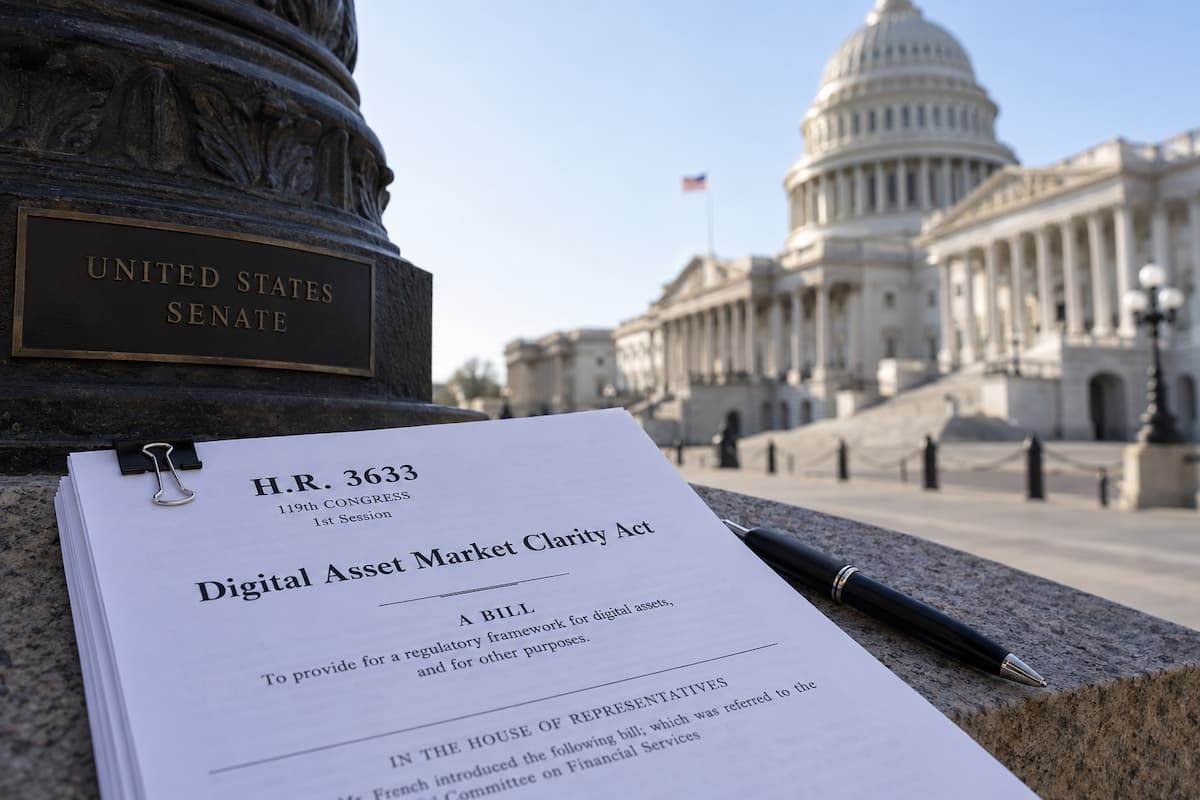
The latest draft amendment to the Digital Asset Market Clarity Act adjusts provisions covering decentralized finance (DeFi) and credit unions. The bill is officially numbered H.R. 3633, which had previously been passed in the House, is currently awaiting action by the Senate Banking Committee.
The Senate Banking Committee has previously advanced the bill through a partisan and bipartisan vote. Ahead of the upcoming Senate Banking Committee vote, the report, titled H.R. The Market Structure Act of 3633 adjusts its treatment of decentralized financial agreements and credit unions.
Since the bill was passed in the House, its core purpose has not changed: to clarify jurisdiction over digital assets between the Securities and Exchange Commission (SEC) and the Commodity Futures Trading Commission (CFTC). For most of the past, the two agencies have conducted sporadic litigation mainly through case-by-case enforcement actions to establish their respective regulatory scopes.
Why DeFi is the hardest part of the bill to write
Securities and commodity laws are based on the assumption that regulated entities, exchanges, brokers, or clearing houses are businesses with specific addresses and accountable executives. However, decentralized financial agreements are often just pieces of code deployed by teams that may have dissolved formal legal structures or handed over governance to a decentralized organization. Writing a law to determine when such agreements constitute regulated activities and when they are simply uncontrolled open source software is not a simple drafting detail; it is the most difficult conceptual issue that the entire bill must address, and it is a revised chapter in this amendment.
The committee's own article-by-article summary and public explanation of the bill's intentions both position legislation to protect registration activities while reserving space for unlicensed software. This distinction sounds clear in press releases, but it is extremely difficult to translate into enforceable legal provisions. The reason why credit unions were included in the draft is more specific: As more and more credit unions explore providing crypto custody or related services to members, lawmakers must decide whether credit union regulators or a new digital asset framework should govern these activities.
What the Senate actually votes on
The Senate Banking Committee has previously advanced an earlier version of the bill through partisan, bipartisan votes, which means the upcoming vote is not the bill's first test, but a checkpoint on a text that has already been revised once to get this far. The committee's vote on further amendments will not send the bill to the president for signature; it will send a specific version of the text to the full Senate, where further amendments are still possible.
The detail worth noting is not whether the bill will pass-which is usually done by committees with bipartisan sponsorship -but what the specific wording of DeFi and credit unions will be when the bill passes committee review. Because if the bill eventually becomes law, industry participants and regulators will actually have to operate on this text.