Exchange Ranking
 Top Exchanges
 24h Volume Ranking
 Popularity Ranking
 Exchange BTC Balance
 Proof of Reserves
 Decentralized Exchanges
 Funding Rate
 Funding Heatmap
 Liquidation Data
 Max Pain
 Long/Short Ratio
 Whale L/S Ratio
 Binance/Okex/Huobi L/S
 Bitfinex Margin L/S
 ETF Tracker
 Solana ETF
 XRP ETF
 Hong Kong ETF
 Bitcoin Treasuries
 Crypto Reversal
 Ethereum Reserves
 HyperLiquid Wallet Analysis
 Hyperliquid Whale Watch
 Large Transactions
 On-chain Movement
 Bitcoin ROI
 Stablecoin Market Cap
 Options Analysis
 News
News Articles
 Economic Calendar
 Features
 Wallet
 Contract Calculator


 Security
 Collections
 Watchlist
 Following
 SOL
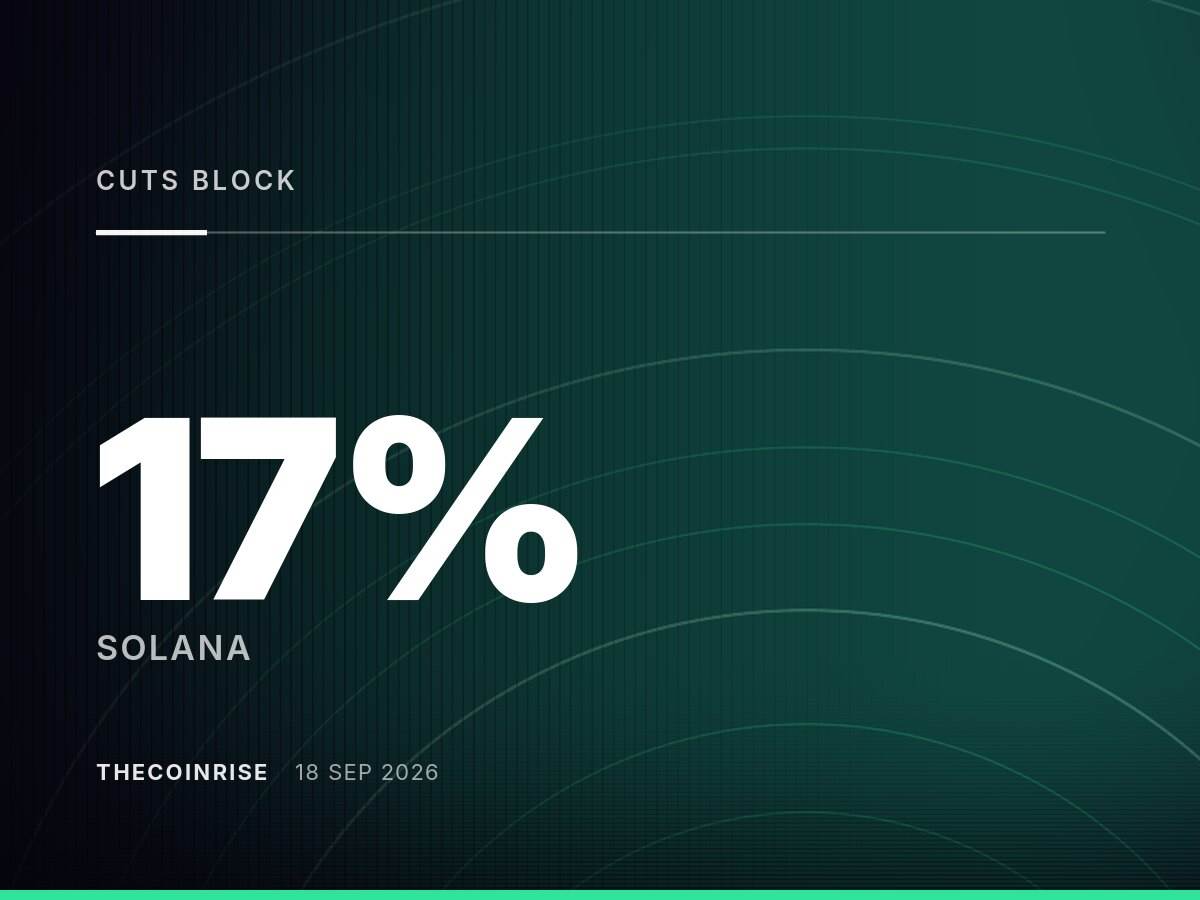
SOL Solana 将目标区块生成时间缩短至 250 毫秒,网络出块频率提升近 17%
Solana 已将其目标槽位(Slot)时间从 300 毫秒缩减至 250 毫秒。这一调整使网络的出块率提升了近 17%,达到每秒四个目标槽位,但并未同比例提高整体处理能力上限。
关键变更与影响
此次时钟频率的加快,将每个验证者作为领导者连续管理四个槽位的窗口期从原来的 1.2 秒缩短为 1 秒。尽管出块速度加快,但由于随着槽位持续时间减少,计算和数据限制也相应降低,Solana 的整体处理能力大致保持不变。
在 250 毫秒的新设定下,预期的 Solana 纪元(Epoch)时长从大约 36 小时缩短至 30 小时。若最终降至 200 毫秒,网络将达到每秒五个目标槽位,但目前尚未确定主网激活日期。
分阶段实施策略
根据区块链数据,新设置已于 9 月 18 日生效。相比之前 300 毫秒配置下的约每秒 3.3 个槽位,当前配置实现了更频繁的更新。该变更是 SIMD-0525 提案的第三阶段,旨在将网络原始设定的 400 毫秒逐步降低至最终的 200 毫秒目标。
“槽位”是指指定验证者可以生成区块的时间段。缩短这一时间段,使得钱包、交易所和交易应用能够更频繁地获取网络状态的最新信息。验证者继续担任连续四个槽位的领导者,但在 250 毫秒的目标下,其名义上的领导窗口已从之前的 1.2 秒降至 1 秒。
Solana 于今年 8 月开始当前的部署,首次将槽位时间从 400 毫秒降至 350 毫秒。SIMD-0525 将这一过程分为四个阶段:350 毫秒、300 毫秒、250 毫秒和 200 毫秒,而非直接跳至最终目标。每次缩减都需要单独激活功能,允许开发者和验证者运营商在推进之前评估网络性能。
对应用层的影响
在 250 毫秒的设定下,每秒会出现四次槽位机会。更短的间隔可以让应用程序获得更实时的交易和网络状态视图,并更快地将区块生产权从一个验证者转移给另一个验证者。基于预言机的市场和自动做市商(AMM)等应用也在提案覆盖范围内,因为它们的运作可能依赖于链上数据的时效性。更短的间隔减少了网络更新之间的时间,使用户能更早看到交易状态的变化。
对于兑换操作,更短的时间间隔可以缩小交易提交到进入网络之间的时段。相关提案指出,更快的确认速度和更频繁的更新是缩短槽位持续时间的益处。
容量与基础设施调整
It should be noted that this change did not increase Solana's raw trading capacity by nearly 17%. Under the SIMD-0525 framework, resource constraints are reduced in proportion to slot duration. Although more slots are generated in a given period of time, each slot is allowed to carry a reduced amount of calculations and data, thereby keeping the total amount of work processed in real time by the network at roughly the same level.
In the proposal based on 60 million units of account, the per-slot limit accelerates and decreases with time. The 250-millisecond configuration corresponds to a per-slot limit of 37.5 million units of calculation, and the planned 200-millisecond phase will be further reduced to 30 million.
Faster blocks have changed Solana's infrastructure requirements. Although the wall clock processing cap remains largely unchanged, infrastructure providers now need to process and store more individual blocks. Applications that calculate elapsed time by multiplying it by a fixed slot duration may need to adapt to a faster clock. As slots advance rapidly, the validity period of block hashes in real time is shortened, leaving less time for transaction processes involving offline signatures or delayed manual approvals.
The era timing has also changed for the same reason. Solana fixes each era to 432,000 slots, so as the length of each slot shortens, the era becomes shorter. Under the previous 300-millisecond goal, an era was about 36 hours long; the 250-millisecond setting reduced its expected duration to about 30 hours. If we move to the final 200-millisecond target, it will be further shortened to approximately 24 hours.
Security mechanisms and subsequent upgrades
Solana 的分阶段槽位缩减是 Agave 4.2 版本发布的一部分。该客户端版本自 8 月起开始激活多项网络变更,包括降低链上存储租金、支持更大交易以及迈向 200 毫秒槽位的路径。
分阶段设计包含与区块跳过率挂钩的安全机制。如果区块跳过率上升到开发者认为不可接受的水平,向下一个槽位设置的进展可能会暂停,这给予验证者在每种配置下运行的时间,然后再激活另一次缩减。目前,200 毫秒阶段尚未设定主网激活日期。
除了更快的槽位外,Solana 的升级还包括其他内容。Solana 还引入了 Transaction V1,将最大序列化交易大小从 1,232 字节提升至 4,096 字节。这种更大的交易格式可以在单个交易中容纳数据密集型操作,如零知识证明和复杂的多重签名指令。Transaction V1 是可选的,传统和版本零交易仍受支持。读取区块的应用程序需要支持较新的格式以正确处理 V1 交易。
交易大小的增加与 SIMD-0525 无关。因此,较大的独立交易不决定槽位时钟,而较短的槽位也不会自动增加交易的最大尺寸。Solana 一直通过功能门独立激活这些更改,这种结构允许一项升级在不要求 Agave 4.2 中包含的其他功能同时激活的情况下进行。
未来展望:Alpenglow 共识升级
The final phase of SIMD-0525 will reduce the target slot time from 250 milliseconds to 200 milliseconds, bringing the network to five target slots per second. As a result, the validator leadership window for the four slots will drop to approximately 800 milliseconds, and the era duration will drop from approximately 30 hours at the current 250-millisecond setting to approximately 24 hours. Solana developers have not yet provided a final reduced mainnet activation date, and progress depends on network behavior under current settings, including whether verifiers can maintain acceptable block skipping rates.
Slot reduction is separate from the consensus redesign in the Alpenglow project. Alpenglow aims to replace TowerBFT with a voting system called Votor and remove on-chain voting transactions from the network's core consensus process. The goal of the Alpenglow consensus upgrade is to achieve final certainty of approximately 150 milliseconds. The code has been included in testing, and the mainnet deployment has been bundled with Agave 4.3 rather than the slot time function gate used for SIMD-0525.
Alpenglow entered the community verifier testing phase in early 2026, allowing operators to run consensus designs on test clusters before mainnetwork deployment. Anza described the system as the largest consensus change in Solana's history. For SIMD-0525, the network is still in the 250-millisecond phase until the developer activates the final function gate. The 200-millisecond configuration will complete the deployment process starting at 400 milliseconds, going through 350 milliseconds, 300 milliseconds, and 250 milliseconds, and reducing resource constraints at each step.