Exchange Ranking
 Top Exchanges
 24h Volume Ranking
 Popularity Ranking
 Exchange BTC Balance
 Proof of Reserves
 Decentralized Exchanges
 Funding Rate
 Funding Heatmap
 Liquidation Data
 Max Pain
 Long/Short Ratio
 Whale L/S Ratio
 Binance/Okex/Huobi L/S
 Bitfinex Margin L/S
 ETF Tracker
 Solana ETF
 XRP ETF
 Hong Kong ETF
 Bitcoin Treasuries
 Crypto Reversal
 Ethereum Reserves
 HyperLiquid Wallet Analysis
 Hyperliquid Whale Watch
 Large Transactions
 On-chain Movement
 Bitcoin ROI
 Stablecoin Market Cap
 Options Analysis
 News
 Articles
 Economic Calendar
 Features
 Wallet
 Contract Calculator


 Security
 Collections
 Watchlist
 Following
 BTC
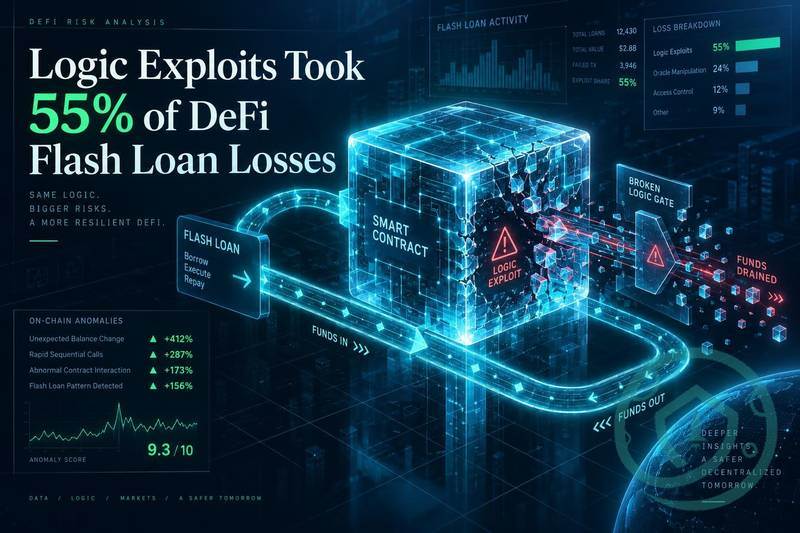
Logic vulnerabilities have accounted for 55% of DeFi's lightning loan losses, surpassing price manipulation and becoming the main attack vector for on-chain lending agreements.
Logic Exploits account for 55%, surpassing price manipulation and becoming the most important attack method in on-chain lending agreements. The replacement of this category marks a structural shift in the way opponents use flash lending: from disrupting the market to internal mechanisms for smart contract codes.
Lightning loans, which allow unsecured borrowing within a single transaction block, have long been used to amplify two different types of attacks. Price manipulation attacks use Oracle dependencies to temporarily distort asset prices to liquidate under-collateralized positions. In contrast, the logic flaw targets flaws in the protocol's own execution path, using borrowed funds to trigger unexpected state changes in the smart contract code.
This majority share of logic vulnerabilities at 55% suggests that opponents are increasingly analyzing bytecode and business logic rather than just manipulating price data sources. This has a direct impact on protocol auditors, security tools, and distributed artificial intelligence systems that model risks along the chain, because the attack surface is now more dispersed and difficult to detect by monitoring oracles alone.
Meaning of 55% share
Logical vulnerabilities account for the majority of attribution means that in terms of total losses from lightning loan-related events, flaws in protocol design or implementation outweigh data source manipulation as loss drivers. Price manipulation attacks rely on weak liquidity or poor oracle integration design; logic holes only require the presence of a reachable code path in the contract, allowing borrowed funds to trigger unexpected results, such as reentry, accounting errors, or improperly configured access controls.
A DeFi Cross-Chain Bridge vulnerability case minted 46 billion fake BTC tokens, which illustrates how logical flaws rather than market conditions can lead to catastrophic losses when contract verification constraints are insufficient.
The difference between logic vulnerabilities and price manipulation
Price manipulation attacks occur at the boundary between the protocol and its data input; logic vulnerabilities occur within the protocol. Defences against price manipulation, such as time-weighted average price oracles and circuit breakers, do not solve the problems on which logic loopholes such as reentry errors, integer overflow paths, or flawed reward accounting rely. Treating these two types of attacks as equivalent can lead to a mismatch in security spending.
Regulators are also paying increasing attention to chain risks. Frameworks such as those being considered in the Commodity Futures Trading Commission's (CFTC) proposed federal crypto rulebook may in the future require protocols to prove that formal verification or independent audits are a condition for compliance, making the importance of logical vulnerability detection even further enhanced.
这一转变对协议安全的意义
为何协议逻辑应获得更多防御关注
当逻辑漏洞代表主要的损失类别时,主要风险表面是合约本身,而非外部条件。如果安全审查主要集中在预言机操纵、流动性深度或市场结构上,将会系统地低估这种暴露风险。形式化验证、不变量测试以及针对意外执行路径的模糊测试(Fuzzing),比在价格操纵主导时期成为了更高优先级的投资。
评估协议安全性的链上AI风险模型需要更重地加权逻辑审计的最新程度和覆盖范围。对于建立在DeFi原语之上的分布式AI基础设施而言,底层借贷市场中的逻辑漏洞暴露代表了一种复合风险层。
如何解读风险对比
类别的交叉并不意味着价格操纵不再是可行的攻击向量;它仅意味着在累计损失方面,逻辑漏洞造成了更大的累积损害。这两种向量仍然活跃,并会继续出现在相同的协议中。实际的启示是,安全框架和审计范围应反映向逻辑分析倾斜55/45权重的比例,而不是将这两类视为等同。
对于协议团队、为DeFi风险定价的保险公司以及做出自动化链上分配决策的AI代理而言,55%这一数字是一个校准信号:当前的主要威胁存在于代码内部,而非市场外部。
要点总结
- 逻辑漏洞占DeFi闪电贷损失的55%,超越价格操纵成为首要损失类别。
- 这一类别的更替表明,对手正针对智能合约执行路径,而非主要依赖预言机操纵。
- 为了匹配转变后的威胁格局,安全审计、链上风险模型和监管合规框架需要更重地加权逻辑漏洞检测。