
 Exchange Ranking
 Top Exchanges
 24h Volume Ranking
 Popularity Ranking
 Exchange BTC Balance
 Proof of Reserves
 Decentralized Exchanges
 Funding Rate
 Funding Heatmap
 Liquidation Data
 Max Pain
 Long/Short Ratio
 Whale L/S Ratio
 Binance/Okex/Huobi L/S
 Bitfinex Margin L/S
 ETF Tracker
 Solana ETF
 XRP ETF
 Hong Kong ETF
 Bitcoin Treasuries
 Crypto Reversal
 Ethereum Reserves
 HyperLiquid Wallet Analysis
 Hyperliquid Whale Watch
 Large Transactions
 On-chain Movement
 Bitcoin ROI
 Stablecoin Market Cap
 Options Analysis
 News
News Articles
 Economic Calendar
 Features
 Wallet
 Contract Calculator


 Security
 Collections
 Watchlist
 Following
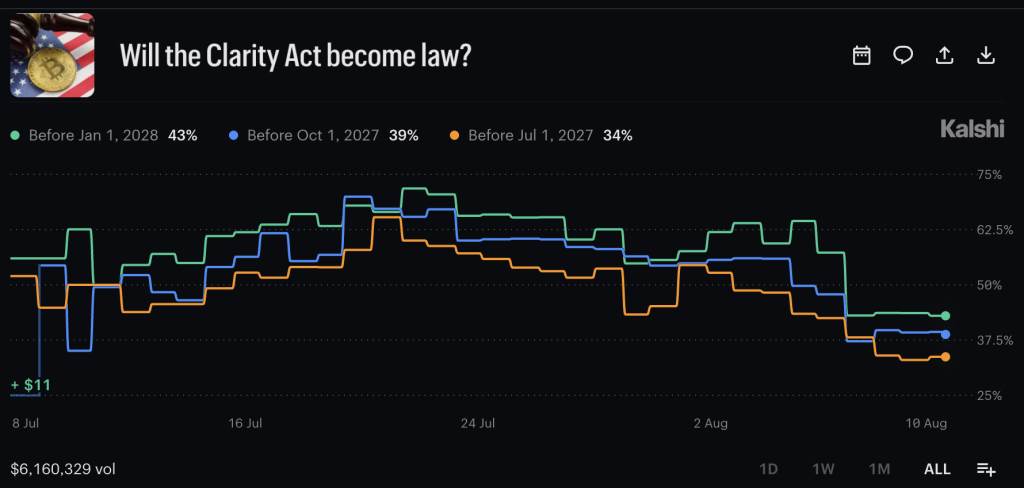
Senate Majority Leader John Thune filed a closing debate motion early Saturday morning involving H.R. 3633 Digital Asset Markets Clarity Act. The move comes on the eve of the Senate's August recess, officially pushing the crypto market structure bill to the agenda after it resumes on September 14. Currently, Kalshi predicts that the probability of the bill passing in September has dropped below 40%.
Filing a closing debate motion does not guarantee passage of the bill, but replaces a target date that has been shifting for months with a fixed procedural event: a closing debate vote that requires the consent of 60 senators to advance. The move is significant because the Senate has previously missed a deadline.
Lawmakers were unable to bring the bill for consideration before the August recess because Democrats refused to provide the unanimous consent needed to speed up the proceedings. The setback narrowed the legislative window ahead of November's midterm elections. Thun's closing debate motion means that the leadership will go directly to the vote counting stage in September without having to spend extra sessions to schedule votes.
Senator Cynthia Loomis, the bill's lead sponsor in the Senate, said Thun's motion "clears the way for a clear bill." Her statement highlighted the key change: The issue is no longer whether the Senate will schedule a vote, but whether Republicans can win enough Democratic votes to pass the bill.
Clear bill Senate vote: September schedule confirmation and outstanding clauses
Closing debate on the motion to advance is a narrow procedural step that requires three-fifths, or 60 votes, of the Senate. That means the 53-seat Republican Party needs at least seven Democrats to start the debate.
Meeting this threshold only opens the bill's deliberations and does not resolve the controversy that has persisted since the Senate Banking Committee passed the bill 15 - 9 in May.
The bill (H.R. 3633) aims to establish a federal regulatory framework for digital assets, dividing regulatory authority between the U.S. Securities and Exchange Commission (SEC) and the Commodity Futures Trading Commission (CFTC), thereby moving away from a case-by-case cryptocurrency regulatory model.
Controversial details in the Senate revised text include the stablecoin reward mechanism. The latest proposal would ban incentives for idle stablecoin balances but allow transaction-based incentives, sparking tensions between banks and stablecoin issuers.
With Kalshi's forecast clear bill's probability of passage in September dropping from 41% to 39%, the September 15 meeting seems unlikely to bring a much-needed breakthrough. Currently, 43% of bettors are betting that the bill will be passed before January 1, 2028.
If it is delayed until 2028, it could have a disastrous impact on the crypto market, as many analysts believe passing the clarity bill will ignite the next bull market.
September Clear Bill Vote and 60-Vote Alliance: Which Democrats, Republicans, Banks and Crypto Companies Decide the Outcome
The calculation of votes needed to pass the bill is clear but challenging. Republicans need seven Democratic votes to pass the closing debate, and the White House views September 15 as a critical juncture.
The Democratic Party is mainly concerned about consumer protection, illegal financial enforcement, and whether government officials can hold commercial interests in cryptocurrencies. A bipartisan proposal that could require President Trump to divest his cryptocurrency investments would affect Democratic support.
Banks and crypto companies disagree on stablecoin rewards. Banks want to treat rewards as deposits to protect their franchises, while crypto issuers believe this will weaken their competitiveness.
Coinbase CEO Brian Armstrong expressed industry dissatisfaction with the Senate's recent inaction on a clear bill, urging lawmakers to complete the process in September to avoid further delays.
Crypto Market Structural Impact: What does the September vote mean for exchanges, stablecoins, DeFi and U.S. Capital Market Infrastructure
Where will the bill go after the August recess?
Clarifying the core jurisdiction of the SEC and CFTC will have an impact on the listing and compliance of exchanges. A clear division will allow the platform to classify tokens based on legal standards, thereby reducing delisting and litigation risks. However, the bill still needs to go through a final debate and a final vote, which is not inevitable.
For stablecoin issuers, the Section 404 compromise distinguishes allowed transaction-related incentives from deposit-based gains, which could force issuers that focus on income-based products to restructure. In contrast, issuers that emphasize payment speed may face limited impact.
The DeFi protocol faces significant uncertainties because the regulatory treatment of unmanaged activities has not yet been clarified. If current DeFi terms are passed, registration or disclosure requirements could be imposed on agreements that are not regulated by the SEC or CFTC. Investors should view September as a guide rather than a final result, as amendments, delays and failures can still occur.
Things to focus on before September: Amendments, Senate vote counting, and House coordination
The most direct indicator is the closing debate vote after the Senate resumes on September 14. On the eve of the vote, party votes reported by named senators and staff will show whether Republicans have secured the seven Democratic votes they need, especially on the presidential spin-off clause for which Democrats are a condition.
Even if the closing debate vote and Senate passage are successful, the process is still not over. Because the Senate has voted on the H.R. Version 3633 has been revised, and the two houses still need to reconcile divergent texts before submitting the final bill to the president for signature. Regardless of the outcome of the closing debate vote, this step may continue beyond September.
In contrast, failure to secure 60 votes would seriously jeopardize the bill's remaining path in the 2026 term because of the increasingly tight legislative schedule ahead of the midterm elections.
























