Exchange Ranking
 Top Exchanges
 24h Volume Ranking
 Popularity Ranking
 Exchange BTC Balance
 Proof of Reserves
 Decentralized Exchanges
 Funding Rate
 Funding Heatmap
 Liquidation Data
 Max Pain
 Long/Short Ratio
 Whale L/S Ratio
 Binance/Okex/Huobi L/S
 Bitfinex Margin L/S
 ETF Tracker
 Solana ETF
 XRP ETF
 Hong Kong ETF
 Bitcoin Treasuries
 Crypto Reversal
 Ethereum Reserves
 HyperLiquid Wallet Analysis
 Hyperliquid Whale Watch
 Large Transactions
 On-chain Movement
 Bitcoin ROI
 Stablecoin Market Cap
 Options Analysis
 News
News Articles
 Economic Calendar
 Features
 Wallet
 Contract Calculator


 Security
 Collections
 Watchlist
 Following
 BTC
BTC  ETH
ETH  SOL
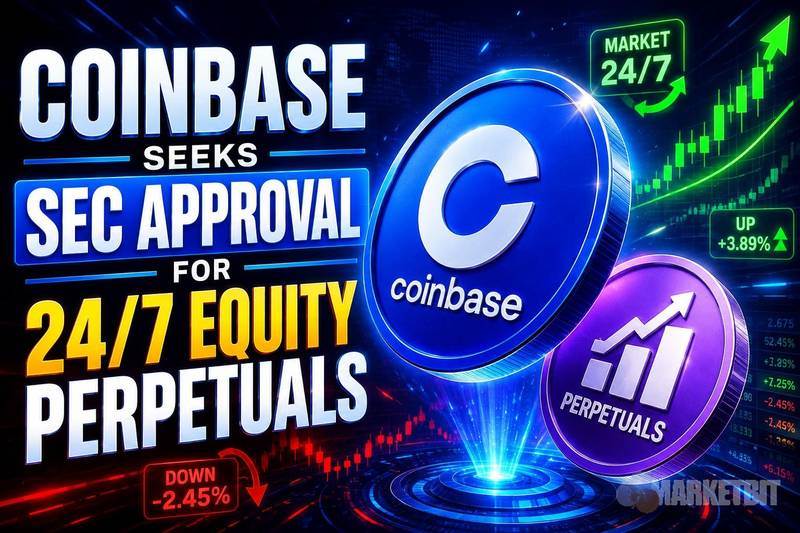
SOL Coinbase filed an SEC notice to register plans to launch individual stock perpetual contracts in the United States.
Coinbase filed two U.S. Securities and Exchange Commission (SEC) notice registration documents on September 1, aiming to introduce individual stock perpetual contracts into the U.S. market through its regulated derivatives exchanges and brokers.
Abstract
Coinbase Derivatives filed Form 1-N to apply to be registered as a securities and futures exchange. Coinbase Financial Markets filed a Form BD-N to apply to register as a limited purpose securities and futures broker and dealer. The documents did not provide a launch date, a list of supporting stocks or proposed leverage limits. Individual stock futures fall under the joint supervision of the SEC and the U.S. Commodity Futures Trading Commission (CFTC).
Coinbase said in a September 3 post that it is working to provide individual stock perpetual contracts in the United States after filing SEC notices for registration of its two regulated derivatives businesses. "We are working hard to bring individual stock perpetual contracts to the United States," the company said. The accompanying documents show that Coinbase Derivatives, LLC filed Form 1-N and Coinbase Financial Markets, Inc. filed Form BD-N. Both notices were filed on September 1.
According to the company, it plans to work with the SEC and CFTC to introduce more financial products to the U.S. market. Coinbase did not announce when the transaction would begin, nor did it clarify which listed companies might be the underlying assets.
Coinbase document establishes dual regulatory path for SEC-CFTC
Under SEC rules, Form 1-N allows exchanges regulated by the CFTC to register with the SEC for the sole purpose of trading securities futures products. According to company regulatory disclosures, Coinbase Derivatives has been operating as a CFTC designated contract market since 2020. The SEC's Form 1-N statement states that the notice provides regulators with information about the exchange's ownership, operations, rules, trading systems and disciplinary procedures. Filing the filing will not transform Coinbase Derivatives into a general stock exchange such as Nasdaq or the New York Stock Exchange.
In terms of brokerage business, the SEC's Form BD-N allows eligible CFTC registrants to register as broker-dealers for trading securities futures only. SEC rules require applicants to be registered with the CFTC as a futures commission dealer or introducing broker and hold membership in the American Futures Industry Association or other qualified association. Coinbase Financial Markets is registered with the CFTC as a futures commission dealer. Its new notice will support clients in accessing listed securities futures through the associated Coinbase Derivatives exchange.
Futures on single securities and narrow-base stock indices are classified as securities futures products under CFTC regulations. Such contracts have both securities and futures characteristics and are therefore jointly regulated by the SEC and CFTC. As a result, the two documents cover different functions: Coinbase Derivatives will provide a market where contracts are listed, and Coinbase Financial Markets will serve as a regulated customer intermediary. Neither of the two documents shown in the announcement contained contract terms and did not confirm final approval for the commercial launch.
Individual stock perpetual contracts will expand existing overseas products
According to an announcement from the Coinbase International Exchange, the company launched equity perpetual futures to qualified customers outside the United States in March. U.S. users are explicitly prohibited from using the service. The first international options provide synthetic exposure to Apple, Microsoft, Alphabet, Amazon, Nvidia, Meta and Tesla. Coinbase also listed contracts linked to SPY and QQQ exchange-traded funds, which track the S & P 500 and Nasdaq 100 respectively.
According to Coinbase, international stock contracts trade continuously, including weekends, initially providing leverage of up to 10 times. ETF perpetual contracts provide leverage of up to 20 times, positions are settled in USDC, and can be cross-margin with other spot and perpetual positions. Perpetual futures differ from standard futures in that they do not have a fixed maturity date. Coinbase's international products use a funding mechanism to bring contract prices closer to the value of its reference asset, allowing traders to maintain leveraged long or short positions without having to buy the underlying stock.
Terms used outside the U.S. should not be considered a confirmed specification for the proposed U.S. product. Coinbase has not said whether its domestic contracts will be traded around the clock, settled in USDC, or subject to the same leverage limits. The company also did not confirm whether its first U.S. product lineup matched the seven technology stocks offered internationally. For U.S. traders, the proposed contract would provide exposure to derivatives rather than ownership of the underlying stock. Coinbase's international product description states that perpetual holders of shares do not enjoy shareholder rights, such as voting rights, associated with the underlying securities.
Coinbase expands regulated derivatives services
These registration notices were released following multiple additions to Coinbase's derivatives business in 2026. In May, CFTC staff granted Coinbase Financial Markets regulatory relief involving qualified U.S. institutions accessing certain derivatives listed on the offshore platform Deribit acquired by Coinbase. In June, the United States approved Coinbase to provide access to global crypto perpetual futures. CEO Brian Armstrong said at the time that it would take years of regulatory work to open up a compliance path for U.S. customers to enter a market that is mainly overseas.
Coinbase has also entered other national markets. On September 2, the company launched 23 futures for eligible Canadian investors, covering perpetual and term contracts linked to Bitcoin, Ethereum, Solana and 20 other crypto assets. Supported Canadian products provide up to 10 times leverage.
Company market data shows that as of September 3, Coinbase Derivatives '24-hour trading volume was approximately US$1.75 billion, while Coinbase International Exchange was approximately US$9.7 billion. Coinbase's data covers all derivatives activity on each exchange and does not separately list the trading volume of equity perpetual contracts.
Perpetual contracts are still controversial in the United States
Coinbase's equity product plan comes as U.S. courts and regulators are still considering how certain perpetual contracts should be classified. In June, CME Group sued the CFTC, alleging the regulator's handling of crypto perpetual contracts offered through platforms including Coinbase and Kalshi. According to CME's complaint, perpetual contracts meet the definition of swaps under the Dodd-Frank Act and should not be regulated as ordinary futures. The exchange operator accused the CFTC of deviating from its past practices and bypassing procedures required for swap products. According to court reports, the CFTC rejected CME's position and called the case "meaningless." There is currently no final ruling that will invalidate regulators 'existing crypto-perpetual contract path.
CFTC officials have individually identified leverage, funding rate fluctuations, manipulation and price convergence as possible risks to sustainable markets. In a speech in June 2025, then-acting chairman Caroline Pham said some commentators questioned whether contracts with no expiration dates could perform the risk management and price discovery functions associated with traditional futures. Equity perpetual contracts may also raise additional trading hours concerns because these contracts may remain active when the stock exchange to which they refer is closed. Coinbase's international risk disclosure warns that equity perpetual contracts involve liquidity, execution and price volatility risks, especially outside regular stock market trading hours.
The September 1 notice did not specify whether the U.S. contract was operating continuously or suspended at the close of the underlying stock market. Coinbase also did not disclose proposed funding calculations, position limits, margin requirements, clearing arrangements or safeguards in the event of a lack of fresh stock prices.