Exchange Ranking
 Top Exchanges
 24h Volume Ranking
 Popularity Ranking
 Exchange BTC Balance
 Proof of Reserves
 Decentralized Exchanges
 Funding Rate
 Funding Heatmap
 Liquidation Data
 Max Pain
 Long/Short Ratio
 Whale L/S Ratio
 Binance/Okex/Huobi L/S
 Bitfinex Margin L/S
 ETF Tracker
 Solana ETF
 XRP ETF
 Hong Kong ETF
 Bitcoin Treasuries
 Crypto Reversal
 Ethereum Reserves
 HyperLiquid Wallet Analysis
 Hyperliquid Whale Watch
 Large Transactions
 On-chain Movement
 Bitcoin ROI
 Stablecoin Market Cap
 Options Analysis
 News
News Articles
 Economic Calendar
 Features
 Wallet
 Contract Calculator


 Security
 Collections
 Watchlist
 Following
 BTC
BTC stablecoin dynamics: Bank of Korea points out that demand for dollar-pegged stablecoin weakens its currency
In the latest stablecoin news, Bank of Korea (BOK) stated on September 3, 2026 that increased demand for dollar-pegged stablecoin may cause the local currency to weaken against the US dollar. This conclusion comes from "Bank of Korea Issues Notes No. 2026-22" written by researchers Kim Ji-hyun and Cho Sang-heum.
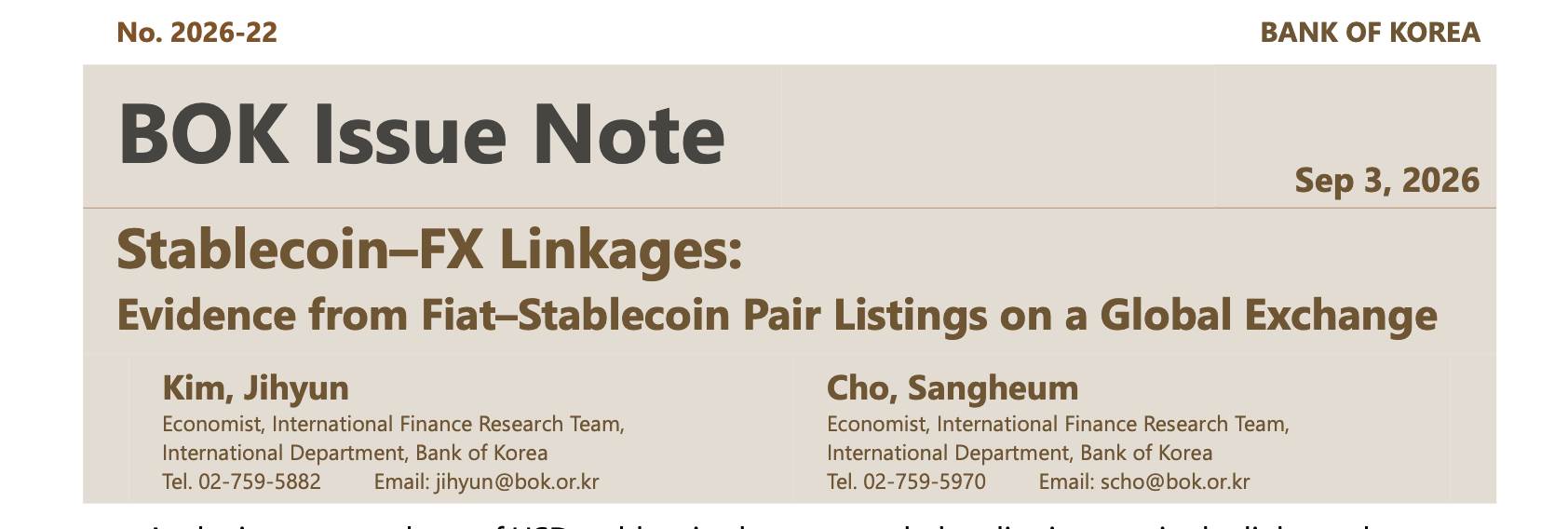 As of September 6, 2026, this has become the major cryptocurrency news that has attracted much attention today because it connects daily purchases of USDT and USDC to the devaluation of the actual currency.
What did the Bank of Korea stablecoin study discover?
This 2026 stablecoin study by the Bank of Korea tracks exchange rate premiums around Binance fiat trading pairs. When Binance launched a trading pair of the euro and Turkish lira pegged to the dollar in stablecoins, the premiums of the USDT and USDC relative to the real dollar value fell by 0.33 to 0.38 percentage points. Subsequently, higher premiums began to correlate with local currency devaluations, which had been almost non-existent before.
mainly found that
- Binan's fiat trading pairs reduced the exchange rate premium by 0.33 to 0.38 percentage points.
- The subsequent higher premium was consistent with the devaluation of the local currency.
- The Bitcoin search shock increased South Korea's premium by approximately 0.85 percentage points, showing a clear Bitcoin search interest effect.
- As of now, news on the exchange rate of the Korean Won against the US dollar has not shown a statistically significant change.
- Since 2022, the Median value of the premium of the Korean won against USDT is approximately 1.67%, ranking among the highest among the 30 currencies studied.
How does purchasing USDT affect the local currency?
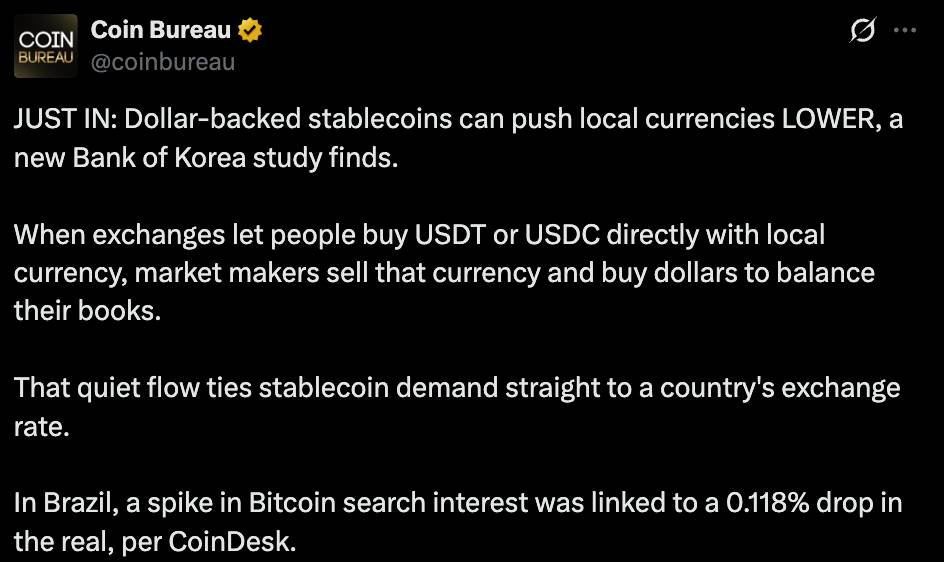
The mechanism is implemented through market makers. When buyers buy USDT or USDC in their local currency, market makers sell these stablecoins and buy U.S. dollars to balance the accounts. This demand for dollar stablecoins quietly translates into real dollar purchases, and this is the impact the Bank of Korea is currently directly measuring.
Does demand weaken the currency? Brazil case
Brazil is currently the clearest case. Buyers there can directly use the real to buy stablecoins in Binance, so demand translates into actual dollar purchases. According to CoinDesk, the surge in interest in Bitcoin searches is related to the depreciation of the real by approximately 0.12% against the U.S. dollar. Coin Bureau also reported the stablecoin news in a tweet.
 Impact of USDT and USDC on exchange rates: South Korea's current case
Bank of Korea remains a key reference for today's stablecoin news, as South Korea does not yet have a direct Korean Won-stablecoin trading pairs on global exchanges. As of September 3, 2026, based on the official daily reference price, the exchange rate of the Korean won against the US dollar is close to 1,576. This is exactly the context in which Bitcoin searches are linked to money that researchers are trying to measure.
Market snapshot
Changes in market premiums, currencies reflect the euro, Turkish lira trading pair-0.33 to-0.38 percentage points followed by devaluation South Korea (no trading pair)+0.85 percentage points (Bitcoin search shock) No significant change in the Korean won, Brazil had direct real trading, devalued approximately 0.12% against the real Pressure on the local currency by stablecoin market makers
Many traders asked "Why is my currency falling?" According to researchers at the Bank of Korea, this part of the answer is already visible. They see this as an impact that the foreign exchange market has on the cryptocurrency market can no longer be ignored. As central bank research increases around USDT prices and USDC news, regulators are paying close attention to whether monetary pressures from crypto demand will add to policy complexity.
Expert Opinion
Market analysts said this adds new evidence that dollar-pegged stablecoins may not remain neutral to the foreign exchange market once local currency access becomes easier. If South Korea allows the opening of won-U.S. dollar trading pairs on major exchanges, the impact could be closer to Brazil's model. The researchers pointed out that their views are personal and do not represent the official policy of the Bank of Korea.
Disclaimer : This article involves central bank research and does not constitute financial or investment advice. Currency and cryptocurrency markets are risky and readers should conduct independent research before making decisions.