Exchange Ranking
 Top Exchanges
 24h Volume Ranking
 Popularity Ranking
 Exchange BTC Balance
 Proof of Reserves
 Decentralized Exchanges
 Funding Rate
 Funding Heatmap
 Liquidation Data
 Max Pain
 Long/Short Ratio
 Whale L/S Ratio
 Binance/Okex/Huobi L/S
 Bitfinex Margin L/S
 ETF Tracker
 Solana ETF
 XRP ETF
 Hong Kong ETF
 Bitcoin Treasuries
 Crypto Reversal
 Ethereum Reserves
 HyperLiquid Wallet Analysis
 Hyperliquid Whale Watch
 Large Transactions
 On-chain Movement
 Bitcoin ROI
 Stablecoin Market Cap
 Options Analysis
 News
News Articles
 Economic Calendar
 Features
 Wallet
 Contract Calculator


 Security
 Collections
 Watchlist
 Following
Canadian Banking Regulation approves tokenized deposits
Canada's banking regulator has just given financial institutions a clear answer to the question: Are tokenized deposits allowed under current law? The answer is yes, and it can be achieved without any new rules. This update on tokenized deposits that Canadian banks can issue marks an important shift in how blockchain-based banking products are integrated into the country's existing regulatory structure.
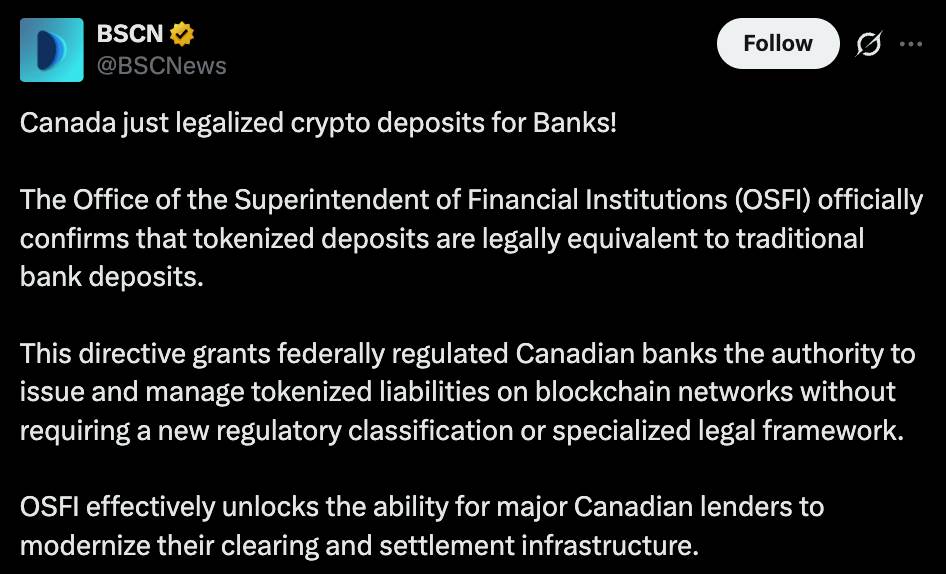 Source: BSCNews release on X platform
OSFI's actual statement
According to the Office of Financial Regulation In an official statement issued by the Office of the Superintendent of Financial Institutions (OSFI) on September 10, 2026, regulators confirmed that there is no legal difference between tokenized deposits and traditional deposits. OSFI positioned the move as a "technology-neutral" clarification, which means the underlying technology used to build or deliver financial products will not change its legal classification. As the statement stated bluntly, the focus is on what the product or service actually is, not how it is built or delivered.
The clarification of why this matters to the Bank of Canada
effectively removes the main uncertainty that previously hindered innovation in this area. Several key points can be drawn from the statement:
- Tokenized deposits are governed by the same legal framework as ordinary deposits, including the Banking Act, the Trust and Loan Companies Act, and the Insurance Companies Act.
- Federal regulators do not need to establish new regulatory classifications or specialized legal frameworks to provide such deposits.
- This applies broadly to "tokenized and other digitally expressed deposits" and not just a narrow product type.
For banks that are cautious about building blockchain-based deposit products due to legal ambiguity, this statement removes certain obstacles, at least in terms of their perception of classification issues.
What banks still need to do
OSFI does not issue blank checks here. The statement made clear that even if third parties are used to build or operate these products, financial institutions remain solely responsible for ensuring compliance. Institutions currently recognized by Canadian regulators that provide tokenized deposits should still meet the following requirements:
Requirements for details Internet and technology risk management to comply with OSFI's B-13 Guidelines Third party risk management to comply with OSFI's B-10 Guidelines Regulatory participation Communicate with their OSFI chief supervisors before launching novel products Legal review sought legal advice as appropriate Therefore, although classification issues have been resolved, But banks still need to pass these products through the same operational and risk supervision processes that apply to any other innovative banking service.
Where does this place in OSFI's broader strategy
This statement reflects a specific regulatory philosophy: Rather than writing completely new rules for every new technology, OSFI applies its existing legal framework and simply clarifies how it applies to new use cases. This approach has practical benefits to the industry because it means banks do not have to wait for a tailor-made tokenization framework to be drafted and approved before moving forward. Instead, as long as institutions follow the risk and compliance expectations that have governed all of their other businesses, the road is open.
What the future may mean
With legal clarity established, Canadian banks now have a clearer track to explore tokenized deposits that Canadian institutions can use to modernize clearing and settlement infrastructure and other things. In theory, blockchain-based deposit tracking could make cross-bank settlements faster and more transparent than older systems. Whether major Canadian lenders move quickly or adopt a more cautious wait-and-see attitude will likely depend on how well they adapt to the regulatory and third-party risk requirements set out in the OSFI clarification.
Conclusion
OSFI's statement that Canadian banks can now offer tokenized deposits solves a real legal issue and does not require any new laws or regulations in any cryptocurrency news. Tokenized deposits are officially considered the same as traditional deposits, opening up a clear path for innovation for agencies under federal regulators, provided they continue to meet the same cybersecurity risks, third-party supervision and regulatory participation standards that already apply within the Canadian banking system.
Disclaimer : This content covers financial markets and is for general information only. Does not constitute financial, investment, trading or legal advice. Crypto assets fluctuate violently and may fall rapidly in value. Always conduct independent research. Before making investment decisions, consult a licensed financial adviser.