Exchange Ranking
 Top Exchanges
 24h Volume Ranking
 Popularity Ranking
 Exchange BTC Balance
 Proof of Reserves
 Decentralized Exchanges
 Funding Rate
 Funding Heatmap
 Liquidation Data
 Max Pain
 Long/Short Ratio
 Whale L/S Ratio
 Binance/Okex/Huobi L/S
 Bitfinex Margin L/S
 ETF Tracker
 Solana ETF
 XRP ETF
 Hong Kong ETF
 Bitcoin Treasuries
 Crypto Reversal
 Ethereum Reserves
 HyperLiquid Wallet Analysis
 Hyperliquid Whale Watch
 Large Transactions
 On-chain Movement
 Bitcoin ROI
 Stablecoin Market Cap
 Options Analysis
 News
News Articles
 Economic Calendar
 Features
 Wallet
 Contract Calculator


 Security
 Collections
 Watchlist
 Following
 BTC
BTC  ZEC
ZEC Core Points
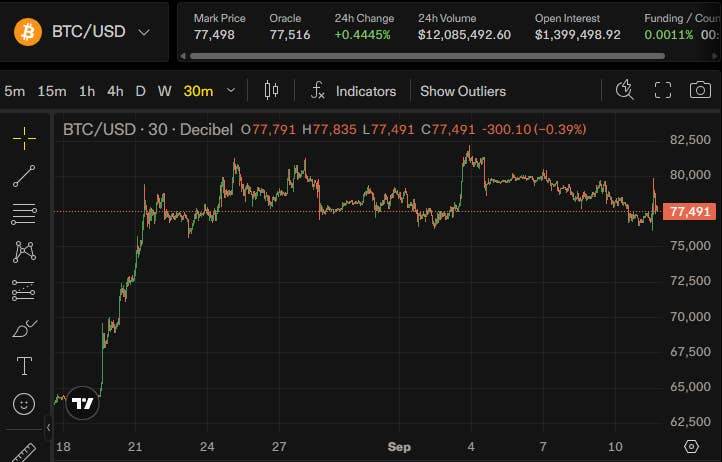
Bitcoin rebounded from a low below $77,000 and re-traded to levels close to $77,300. During the same period, Zcash became the largest decline among the major tokens, a phenomenon that suggests the market is concentrating on clearing leveraged positions. Open interest data and funding rate data on derivatives platforms showed that the decline was triggered by mandatory liquidation rather than new negative news.
The truth behind the rebound: deleveraging rather than fundamental improvements
Bitcoin's rebound to $77,300 in itself is not the most noteworthy focus, but what is more noteworthy is what state it has recovered from. In the selling wave, it was not Bitcoin that bore the biggest selling pressure, but Monero. This detail changes the judgment of the overall market trend.
If it is a broad macro shock (such as interest rate repricing driven by the consumer price index CPI), then it should affect all major assets according to their respective volatility characteristics. However, when a token falls much more than other assets during a joint sell-off period, it usually means that the concentrated leveraged positions within the particular asset have been forcibly cleared, rather than new negative news on the asset itself.
Operating mechanism of leverage clearing
Perpetual contracts allow traders to open positions at amounts far in excess of their margin deposits. Trading platforms track the resulting positions through two public data sources: "Open Interest", which is the total value of open contracts, and "Funding Rate", which is a fee paid by long positions to short positions (or vice versa), designed to anchor the contract price near the spot price.
Monero derivatives dashboard data aggregated on platforms such as Coinglass clearly demonstrates the process of rapid dissolution of this accumulation of positions. When a token accumulates a crowded and highly leveraged position on one side, moderate price fluctuations in the opposite direction are enough to trigger automatic clearing. These liquidations force more selling, which in turn push prices down further, creating a self-reinforcing downward spiral. This process is independent of changes in Bitcoin's own fundamentals.
We need to point out this mechanism bluntly: Monero fell not because of new information about the asset, but because too many traders leveraged in the same way, and the CPI-driven price correction provided the market with the push it needed to clear these positions. Bitcoin prices recover faster than Monero, which is consistent with the above judgment, because Bitcoin has enough liquidity and leverage depth to absorb shocks, while markets like Monero are less liquid and more crowded positions cannot do this.
Correctly interpreting market recovery
Headlines such as "Bitcoin Rounds" can easily mislead people into thinking that the entire market has regained confidence. What actually happened was more limited: an interest-rate-driven correction triggered a leverage liquidation concentrated on a single asset, and once this forced selling power was exhausted, the price of Bitcoin regained its footing. This is because the initial decline was essentially unrelated to Bitcoin.
This distinction is crucial for traders trying to use this rally as a signal. A leverage-driven market recovery does not indicate whether the underlying interest rate concerns that triggered the sell-off have truly eased.