Exchange Ranking
 Top Exchanges
 24h Volume Ranking
 Popularity Ranking
 Exchange BTC Balance
 Proof of Reserves
 Decentralized Exchanges
 Funding Rate
 Funding Heatmap
 Liquidation Data
 Max Pain
 Long/Short Ratio
 Whale L/S Ratio
 Binance/Okex/Huobi L/S
 Bitfinex Margin L/S
 ETF Tracker
 Solana ETF
 XRP ETF
 Hong Kong ETF
 Bitcoin Treasuries
 Crypto Reversal
 Ethereum Reserves
 HyperLiquid Wallet Analysis
 Hyperliquid Whale Watch
 Large Transactions
 On-chain Movement
 Bitcoin ROI
 Stablecoin Market Cap
 Options Analysis
 News
News Articles
 Economic Calendar
 Features
 Wallet
 Contract Calculator


 Security
 Collections
 Watchlist
 Following
 BTC
BTC Bitcoin and cryptocurrency are about to usher in the most event-intensive week of 2026
Bitcoin and cryptocurrency markets are entering the most critical and volatile week of 2026, and a number of major developments may trigger violent fluctuations in cryptoassets and global markets. The week has a tight schedule: Tuesday will be a key Senate voting day on U.S. cryptocurrency legislation, followed by monetary policy decisions announced by the Federal Reserve on Wednesday, the Bank of England on Thursday, and the Central Bank of Japan on Friday. In addition, this Friday will also usher in quarterly derivatives maturity settlement.
Bitcoin is currently hovering around US$77,000, and the choice at this time is particularly important. BTC has been difficult to regain its footing in the US$78,000 to US$80,000 range, and upcoming major events may serve as a catalyst for the market to break through the recent volatility range.
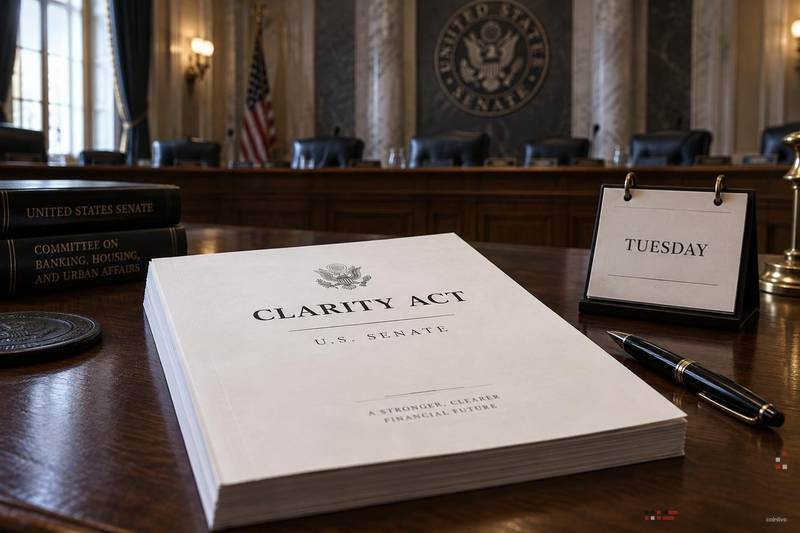
Tuesday: CLARITY bill faces critical Senate test
The first major crypto asset-exclusive event will occur on Tuesday, September 15. The Senate plans to hold a closing debate vote on the procedural motion of the CLARITY bill at 2:15 p.m. EDT. The motion requires 60 votes to overcome this procedural hurdle. The Republican Party currently holds 53 seats, so it must win bipartisan support.
Importantly, this is not the final passage of the CLARITY Act. If the vote is successful, the bill will move to further review in the Senate. The legislation aims to establish a broader federal framework for digital asset markets, clarifying the respective areas of responsibility of the Securities and Exchange Commission (SEC) and the Commodity Futures Trading Commission (CFTC). The latest text also covers areas such as custody, decentralized finance (DeFi), anti- money laundering compliance and registration requirements.
Sen. Cynthia Loomis is pushing Democrats to support the bill even though more than 100 changes requested by Democrats have been included during the negotiation process. But differences remain, especially on ethics provisions. Therefore, a failure to vote on Tuesday would constitute a major setback to current efforts to pass comprehensive legislation regulating the U.S. crypto market. Although passing the closing debate motion does not immediately mean that the bill becomes law, it will remove an important and imminent obstacle.
Wednesday: The Federal Reserve may become Bitcoin's biggest catalyst
For Bitcoin, Wednesday may even be more important than Tuesday. U.S. retail sales data will be released at 8:30 a.m. EDT, providing another window on the health of the economy before the Federal Reserve releases its policy decision at 2:00 p.m.
This week may be the most important week of 2026 for cryptocurrencies and global markets. Tuesday, September 15: -Closing debate vote on the CLARITY bill, 2:15 p.m. EDT-60 votes needed, Republicans only had 53 seats-Democrats suspended support due to ethics rules
Recent market expectations have fluctuated greatly. Sometimes market pricing strongly favors a 25 basis point hike, but with new employment and inflation data released, the probability changed significantly. A Reuters poll released on September 9 showed that most economists expect the Federal Reserve to keep interest rates unchanged, while a growing minority expects to raise interest rates at least once before the end of the year. This distinction is crucial because the claim that interest rate hikes are a foregone conclusion is outdated.
For Bitcoin, the interest rate decision itself is only part of the story. Traders will also pay close attention to the Federal Reserve's updated forecasts and Chairman Kevin Walsh's press conference at 2:30 p.m. EDT to explore future policy directions. A more hawkish Fed stance could push up Treasury yields and put pressure on risky assets, including Bitcoin; a more dovish signal could have the opposite effect, especially as traders start to reduce expectations for further monetary tightening.
Thursday and Friday: Decisions from the two major central banks follow one after another
The story of global monetary policy will not end with the Fed's decision. The Bank of England will announce its decision on Thursday, September 17. A Reuters poll showed that despite rising inflationary pressures, economists generally expect the Bank of England to maintain its benchmark interest rate at 3.75%. However, as three policymakers voted in favor of raising interest rates at previous meetings, the language of this decision will still have an impact on global bond and money markets.
followed by Japan Bank. Japan's Central Bank will hold a meeting from September 17 to 18. A Reuters poll showed that almost all economists surveyed expect Japan's central bank to raise its policy rate by 25 basis points to 1.25% on Friday, which would bring Japan's policy rate to its highest level in decades.
Japan's central bank's impact on bitcoin may be particularly unique because Japan's interest rate rise will affect the yen carry trade. Investors have historically been accustomed to borrowing in yen at low cost to fund positions in other regions. As Japanese interest rates rise and the yen strengthens, some leveraged positions may become unattractive and be closed. This could put broader pressure on risky assets as a whole, rather than just the Japanese market. This does not mean that Japan's central bank's interest rate hike will inevitably cause Bitcoin to fall, but immediately after the Fed's decision, it increased the source of global liquidity risk.
Quarterly derivatives expiration ends the week
Friday brings another potential source of volatility. September 18 is the quarterly expiration date for U.S. derivatives, when stock options, index options and stock index futures will expire simultaneously. Although this is not a dedicated Bitcoin option expiration date and therefore should not be seen as a direct catalyst for crypto-assets, quarterly expiration tends to generate unusually heavy trading volume and position adjustments in traditional markets. If stocks have already experienced sharp swings following the decisions of the Federal Reserve and the Central Bank of Japan, Friday's expiration could amplify this volatility. Bitcoin's growing sensitivity to broader risk sentiments means that these traditional market movements could spill over into the crypto space.
What does this mean for Bitcoin?
Bitcoin is essentially entering a four-day "marathon" test. Tuesday was the main test of U.S. crypto legislation; Wednesday included retail sales data, Federal Reserve resolutions, new forecasts and a press conference by the Federal Reserve Chairman; Thursday involved the Bank of England; and Friday combined Japan central bank decisions with quarterly derivatives maturities.
For BTC, approximately US$76,000 remains an important near-term support area. Losing that position could turn attention to $75,000, followed by a larger level of weekly support around $72,800. On the other hand, bulls need to regain about $78,300 before they can seriously try to break the $80,000 mark again. Above that, about $82,000 remains the next major level of technical resistance.
Given that Bitcoin is already struggling near $77,000, any event this week could be crucial. All of these events erupted in a concentrated manner in just four days, making this one of the most decisive weeks for Bitcoin in 2026.













![[Altcoin Season] Solana and BNB have taken action: Traders are focusing on the next 100 times crypto](/d/file/20260914/ed4ef83dafcd11f19c9ab80d425f811e.jpg)