Exchange Ranking
 Top Exchanges
 24h Volume Ranking
 Popularity Ranking
 Exchange BTC Balance
 Proof of Reserves
 Decentralized Exchanges
 Funding Rate
 Funding Heatmap
 Liquidation Data
 Max Pain
 Long/Short Ratio
 Whale L/S Ratio
 Binance/Okex/Huobi L/S
 Bitfinex Margin L/S
 ETF Tracker
 Solana ETF
 XRP ETF
 Hong Kong ETF
 Bitcoin Treasuries
 Crypto Reversal
 Ethereum Reserves
 HyperLiquid Wallet Analysis
 Hyperliquid Whale Watch
 Large Transactions
 On-chain Movement
 Bitcoin ROI
 Stablecoin Market Cap
 Options Analysis
 News
News Articles
 Economic Calendar
 Features
 Wallet
 Contract Calculator


 Security
 Collections
 Watchlist
 Following
 BTC
BTC 2026 Bitcoin price forecast: bull market target of US$98,000, bear market bottom line of US$60,000
Based on the volatility of spot price of US$76,950 on September 13, 2026 (Data sources: CoinGecko, Coinbase and Kraken, the price difference among the three is within US$17), our forecast for Bitcoin prices for the rest of 2026 is US$98,000 for a bull market scenario and US$60,000 for a bear market scenario.
A popular question often asked is: "Can Bitcoin return to $100,000 this year?" But the more valuable question is: "What extremes are the market paying a premium for?" The answer is both ends. Polymarket on "What price will Bitcoin reach in 2026?" The ladder contract has been traded for US$65.4 million. The market's pricing in the middle range is highly consistent with the volatility realized by Bitcoin, but not in the marginal range. Traders pay a 2.75% probability to get the chance to touch $150,000, while the volatility model only gives a probability of 0.1% to 0.4%. At the same time, traders pay a 9.0% probability to get the chance to fall to $45,000, while the volatility model only gives a probability of 0.9% to 3.5%. Both narratives "reaching $150,000 before Christmas" and "plunging to $45,000" cost multiple times their statistical value.
This gap is currently the most useful information for price forecasts, as it will be verified over the next week. The Federal Reserve will decide on interest rate policy on September 16. Interest rate hikes are regarded as a benchmark scenario, and the US spot Bitcoin ETF has just recorded capital outflows for four consecutive trading days.
We used the Barrier Model to reconstruct Polymarket's entire 2026 ladder contracts based on two volatility regimes: the past 90 days (annualized 36.3%) and the past 12 months (annualized 44.3%). The model measures the same thing as the contract measures: the probability of hitting a price at any point before December 31, rather than the probability of closing at that price. Between $65,000 and $100,000, the difference between the market and the model is about one-fifth. Beyond these levels, the market is buying "lottery tickets" on both ends. The integer price target quoted by everyone is $100,000, and the probability of hitting it is 19.5%, but the probability of closing above this at the end of the year is only 8% to 12%.
Key Facts: September 2026 Bitcoin Price Forecast
- Price: September 13, 2026 BTC/USD is $76,950, with a market value of approximately US$1.55 trillion- CoinGecko, cross-verified by Coinbase and Kraken
- Year-to-Date Performance: -12.9%(Starting from $88,364 on December 31, 2025);+19.9% in August;-38.3% down from the record closing price of $124,740 on October 7, 2025- FinanceFeeds based on CoinGecko's closing price
- Bull $98,000 /Bear $60,000: One-year standard deviation range based on 12-month realized volatility of 44.3%- FinanceFeeds calculates
- 19.5% Polymarket odds on hitting $100,000 in 2026;29.5% odds of falling to $60,000;7.55%Odds of setting a new all-time high before the end of the year- Polymarket, September 13, 2026
- 78.5% Polymarket's odds on a 25 basis point Fed rate hike on September 16; CME FedWatch is close to 90% after CPI data was released- Polymarket, CNBC
- -US$462.7 million Net outflow of U.S. spot Bitcoin ETF between September 8 and 11, Previously, there was a net inflow of US$905.4 million from September 3 to 4- Farside Investors
- 3.4% In August, the US CPI inflation rate, core prices rose 0.3% month-on-month, one-tenth higher than the forecast-Bureau of Labor Statistics via CNBC, September 11, 2026
#@0_39#@
Bitcoin's daily closing price over the past 12 months, as well as the US$98,000 bull and US$60,000 bear levels noted by FinanceFeeds. Chart source: FinanceFeeds. Data source: CoinGecko.
#@0_39#@
What really drives Bitcoin: An unplanned interest rate hike
Bitcoin had its best month of the year in early September, rising from $64,743 to $77,658 in August, a 19.9% increase. Prices have since stalled, falling 0.9% so far this month as the macro context moves in a direction never considered in Bitcoin's bull market assumptions. The U.S. central bank is being priced to raise rates rather than cut rates.
The trigger point is the August Consumer Price Index (CPI) released on September 11. According to CNBC, overall prices rose 0.4% month-on-month and 3.4% year-on-year, in line with expectations. The problem lies in the core reading (excluding food and energy): a month-on-month increase of 0.3%, compared with a forecast of 0.2%. A mere 0.1 percentage point deviation is enough to change the situation. According to CNBC, CME FedWatch showed that the probability of a rate hike at the September 15-16 meeting soared to nearly 90%. Polymarket's most-traded book,"September Federal Reserve Resolution?" The market (with a transaction volume of $143.3 million) now sets the probability of a 25 basis point rate hike at 78.5%, and the probability of remaining unchanged at 20.5%.
The reaction to Bitcoin that day was thought-provoking. It fell when the data was released, then recovered within minutes, as we covered in our real-time interpretation of Bitcoin's August CPI data, and has remained in the $76,000 to $78,000 region since then. Think of Bitcoin as the longest-lasting asset in your portfolio: it pays no interest and its value depends on expectations of monetary policy for years to come, so higher discount rates hit it hardest. The market is weighing not whether there will be one rate increase (as it is already largely priced), but whether the September 16 guidance heralds a second rate increase. Federal Reserve Chairman Kevin Warsh said if inflation does not improve,"we still have work to do," CNBC reported.
Investors have no doubts about the direction of the direction. "While there is no guarantee that the Fed will raise interest rates next week, it is difficult to see how the central bank can justify keeping rates unchanged," Chris Zaccarelli, chief investment officer at Northlight Asset Management, told CNBC after the data was released.
Quick points:
Bitcoin's August rebound met with the Federal Reserve, which was about to raise interest rates. The odds of a 25 basis point change are 78.5% on Polymarket and close to 90% on CME; for Bitcoin, the key factor is the interest rate path announced on September 16, not the rate increase itself.
Institutional and Industry Response
ETF buying reversal
The U.S. spot Bitcoin ETF was once a marginal buyer before the Labor Day holiday, with inflows of $730.8 million on September 3 and $174.6 million on September 4, according to Farside Investors. Then the flow of funds changed. The fund lost $46.6 million on September 8,$120.2 million on September 9,$282.7 million on September 10, and $13.2 million on September 11, although this was true on days when CPI was announced and prices were stable. A total of US$462.7 million was outflows over the four trading days, accounting for about half of the pre-holiday surge. Our report on ETF outflows on September 10 tracks the same reversal from a different data provider, which had a lower bitcoin outflows that day, at approximately $165 million; traffic trackers vary depending on the method, and for consistency, we use Farside data throughout.
A long-term perspective is crucial for bull market cases. Since launch, U.S. spot funds have net inflows of $55.2 billion, of which BlackRock's IBIT alone contributed $64 billion, while Grayscale's GBTC cumulative redemptions were $27.8 billion, according to Farside data. Structural buyers have not left. Only during the revaluation of interest rates did they stop marginal increases in holdings.
Largest corporate holders suspended buying
Strategy (formerly MicroStrategy) held its position unchanged at 845,050 BTC for the week ended September 7 and used cash to buy back STRC preferred shares, as we reported in Strategy's latest position update. CEO Phong Le said the company had previously sold approximately 7,000 BTC units at prices between $60,000 and $65,000 to fund preferred stock dividends. When looking at our bear market case, this is worth keeping in mind: For Bitcoin's largest treasury holder,$60,000 is not an abstract level, but what it already serves as a seller. Our MSTR bull and bear market scenarios analyze the other side of the deal.
Exchange claims bottom
This week Coinbase CEO Brian Armstrong took the opposite stance. In an interview with Bloomberg Television on September 10 (reported by Bitcoin.com and covered in our article on Armstrong's bottom-out remarks), he said: "I personally think we have seen a bottom in the bitcoin price this cycle. As we usher in the next halving event, it will start to rise in the next year or two."
Quick points:
ETF: After two days of inflow of $905.4 million, four days of outflow of $462.7 million.
Strategy: Buy back your own shares instead of Bitcoin.
Coinbase: Says cyclical lows have reached.
Money flow data and executive comments point in the opposite direction.
Data Analysis: What is Polymarket's correctness and overvaluation
To test market consensus, we used a barrier model to price each execution price of Polymarket's 2026 ladder contract, which gives the probability that Bitcoin will break through a certain level at any time between now and December 31. We run the model using two volatility inputs from CoinGecko's closing price: 36.3%(last 90 days) and 44.3%(last 12 months). The liquidity of pending orders for all legs below is between $38,000 and $508,000, so these are true market depth and not outdated quotes.
Touching the conclusions of the Polymarket model (90-day volatility) model (12-month volatility) before December 31 $150,0002.75%0.1%0.4% Highly overestimated $120,0008.0%2.0%5.3% overestimated $100,00019.5% 16.4% 24.5% Reasonable $90,00040.5% 39.7% 47.8% Reasonable $70,00064.0% 66.4%72.9% Reasonable to underestimate $60, 00029.5% 23.8% 34.4% Reasonable $50,00013.5% 3.7% 9.3% Overvalued $45,0009.0% 0.9% 3.5% Severely overvalued. This leads to three conclusions. First, the crowd is well aligned with the trends that most holders care about. A journey to $90,000 or $70,000 is priced within a few percentage points of what Bitcoin's own history suggests. Second, it systematically pays exorbitant premiums for extreme situations, ranging from 7 to 27 times at $150,000 and from 3 to 10 times at $45,000. This is the same as the "favourite-longshot bias" we measured in Dogecoin ladder contracts in August, when call options contracts were trading at 18 times their volatility value. Third, mispricing at the tail is symmetrical, which suggests that a ladder contract should not be interpreted as being long or short; it is just too expensive on both ends.
Historical high contracts illustrate the same problem. Polymarket is pricing it at 7.55% for a new high before December 31 (exceeding the intraday peak of $126,080 on October 6, 2025, shown by CoinGecko data). Our model sets the probability of hitting this level at 1.0% to 3.3%. A 64% gain in 15 weeks is not impossible for Bitcoin, but it must be paid at the right price.
This is where our horizon comes from. The $98,000 bull market case and the $60,000 bear market case are a one-year standard deviation year-end range based on 12-month volatility, within which there is approximately a two-thirds probability that Bitcoin will close in this range based on its own lagging behavior.
Bull Market Case: US$98,000 (+27.4%)
- Probability of hitting before December 31: 19.8% to 28.2%
- Probability of closing at this price or higher: 9.4% to 13.2%
- Requirements: Only one interest rate increase on September 16 and the interest rate path is flat; ETF inflows return to the pace of early September; break through the US$83,000 -86,000 supply zone
- Reason for objection: year-to-date decline of 12.9%, while Polymarket gives it a 19.5% probability of outperforming gold and the S & P 500 in 2026
Bear market case: US$60,000 (-22.0%)
- Probability of reaching before December 31: 23.8% to 34.4%
- Probability of closing at this price or lower: 12.5% to 18.3%
- Conditions required: Guidance signal for a second rate increase; continued ETF redemption; Retesting the July 1 low closing price of $58,566
- Reason for objection: Strategy has sold and suspended in the $60,000 -65,000 range; the mandatory seller pool in this area is small
Quick Points:
Polymarket is right between $70,000 and $100,000 and wrong in all respects beyond this range. The probability of hitting $100,000 is about one in five; a year-end close above that is closer to one in ten. Anyone who quotes $150,000 or $45,000 is citing tail risk that the market overvalues.
Regulatory and policy tensions
Pressure on Bitcoin this month comes from monetary policy rather than crypto regulation, and the Federal Reserve has been exceptionally clear in its tests. Commissioner Christopher Waller made this clear in a speech on September 3, eight days before the CPI data is released, saying decisions will be "heavily influenced by what we learn about August inflation." The core reading in August was one-tenth higher. The current federal funds target rate ranges from 3.50% to 3.75%, and a 25 basis point rate increase would raise it to 3.75% to 4.00%.
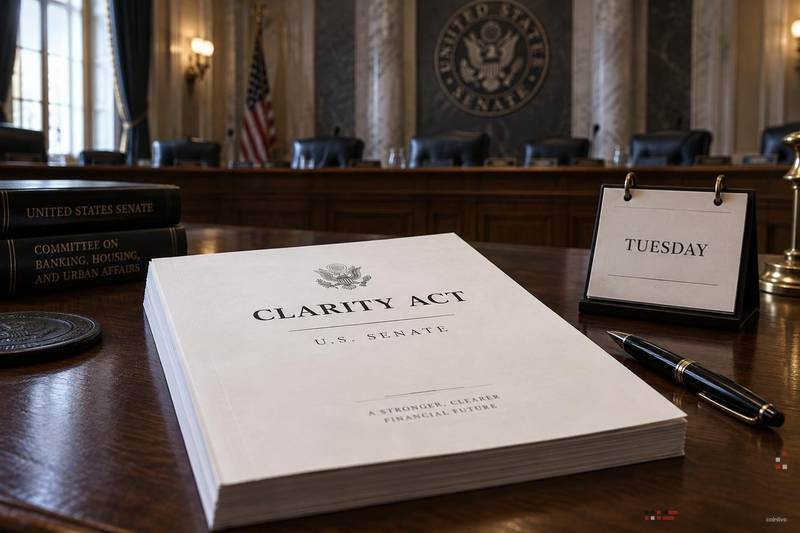
In contrast, specific rule-making for cryptocurrencies is moving towards inclusiveness. The SEC's proposed Crypto Asset Regulations includes a $5 million exemption for start-ups and a $750 million annual financing exemption. Public comments will close on October 20. For details, see our report on the SEC's Crypto Rule Book. In the Senate, the Republican Party issued a revised version of the Digital Asset Markets CLARITY Act on September 10, requiring non-decentralized DeFi trading agreements to be registered with the CFTC. For more details, see our report on the updated CLARITY Act.
Summarize this tension in one sentence: Washington is building Bitcoin's infrastructure, while the Federal Reserve is raising its cost of capital. Legislation is a tailwind for many years; the interest rate path is a headwind for the quarter, and prices will respond to more recent factors. Waller's own wording shows how close the committee is to the tipping point:
"However, if the inflation data is strong, I will consider raising rates. I think current policies are only slightly more restrictive on aggregate demand, and the acceleration of inflation may not be enough to persuade me to support more tightening policies."
- Christopher Waller, Governor of the Federal Reserve
What happens next: Three judgments
1. September 16 sets the direction for the rest of the quarter
Interest rate hikes have been priced; guidance is not yet known. If the committee's interest rate path shows a move and a pause, there will be room for early September ETF purchases to resume and Bitcoin will have a path back into the $83,000 to 86,000 area that once curbed recovery. If a second rate increase is shown and the four-day outflow streak will be extended, the 26.5% probability of falling to $70,000 in Polymarket's September contract looks underestimated. We believe that the second outcome is more likely to be priced than achieved, which is why our bull market case is above, not below, spot prices.
2. $100,000 is a touch transaction, not a year-end closing forecast
Based on current volatility, the probability of Bitcoin trading to $100,000 at some point before December 31 is about one in five, while the probability of closing above this at the end of the year is only about one in ten. As the quarter moves forward, we expect that circulated price targets will tend to "touch" the statement, and readers should view any unlimited "$100,000 before year end" as the lower of these two numbers.
3. Tail risk will depreciate before redemption
The tail of mispricing is usually corrected through time decay rather than through the event itself. With 109 days left, each quiet week reduces the value of the $150,000 and $45,000 legs. We believe the most unlikely outcome is the one that both camps are clamoring for.
In short, our view is that Bitcoin will end 2026 with about a two-thirds probability that it will be between $60,000 and $98,000, and it will be up to the Federal Reserve, rather than the halving narrative, to decide which half of the range it will spend in the fall.
Frequently Asked Questions (FAQ)
What is the Bitcoin price forecast for the end of 2026?
FinanceFeeds 'bitcoin price forecast is $98,000 for a bull market scenario and $60,000 for a bear market scenario at the end of 2026, based on a spot price of $76,950 on September 13. These levels are based on a one-year standard deviation range of 44.3% for Bitcoin's 12-month realized volatility, so based on its own history, Bitcoin has about a two-thirds probability of closing in this range.
Will Bitcoin hit $100,000 in 2026?
Polymarket is pricing at 19.5% for reaching $100,000 before December 31. Our volatility model puts it at 16.4% to 24.5%, so market pricing is relatively fair. A year-end closing above $100,000 is less likely, at around 7.8% to 11.5%, because reaching requires only one print, and closing requires holding that level on December 31.
Will Bitcoin fall to $60,000 again?
Possibly. Polymarket prices a drop to $60,000 during 2026 at 29.5%, compared with 23.8% to 34.4% for our model. Bitcoin was as low as US$58,566 on July 1, 2026. A second rate hike signalled on September 16, or continued ETF outflows, will be the most likely triggers for the retest.
How does the Federal Reserve's interest rate decision affect the price of Bitcoin?
Higher policy rates increase returns on cash and bonds and reduce the present value of non-yielding assets such as Bitcoin. Polymarket is pricing a 25 basis point rate hike on September 16 at 78.5%. Since interest rate hikes have been largely priced, bitcoin prices are more sensitive to whether the Fed guidance heralds further increases.
Is Bitcoin ETF buying or selling now?
According to the latest data, it is selling. According to Farside Investors, the U.S. spot Bitcoin ETF recorded a net outflow of $462.7 million between September 8 and 11, following a net inflow of $905.4 million between September 3 and 4. Cumulative net inflows since launch remain positive at $55.2 billion, led by BlackRock's IBIT.
Will Bitcoin hit a new all-time high this year?
This is unlikely based on current volatility. Bitcoin needs to exceed its intraday record of $126,080 on October 6, 2025, or a 64% increase. Polymarket is pricing the pre-December 31 new high at 7.55%; our barrier model puts the probability of hitting that level at 1.0% to 3.3%, indicating that the market is paying an exorbitant premium for it.
This article is for information purposes only and does not constitute investment advice or a recommendation to buy or sell any assets. Cryptocurrency prices are highly volatile. Prices are data as of September 13, 2026;Polymarket odds are directly read from Polymarket open market data on the same day and continue to change. Probability estimates are model outputs based on historical volatility and are not deterministic predictions.














![[Altcoin Season] Solana and BNB have taken action: Traders are focusing on the next 100 times crypto](/d/file/20260914/ed4ef83dafcd11f19c9ab80d425f811e.jpg)