Exchange Ranking
 Top Exchanges
 24h Volume Ranking
 Popularity Ranking
 Exchange BTC Balance
 Proof of Reserves
 Decentralized Exchanges
 Funding Rate
 Funding Heatmap
 Liquidation Data
 Max Pain
 Long/Short Ratio
 Whale L/S Ratio
 Binance/Okex/Huobi L/S
 Bitfinex Margin L/S
 ETF Tracker
 Solana ETF
 XRP ETF
 Hong Kong ETF
 Bitcoin Treasuries
 Crypto Reversal
 Ethereum Reserves
 HyperLiquid Wallet Analysis
 Hyperliquid Whale Watch
 Large Transactions
 On-chain Movement
 Bitcoin ROI
 Stablecoin Market Cap
 Options Analysis
 News
 Articles
 Economic Calendar
 Features
 Wallet
 Contract Calculator


 Security
 Collections
 Watchlist
 Following
 BTC
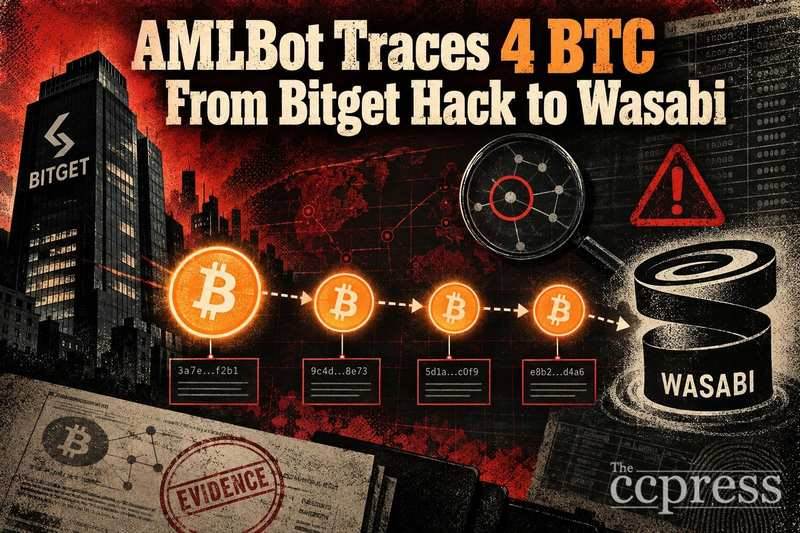
AMLBot追踪Bitget被盗的4枚比特币流向Wasabi混币服务,合规挑战凸显
区块链分析公司AMLBot表示,其追踪到约4枚比特币与Bitget黑客攻击有关,这些资金被转入Wasabi CoinJoin。CoinJoin是一种比特币隐私协议,通过汇集交易来掩盖资金来源。这一发现将合规视角聚焦于加密货币领域长期存在的一个核心矛盾:即在链上追踪非法资金与实际阻止资金转移之间存在的巨大鸿沟。
AMLBot如何将比特币与Bitget攻击关联起来
作为一家加密货币合规和区块链分析平台,AMLBot识别出了一条由约4枚比特币组成的资金链路,这些资金从与Bitget黑客攻击相关的钱包转移到Wasabi CoinJoin服务中。CoinJoin的工作原理是将多个用户的比特币输入合并到一笔交易中,这使得调查人员很难追踪哪笔输出对应哪个发送者。
此次追踪之所以引人注目,正是因为它成功定位到了CoinJoin的入口点。能够追踪至此并非易事,这意味着AMLBot的归因逻辑在资金消失进入混合池之前,成功跨越了多个跳转节点。然而,一旦进入该混合池,区块链的可见性便开始下降。
此类与交易所相关的安全事件正引起行业合规团队越来越多的关注。2025年初发生的Bybit黑客攻击导致15亿美元损失,引发了类似的链上调查和合规响应浪潮,这凸显出事后归因工作已成为行业标准做法。
为何Wasabi CoinJoin的资金轨迹提升了风险等级
Wasabi Wallet是一款合法的开源比特币钱包,其内置了CoinJoin功能作为隐私保护特性。这种合法性使其成为需要快速隐藏资金去向的常见目的地,无论是出于隐私意识的用户,还是试图切断调查线索的黑客行为者。
将资金追踪至CoinJoin入口并不等同于追回资金。一旦比特币进入CoinJoin轮次,输入端与输出端之间的链接会被故意切断。调查人员可以确认资金已到达混合服务,但要确定其后续去向,则需要依靠概率分析、交易所合作,或者运气好能重新流入经过KYC(了解你的客户)验证的钱包。
这种“可见性”与“控制权”之间的差距,是任何试图追回被盗加密资产的人面临的核心难题。2025年价值17亿美元的加密货币盗窃潮后的合规推动表明,即使拥有强大的归因能力,若缺乏执法部门和交易所在整个链条多环节的协作,也极少能直接转化为资产追回成果。
此次追踪对交易所和加密货币合规意味着什么
For exchanges, hacking incidents that route funds to privacy tools are both a security issue and a compliance issue. Compliance teams are obligated to report suspicious transaction flows to financial intelligence units, and the documented trajectory of funds flowing into CoinJoin services provides investigators with a specific last known location, although it may not be the final destination.
In this process, AMLBot's role represents the operating model of compliance analysis in the post-hacker era: rapid on-chain tracking is carried out to establish a capital flow path before financial clues cool down. Companies like AMLBot monitor wallet clusters, flag addresses associated with known hacking attacks, and try to use heuristic analysis to follow funds across hybrid jump nodes.
Exchanges face a wide range of regulatory reviews, covering not only sanctions compliance, but also responses when stolen funds flow through their platforms or users 'wallets. Exchanges that can prove they have flagged and reported inflows of funds linked to Wasabi have far better legal status than those that silently process these coins.
The more difficult question is, can analytical tools alone truly close the loop? Once about 4 bitcoins entered the CoinJoin round, the compliance record showed a trajectory that stopped at a wall. Investigators can record entry points, but whether they can track exports is a completely different issue, and this is also a problem that currently analytical platforms have not been able to solve on a large scale.
Will the new generation of CoinJoin analysis tools change the way this is calculated, or will privacy agreements remain one step ahead of compliance infrastructure?