Exchange Ranking
 Top Exchanges
 24h Volume Ranking
 Popularity Ranking
 Exchange BTC Balance
 Proof of Reserves
 Decentralized Exchanges
 Funding Rate
 Funding Heatmap
 Liquidation Data
 Max Pain
 Long/Short Ratio
 Whale L/S Ratio
 Binance/Okex/Huobi L/S
 Bitfinex Margin L/S
 ETF Tracker
 Solana ETF
 XRP ETF
 Hong Kong ETF
 Bitcoin Treasuries
 Crypto Reversal
 Ethereum Reserves
 HyperLiquid Wallet Analysis
 Hyperliquid Whale Watch
 Large Transactions
 On-chain Movement
 Bitcoin ROI
 Stablecoin Market Cap
 Options Analysis
 News
 Articles
 Economic Calendar
 Features
 Wallet
 Contract Calculator


 Security
 Collections
 Watchlist
 Following
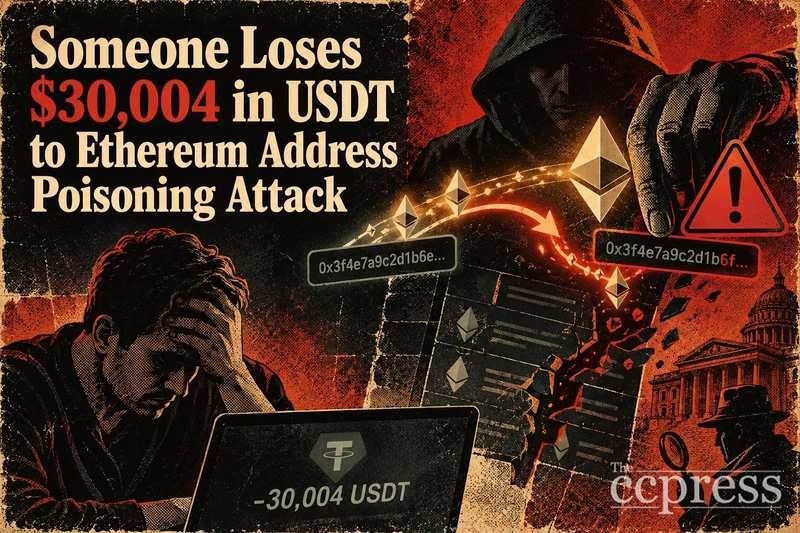
Cryptocurrency user loses US$30,000 USDT due to address obfuscation attack
A cryptocurrency user lost US$30,004 in USDT (TEDA) after sending funds to a fake Ethereum address. Chain security monitors identified the incident as an "Address Poisoning", one of the most deceptive and simple scams in the cryptocurrency space.
This incident was discovered and flagged by Web3 anti-fraud platform ScamSniffer. The platform specifically monitors wallet theft vulnerabilities in the Ethereum network. The stablecoin loss of more than $30,000 highlights the fact that a slight carelessness in the trading process can lead to irreversible financial losses. This attack takes advantage of the habit of most users: when checking wallet addresses, only the first and last few characters are checked, and the complete address string is ignored.
What happened: US$30,004 disappeared
The attacker would generate a wallet address very similar to the address the victim recently interacted with, and then send a zero-value or dust transaction to the victim from the counterfeit address, pushing the counterfeit address into the victim's transaction history. The next time victims prepare to send funds, they copy the familiar address from their historical lists. As a result, funds were transferred to the attacker's wallet rather than the intended recipient. On the Ethereum network, due to the irreversibility and anonymity of USDT transfers, once the transaction is confirmed, it is almost impossible to recover funds.
The $30,004 loss reminds us that even users who are already cautious by general standards can fall for it. That amount is a serious financial blow for many individuals, but it is not small enough to attract the level of public attention that a major multimillion-dollar breach.
How to protect your USDT from address obfuscation attacks
Such attacks do not require malware, phishing links, or smart contract vulnerabilities. The only thing it requires is for victims to blindly trust transaction history without conducting a complete address check. Therefore, preventive measures rely entirely on behavioral changes.
- Always verify the complete destination address: Before signing any transaction, be sure to check the complete address, not just the first and last four characters. Attackers specifically designed the address to match in the visible front and rear parts, while tampering with the middle part. Character by character checking can fill this gap.
- Use a trusted address book: Most modern wallets allow you to save and mark verified addresses. Copying addresses from saved contacts, rather than from transaction history, eliminates this risk completely. If your wallet does not support address book functionality, record your frequently used addresses in a separate encrypted document and compare them manually.
- Send small test first: When transferring large amounts of money to an address that has not been used recently, send a small test amount first. The cost of testing transactions is negligible and far less than the cost of mistransferring funds. If the test funds arrive correctly, the full transfer is made.
- Review Wallet Warnings: Carefully review the warnings issued by your wallet before signing a transaction. Multiple wallet and browser extensions, including the integrated ScamSniffer tool, flag addresses that resolve known obfuscation patterns. Don't ignore these tips before reading.
It is worth noting that the U.S. Securities and Exchange Commission's (SEC) expansion of the scope of regulation of crypto assets, including ongoing federal efforts to establish a crypto rule book, has not yet provided any meaningful avenue of relief for individual victims of address confusion scams. Blockchain transactions are final and no regulatory authority can revoke confirmed transfers.
stablecoin users on Ethereum are a particularly attractive target because USDT transfers are high-value, high-frequency and often routine, which is when vigilance is most easily relaxed. Projects that track DeFi security, including those monitoring Ethereum's growing role in institutional finance, have consistently identified address obfuscation as one of the most persistent social engineering threats on the network.
除了ScamSniffer的报告外,关于受害者身份、攻击者地址或资金最终去向的更多细节尚未得到证实。攻击者是否已被识别,或者资金是否已转移到交易所,目前仍属未知。三万美元在一次交易确认的时间内消失。还需要有多少用户遭受损失,才能让人把双重核对地址变成像锁门一样自动的习惯?