Exchange Ranking
 Top Exchanges
 24h Volume Ranking
 Popularity Ranking
 Exchange BTC Balance
 Proof of Reserves
 Decentralized Exchanges
 Funding Rate
 Funding Heatmap
 Liquidation Data
 Max Pain
 Long/Short Ratio
 Whale L/S Ratio
 Binance/Okex/Huobi L/S
 Bitfinex Margin L/S
 ETF Tracker
 Solana ETF
 XRP ETF
 Hong Kong ETF
 Bitcoin Treasuries
 Crypto Reversal
 Ethereum Reserves
 HyperLiquid Wallet Analysis
 Hyperliquid Whale Watch
 Large Transactions
 On-chain Movement
 Bitcoin ROI
 Stablecoin Market Cap
 Options Analysis
 News
 Articles
 Economic Calendar
 Features
 Wallet
 Contract Calculator


 Security
 Collections
 Watchlist
 Following
Analysis of youth employment trends in high-risk industries in AI and synthesis of views of relevant agencies
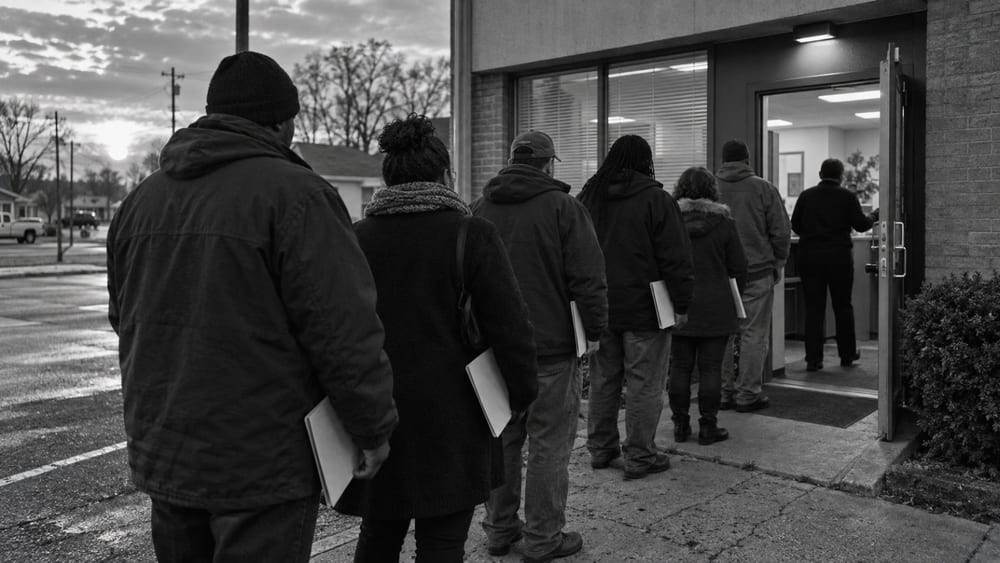
Recent research shows that in occupations that are more affected by artificial intelligence (AI), the employment rate of workers between 22 and 25 years of age is 19% lower than that of the control group.
The Stanford Institute of Digital Economics analyses employment flows as of June 2026, based on ADP pay data. The study compares with AI workers of the same age with lower exposure. The data for July 2025, calculated using the same methodology, show a 15% gap at that time.
According to the September 2026 job openings and labour mobility survey (JOLTS) published by the United States Bureau of Labor Statistics, the number of layoffs and dismissals was 1.6 million, a ratio of 1.0 per cent, with no significant change from the previous month. The monthly recruitment rate was 5.4 million, with a recruitment rate of 3.4 per cent. The JOLTS survey summarized the overall human resource mobility of United States enterprises, such as recruitment, separations and layoffs.
Also, the number of new applications for unemployment benefits published by the United States Department of Labor for the week ending 7 November has been adjusted seasonally to 200,000, an increase of 9,000 over the previous week. The average of four-week movements is 195,250, which is the same as the previous week.
Projections and perspectives of major financial institutions and research institutions
The Goldman Sachs Research Department, in a discussion on the labour market released on 2 July, noted that Joseph Briggs suggested that about 9 per cent of American workers in the AI transition could be reassigned to new jobs. This estimate is based on the assumption that productivity would increase by 15 per cent when AI becomes fully available.
The McKinsey Global Institute, in a report released on 29 September, speculated that by 2035, about 11 million workers in the United States might need to be moved from a shrinking occupational field to other areas. Depending on different automation rates, estimates range from 6 million to 16 million.
Specific cases of technology impacts and business dynamics
There is still a difference of opinion in the academic world as to whether the introduction of technology will lead to the death of the entire job. An article by a computer scientist at Princeton University states that, while AI can reduce its performance in software development, problem definition and results validation still exist.
In the cryptocurrency industry, Coinbase ($COIN)’s structural adjustment plan is a known case. In a bulletin submitted to the United States Securities and Exchange Commission (SEC) on 5 May, Coinbase stated that it planned to cut some 700 employees, or about 14 per cent of its global workforce.