
 Exchange Ranking
 Top Exchanges
 24h Volume Ranking
 Popularity Ranking
 Exchange BTC Balance
 Proof of Reserves
 Decentralized Exchanges
 Funding Rate
 Funding Heatmap
 Liquidation Data
 Max Pain
 Long/Short Ratio
 Whale L/S Ratio
 Binance/Okex/Huobi L/S
 Bitfinex Margin L/S
 ETF Tracker
 Solana ETF
 XRP ETF
 Hong Kong ETF
 Bitcoin Treasuries
 Crypto Reversal
 Ethereum Reserves
 HyperLiquid Wallet Analysis
 Hyperliquid Whale Watch
 Large Transactions
 On-chain Movement
 Bitcoin ROI
 Stablecoin Market Cap
 Options Analysis
 News
News Articles
 Economic Calendar
 Features
 Wallet
 Contract Calculator


 Security
 Collections
 Watchlist
 Following
Key Insights
Robinhood News focuses on Teneve's efforts to promote tokenization of U.S. stocks.
Robinhood CEO Vlad Tenev supports real-time settlement and 24/7 trading.
U.S. regulators have advanced multiple tokenized securities frameworks during 2026.
Robinhood News focuses on access to U.S. tokenized stocks
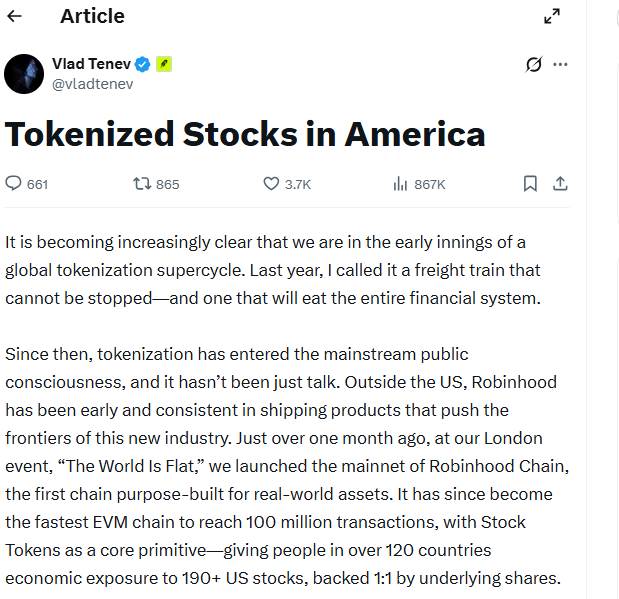
Robinhood News centers on CEO Vlad Teneve's renewed push for U.S. tokenized stocks. Tenev said on August 18 that tokenization could reshape financial infrastructure through faster settlements, continuous transactions, and portable assets.
This argument is important because Robinhood already offers stock tokens outside the United States. At the same time, U.S. regulators are also taking steps towards more clearly handling blockchain-based securities during 2026.
Tenev wrote that the United States is still unable to obtain Robinhood stock tokens. He described the current stage as the "early stage" of the global tokenization cycle.
The Robinhood CEO believes that the tokenized market can support real-time settlement, 24/7 trading, and direct asset portability. He also said that blockchain settlement can reduce the risks posed by delayed settlement processes.
In May 2024, the U.S. Securities and Exchange Commission shortened the standard settlement cycle for most securities transactions to T+1. Former SEC Chairman Gary Gensler said the move reduces credit risk, market risk and liquidity risk.
Tenev believes that the blockchain system can further shorten this process through instant settlement. As such, his argument is aimed at post-transaction infrastructure, not just extending transaction times.
Robinhood launched equity and exchange traded fund tokens for eligible European clients in June 2025. The company said the products initially covered more than 200 U.S. stocks and funds.
Robinhood's product announcement also mentions that stock token holders can receive dividend payments. These tokens initially ran on Arbitrum and were later planned to migrate to Robinhood Chain.
Robinhood News: Expand business beyond Europe
In the second quarter of 2026, Robinhood further expanded its tokenization strategy. The company said qualified users in more than 120 countries can gain access through Robinhood Wallet.
Robinhood also launched Robinhood Chain's public main network at its London event. The company describes it as an Ethereum Layer 2 network for financial services and real-world assets.
Tenev said on August 18 that Robinhood stock tokens are always fully backed by underlying securities. However, he acknowledged that the tokens do not provide direct ownership of underlying stocks.
This distinction remains important under U.S. securities law. Robinhood stated in an April 2026 filing that European equity tokens provide economic risk exposure but do not give shareholders voting rights.
The document also warns that U.S. regulators may claim jurisdiction over products related to U.S. listed securities. As a result, Robinhood continues to view regulatory risk as a business risk.
Tokenized securities under the framework of U.S. SEC rules
The U.S. Securities and Exchange Commission has taken steps towards more clearly handling tokenized securities during 2026. A January employee statement stated that stocks, bonds, options and other securities can be tokenized.
The statement stated that federal and state laws still apply to tokenized securities trading. At the same time, the legal treatment depends on the structure of each token and the rights attached to it.
The New York Stock Exchange submitted rules on trading in tokenized securities in April. The proposal recommends using the infrastructure of the depository trust company in the tokenization pilot.
Under the framework, eligible tokenized securities will retain traditional shareholder rights. The exchange also proposes to keep it within the existing national market system.
The Depository Trust and Clearing Corporation said in May that its tokenization service plan will start in October 2026. The service will cover selected custody assets while retaining traditional ownership rights.
The U.S. Securities and Exchange Commission's proposal for the Regulation of Cryptoassets on August 18 covers the issuance of cryptoassets more broadly. The proposal provides exemptions and disclosure rules for certain investment contracts involving crypto assets.
The proposal itself does not authorize Robinhood's stock token model in the United States. However, regulators continue to build frameworks around blockchain-based financial products.
Robinhood News: Waiting for U.S. regulatory path
Teneve urges policymakers to quickly modernize securities rules. He believes that if U.S. regulators delay access to tokenized stocks, overseas markets may move faster.
Robinhood's overseas model provides users with economic risk exposure, but does not provide direct stock ownership. The American Exchange proposal focuses on tokenized securities that retain traditional shareholder rights.
This structural difference may affect any future launch plans in the United States. Robinhood must abide by rules on securities, custody, clearing and market structure.
The next verifiable catalyst is the tokenization service that the Depository Trust and Clearing Corporation plans to launch in October. Robinhood has not announced a launch date for the U.S. stock token.
























