Exchange Ranking
 Top Exchanges
 24h Volume Ranking
 Popularity Ranking
 Exchange BTC Balance
 Proof of Reserves
 Decentralized Exchanges
 Funding Rate
 Funding Heatmap
 Liquidation Data
 Max Pain
 Long/Short Ratio
 Whale L/S Ratio
 Binance/Okex/Huobi L/S
 Bitfinex Margin L/S
 ETF Tracker
 Solana ETF
 XRP ETF
 Hong Kong ETF
 Bitcoin Treasuries
 Crypto Reversal
 Ethereum Reserves
 HyperLiquid Wallet Analysis
 Hyperliquid Whale Watch
 Large Transactions
 On-chain Movement
 Bitcoin ROI
 Stablecoin Market Cap
 Options Analysis
 News
News Articles
 Economic Calendar
 Features
 Wallet
 Contract Calculator


 Security
 Collections
 Watchlist
 Following
 BTC
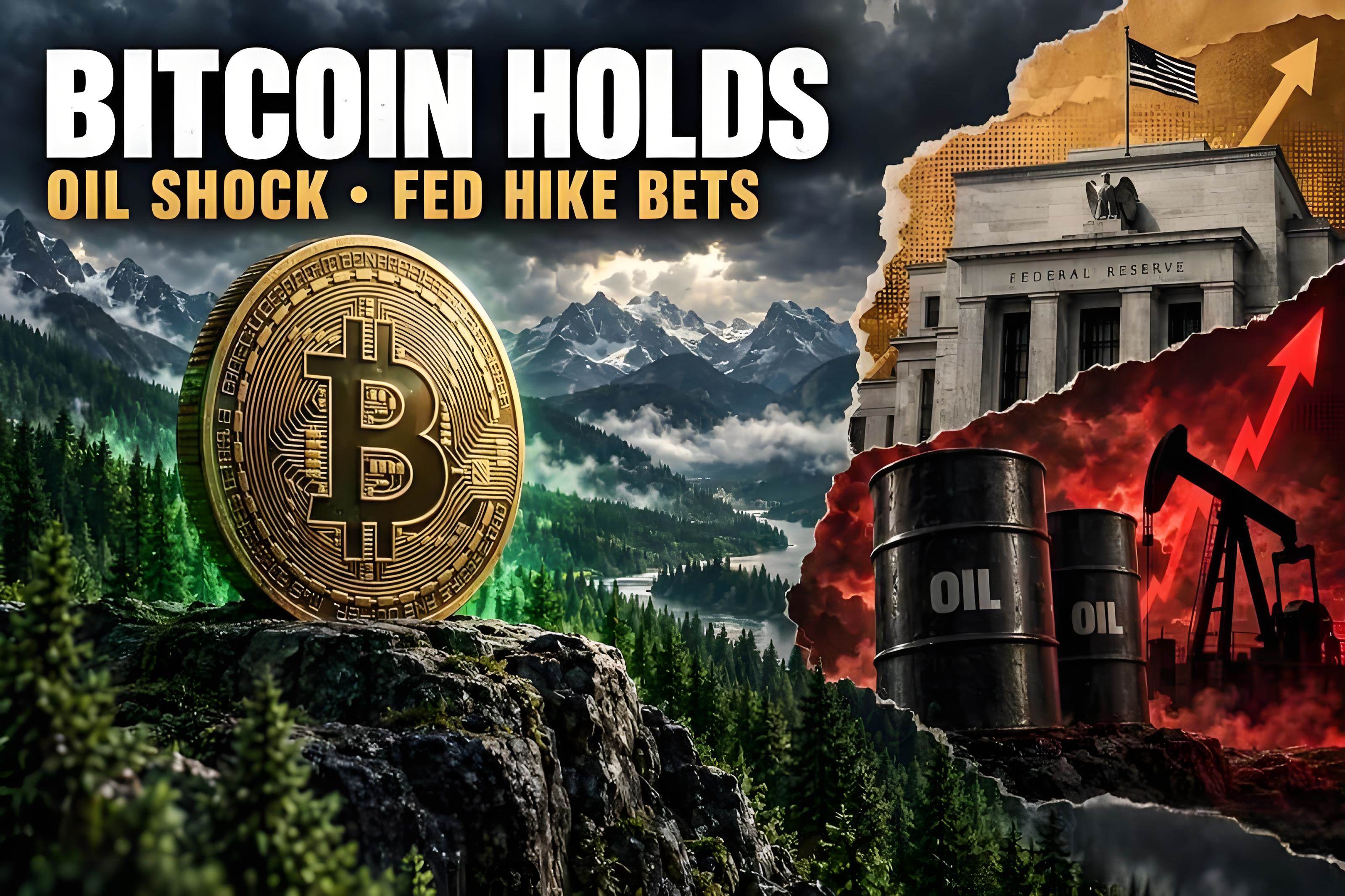
BTC The oil price shock rekindled expectations of interest rate hikes, Bitcoin held steady while Wall Street stagnated
Against the background of rising oil prices and weakening U.S. stock markets, Bitcoin's correction was limited, which made the market focus on interest rate uncertainty return to focus. Disagreements within the Federal Reserve on inflation provide a specific policy basis for this uncertainty, while Bitcoin's price resilience fails to fully reflect changes in borrowing costs or liquidation liquidity.
Core Points
- Data differences: Bitcoin price changes reported by different institutions and the decline in U.S. stocks occur during different trading hours, so direct comparisons require caution.
- Inflation concerns: Energy inflation has been one of the factors considered by the Federal Reserve in its decision to maintain interest rates. Reports on the probability of a rate hike have not been independently confirmed.
- Observation indicators: Investors should continue to pay attention to oil price movements, time-stamped interest rate expectations, and the next Federal Open Market Committee (FOMC) meeting to test Bitcoin's resilience.
Bitcoin Stability: Relative Resilience and Market Background
Bitcoin Price Volatility
According to reports on September 8, the price of Bitcoin was approximately US$78,524, down 0.72%. This is a snapshot at a specific point in time and does not provide a separate time zone for the release of exchange quotes or confirmations. Subsequently, data retrieved by CoinGecko at 03:03 UTC on September 9 showed that the price of Bitcoin was US$78,696. This provides subsequent market context rather than a simultaneous comparison with the previous U.S. stock market trading session.
At the same time point, CoinGecko recorded a rolling 24-hour decline of 0.33%. Because Bitcoin transactions are ongoing, this rolling return is neither a result of a calendar day nor a contemporaneous measure that matches the U.S. stock market. In addition, the market value at that time was approximately US$1.581 trillion, and the 24-hour trading volume was approximately US$37.33 billion. These aggregate metrics do not indicate how much executable liquidity is available to liquidators in any particular Wrapped-BTC pool.
Sentiment Index and Market Sentiment
Alternative.me's observation at 00:00 UTC on September 9 showed that its Crypto Fear and Greed Index was 66, classified as "Greed". This broad market composite index cannot identify specific reactions of bitcoin holders to oil prices or Fed policies.
Wall Street's pause: Stock market performance and safe asset controversy
Major stock indexes fall
CBS/AP's update at 1:13 pm on September 8 pointed out that the S & P 500 index fell 0.4%, the Dow Jones Industrial Average fell 575 points (or 1.1%), and the Nasdaq Composite Index fell 0.1%. Among them, Dow data is based on observations at noon EST. These are intraday declines, not verified closing returns.
Bitcoin's moderate correction and losses in equity assets support the cautious description of "resilience" but do not establish its relative excess returns over a common time period. At the same time, the data do not resolve the debate about whether Bitcoin plays a safe-haven role in U.S. -Iran tensions: There is no direct evidence in these snapshots of defensive capital flows.
How oil price shocks reignite interest rate hikes
Oil prices and inflationary pressures
The same CBS/AP report pointed out that Brent crude oil prices rose 0.6% to US$97.54 a barrel, having previously hit a high of US$99.46 in intraday trading. This fluctuation occurred against the backdrop of the Middle East conflict and uncertainty in the Strait of Hormuz. According to reports, the Global Shipping Group, an 18-nation maritime alliance, believes conflicts and other disruptions are evidence of lasting shifts in shipping conditions and says cooperation and compliance with maritime rules may reduce supply chain volatility.
In its July 29 statement, the Federal Reserve already attributed higher-than-target inflation in part to supply shocks, including energy, and cited uncertainty caused by the conflict in the Middle East. As a result, intraday gains in Brent crude have reinforced risks that policymakers have clearly identified; continued energy costs may amplify cost pressures, but uncertainty remains about this transmission effect and policy response.
The battle between expectations of interest rate hikes and reductions in interest rate cuts
In its July decision, the Federal Open Market Committee (FOMC) voted 9 - 3 to maintain the federal funds target rate in the range of 3.50%-3.75%. Beth M. Hammack, Neel Kashkari and Lorie K. Logan and his group preferred a 25 basis point hike, while the statement noted that inflation remained above the Fed's 2% target. This documented objection suggested that raising interest rates was already a realistic policy option at the time.
For DeFi users who compare yields on stablecoin supply with dollar alternatives, the constant interest rate range provides a macro benchmark rather than evidence of an increase in the annualized yield (APY) or negotiated lending rate on the loan pool. Decrypt reported that the probability of a rate hike in September is about 57%-59%, an estimate derived from CME FedWatch. However, the time-stamped CME tables and comparable previous observations have not been independently verified, so the scale of any probability change cannot be determined.
Decrypt also pointed out that the employment data was the catalyst, so reported expectations for rate hikes cannot be attributed solely to oil prices. Its reported rate increase estimates involve raising interest rates rather than just reducing interest rates, but this is still market pricing rather than a commitment from the Federal Reserve. As for the question of how interest rate expectations affect Bitcoin money flows, evidence of money flows beyond price snapshots is needed.
Observation signals for Bitcoin and the broader market
Signals to test Bitcoin's resilience
The reported rise in Brent crude and the smallest decline recorded by CoinGecko constitute a conditional test: If oil prices continue to strengthen and interest rate hikes repricing are independently confirmed, this will test whether Bitcoin's limited retracement can be sustained. Updated inflation readings, Federal Reserve communications, and Bitcoin returns aligned with U.S. stock trading hours will help distinguish whether this is a persistent phenomenon or a temporary mismatch caused by a mismatch in observation windows.
For bitcoin-backed DeFi positions, CoinGecko's aggregate volume failed to address the issues of smart contract risk, oracle risk and exit liquidity concentration. Governance decisions about mortgage factors or supply caps require evidence of specific agreements and cannot be inferred solely from Bitcoin's modest decline. The next policy decision window currently confirmed is the FOMC meeting from September 15 to 16, 2026.
Disclaimer : This article is for information reference only and does not constitute financial or investment advice. There are significant risks in the cryptocurrency and digital asset markets. Be sure to conduct independent research before making a decision.