Exchange Ranking
 Top Exchanges
 24h Volume Ranking
 Popularity Ranking
 Exchange BTC Balance
 Proof of Reserves
 Decentralized Exchanges
 Funding Rate
 Funding Heatmap
 Liquidation Data
 Max Pain
 Long/Short Ratio
 Whale L/S Ratio
 Binance/Okex/Huobi L/S
 Bitfinex Margin L/S
 ETF Tracker
 Solana ETF
 XRP ETF
 Hong Kong ETF
 Bitcoin Treasuries
 Crypto Reversal
 Ethereum Reserves
 HyperLiquid Wallet Analysis
 Hyperliquid Whale Watch
 Large Transactions
 On-chain Movement
 Bitcoin ROI
 Stablecoin Market Cap
 Options Analysis
 News
News Articles
 Economic Calendar
 Features
 Wallet
 Contract Calculator


 Security
 Collections
 Watchlist
 Following
 BTC
BTC CLARITY bill text changes substantially before first Senate vote
Three core facts suggest that the text of the CLARITY bill--not just its political attributes---changed in the days before the Senate first faced its test.
The text of the bill itself before the vote has been rewritten.
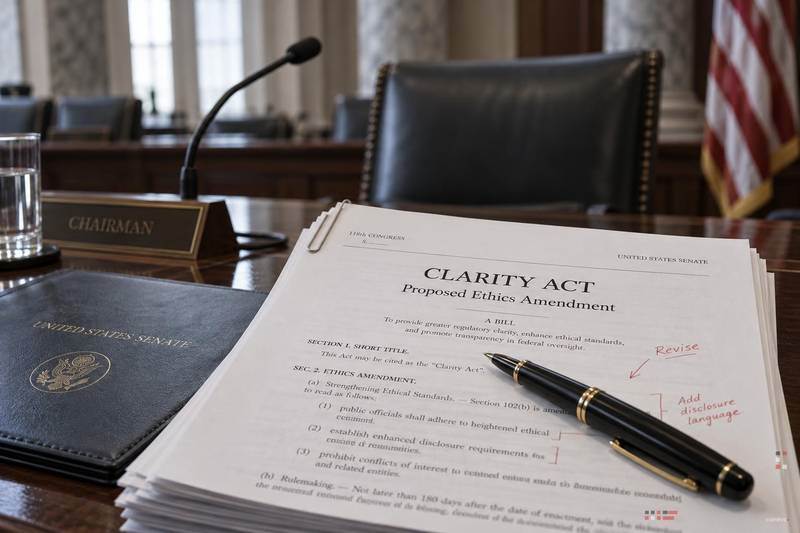
The version of the Crypto Clarity Act that is now about to be submitted to the Senate for a vote is not the original version originally proposed. According to multiple media reports, the revised draft adds new ethics provisions and deletes the part originally targeted at the Central Bank's Digital Currency (CBDC). This constitutes a substantive change to the voting content, not a procedural adjustment: between the two draft versions, the bill's jurisdiction over "CBDC related conduct" has been narrowed.
However, this amendment does not resolve the fundamental jurisdictional issue that the bill seeks to clarify, whether the Securities and Exchange Commission (SEC) or the Commodity Futures Trading Commission (CFTC) has primary regulatory authority over digital assets. This division of power remains the core outstanding question that the vote attempts to answer.
Republicans provided revised text, not concessions
In addition, Senate Republicans sent Democrats what they called a "final offer" on the CLARITY Act. This development was widely reported by many media outlets, making it one of the more detailed events recorded during the period.
The offer includes revised legislative text submitted shortly before the expected Senate vote. A "final offer" is a negotiating gesture, not a verdict or a passed bill. Relevant reports did not confirm that Democrats had accepted the text or that it was the version that would be put to a vote. But it establishes the fact that at the same time as the ethics rule revision was reported and the CBDC clause revision was being revised, the legislative text was still being revised in the negotiation room. This means that on the eve of the same vote, at least two independent channels for text change were operating simultaneously.
A key fact is that a vote requires 60 votes.
Multiple media reports have clearly pointed out a key procedural fact: the vote scheduled for Tuesday, September 15 requires 60 votes to move forward, which is the bill's first test in the Senate. Senator McCormick urged the Senate to hold a vote. President Trump met with advisers on the bill before Tuesday's meeting.
None of these actions can determine the voting result. But they set a mechanical threshold in the record: the bill needed to cross 60 votes, not a simple majority; and this was the first test, not final passage.
Record what is displayed and what is not displayed
Combining the above three points, we can see a bill that is undergoing substantive revisions at least two levels: on the one hand, revisions to the ethics clause and CBDC section, and on the other hand, textual adjustments under negotiation. The bill is facing the 60-vote procedural threshold needed for its first test. There were no reports confirming that the bill had passed, that Democrats accepted the Republican offer, or that the version voted on Tuesday was final in any sense (other than the label attached to the offer).
Among this series of information, the 60-vote threshold is the only data that is not a negotiable language but a fixed program requirement, and it is also the fact that it is most likely to remain important no matter which version of the text is ultimately placed on the desktop.
The facts shown in the records include: the revised bill text, Republican offers for the revised text, and the 60-vote threshold required for Tuesday's first Senate test. None of these three documents confirm the final result, but only clarify the terms and basis for determining the results.