Exchange Ranking
 Top Exchanges
 24h Volume Ranking
 Popularity Ranking
 Exchange BTC Balance
 Proof of Reserves
 Decentralized Exchanges
 Funding Rate
 Funding Heatmap
 Liquidation Data
 Max Pain
 Long/Short Ratio
 Whale L/S Ratio
 Binance/Okex/Huobi L/S
 Bitfinex Margin L/S
 ETF Tracker
 Solana ETF
 XRP ETF
 Hong Kong ETF
 Bitcoin Treasuries
 Crypto Reversal
 Ethereum Reserves
 HyperLiquid Wallet Analysis
 Hyperliquid Whale Watch
 Large Transactions
 On-chain Movement
 Bitcoin ROI
 Stablecoin Market Cap
 Options Analysis
 News
 Articles
 Economic Calendar
 Features
 Wallet
 Contract Calculator


 Security
 Collections
 Watchlist
 Following
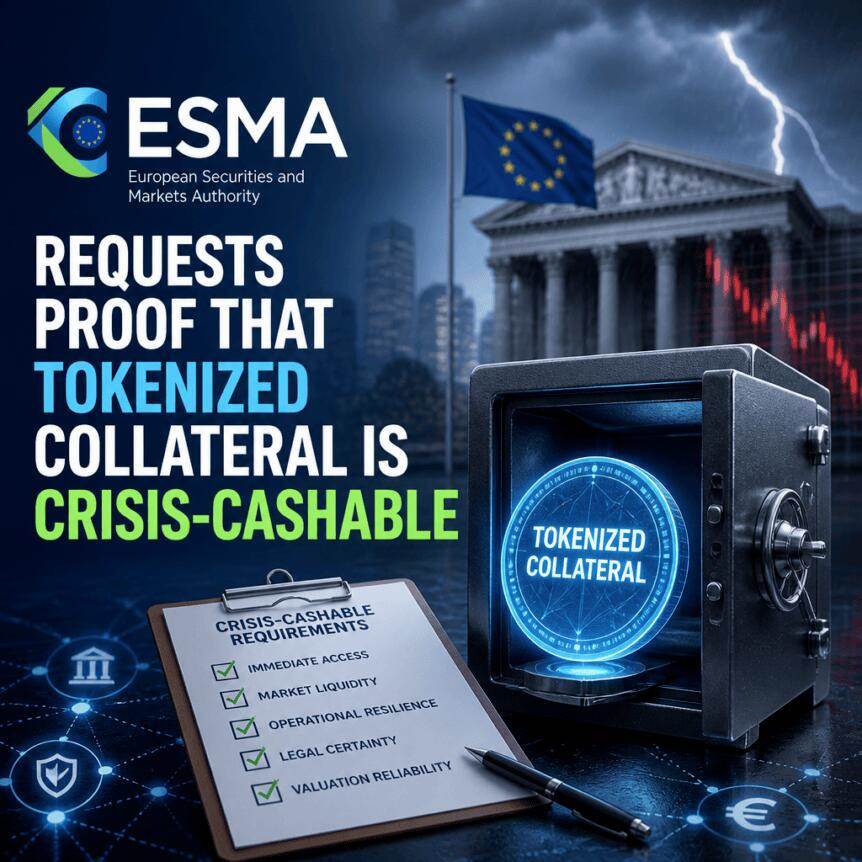
European regulators require clear evidence that tokenized collateral can be quickly monetized in crises
European regulators are pushing for clearer evidence that tokenized collateral can be safely used when the clearing house's market deteriorates. The European Securities and Markets Authority (ESMA) has issued an evidence call announcement aimed at understanding how tokenized assets can be accessed, cleared and managed under central clearing arrangements, especially in stress scenarios.
This move by ESMA came into being as tokenized collateral moved from the pilot phase to the actual clearing workflow. Banks and investors are increasingly looking for faster and more flexible access to securities to meet margin requirements, and services based on distributed ledger technology are beginning to appear in mainstream infrastructure.
Key Points
- Verification of Liquidation Capability: ESMA is seeking evidence to confirm whether the clearing house can access tokenized collateral and convert it into cash in a stressful scenario caused by default.
- Coverage is extensive: This consultation covers tokenized representation of traditional assets, as well as assets issued directly on distributed ledgers.
- Definition of Legal Rights: Regulators want to clarify whether token transfers create enforceable ownership rights for underlying assets.
- Interaction with other financial instruments: ESMA is also reviewing the interactions between tokenized collateral and stablecoins, central bank digital currencies, and tokenized deposits.
- 前期基础:此次审查紧随早期基础设施建设的步伐,包括Eurex Clearing推出的DLT支持抵押品服务以及欧元体系的Pontes结算平台。
为何ESMA现在要求提供证据
ESMA在周五发布的证据征集公告中表示,需要建立“确保代币化市场跨境安全且大规模运营的条件”,强调法律确定性、互操作性基础设施以及适当的监管。ESMA主席Verena Ross指出,监管机构必须理解如何将代币化抵押品整合到现有的跨境框架中,同时不削弱风险控制措施。
此次咨询的核心是一个实际问题:如果清算会员违约,清算所能否可靠地获取代币化抵押品,将其清算,并使用所得款项履行义务?ESMA征求行业反馈的目的是测试当前的欧盟规则和操作流程在抵押品以代币化形式存在时是否足够有效。
咨询涵盖的内容:代币化抵押品模型
ESMA的范围不仅限于单一的技术方法。该咨询涉及两种广义形式的代币化抵押品:一是仍位于传统金融基础设施内的资产的代币化代表;二是直接在分布式账本上发行的资产。
Regulators also want to understand how these tokenized structures work in conjunction with other payment and value layers on the chain or associated with tokens. Specifically, ESMA said it would review its interactions with stablecoins, central bank currencies and tokenized deposits-components that could significantly affect the path of liquidity during stressful events.
Even if an asset is considered liquid in its traditional form, ESMA warns that tokenization may introduce additional risks. These risks include delays or restrictions on transfers related to redemption processes-issues that can become critical in time-sensitive margin management and default handling.
ESMA further asked respondents to address legal, regulatory and structural issues regarding custody rights and rights. Specifically, the consultation included whether token transfers were sufficient to confer ownership or other enforceable rights over the underlying assets, rather than just transferring digital representatives.
From real-time DLT collateral services to regulatory review
In Europe, tokenized collateral is no longer a purely theoretical concept. ESMA issued the evidence solicitation order after Eurex Clearing launched a collateral service based on distributed ledger technology in July 2025. Based on service promotion, Eurex Clearing said it became the first central counterparty (CCP) in the world to launch a DLT-backed collateral mobilization service, allowing securities to be moved from one custody location to another.
The process includes a real-time transaction executed for Dutch pension fund investor PGGM to transfer the securities from another custody location. The existence of such operating instances may be one reason why ESMA is now formally raising questions that no longer focus on whether tokenization moves assets, but on whether it retains the speed, certainty and legal strength required for liquidation under pressure.
As these services expand, differences in the impact of tokenization on transfer times, redemption mechanisms, and ownership enforceability have become central to risk management. ESMA's emphasis on liquidity-that is, converting tokenized collateral into cash when markets are under pressure-suggests it believes these details are regulatory gaps that must be filled with evidence.
How the Pontes platform and central bank clearing affect tokenized clearing
ESMA's consultation follows the development of other infrastructure aimed at making tokenized clearing more interoperable with existing systems. Regulators cited the Eurosystem's Pontes platform launched in September, which allows financial institutions to use central bank currency to settle tokenized asset transactions.
ESMA stated that Pontes could support tokenized collateral arrangements by connecting blockchain-based infrastructure to existing settlement tracks. This is important for clearing because central bank monetary clearing is often seen as a key element in reducing settlement risk and improving liquidity management-two aspects that are particularly important in stressful events.
Still, Pontes mainly addresses the settlement of tokenized transactions rather than the broader issue of ESMA's concern: what happens to tokenized collateral when a member defaults. As a result, the consultation suggests that regulators are looking at the entire chain-how collateral is held, how access is made, how rights are attached, and how quickly liquidation occurs.
What should investors and market participants focus on next
ESMA's collection of evidence is an early but decisive step: It suggests that tokenized collateral used for central clearing will face rigorous scrutiny of liquidity and enforceable rights, not just technical feasibility. Market participants should pay close attention to the feedback ESMA receives and ESMA's regulatory direction in terms of legal certainty and operating standards in default scenarios, where delayed or ambiguous ownership mechanisms can have a disproportionate impact.