Exchange Ranking
 Top Exchanges
 24h Volume Ranking
 Popularity Ranking
 Exchange BTC Balance
 Proof of Reserves
 Decentralized Exchanges
 Funding Rate
 Funding Heatmap
 Liquidation Data
 Max Pain
 Long/Short Ratio
 Whale L/S Ratio
 Binance/Okex/Huobi L/S
 Bitfinex Margin L/S
 ETF Tracker
 Solana ETF
 XRP ETF
 Hong Kong ETF
 Bitcoin Treasuries
 Crypto Reversal
 Ethereum Reserves
 HyperLiquid Wallet Analysis
 Hyperliquid Whale Watch
 Large Transactions
 On-chain Movement
 Bitcoin ROI
 Stablecoin Market Cap
 Options Analysis
 News
 Articles
 Economic Calendar
 Features
 Wallet
 Contract Calculator


 Security
 Collections
 Watchlist
 Following
 ETH
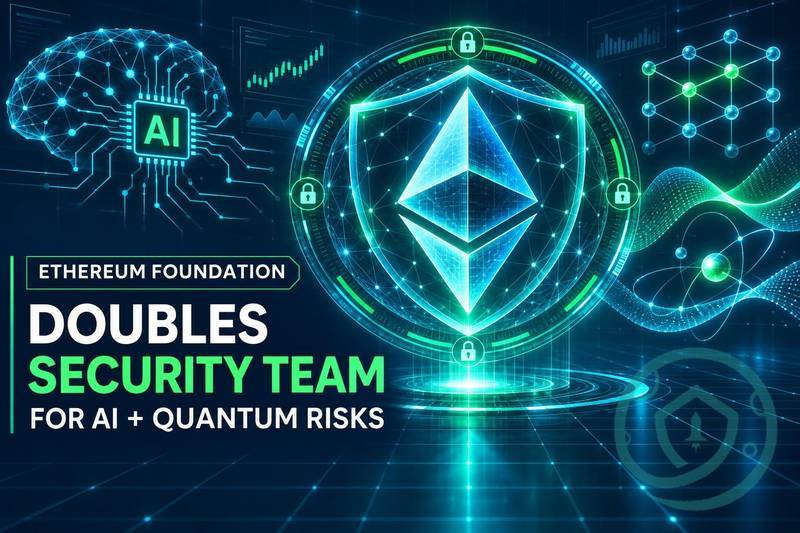
The Ethereum Foundation accelerates the security upgrade to deal with quantum computing and artificial intelligence threats
In a blog article published on Monday, the Etheleum Foundation announced that mitigation measures against quantum calculations had long been under way in the planning process, but artificial intelligence had become a more pressing security risk — which prompted the Foundation to make the enhancement of the safety of protocol a top priority.
The article also outlined how the planned upgrade would reach the core of the Etheleum infrastructure, including the certificationer ' s signature, the trade authorization and the validation mechanism for Rollup data.
Core elements
- Team expansion:The Ethereum Foundation has doubled the size of the Protocol security team to keep up with a faster and more secure development cycle.
- Bottom-up change:The upgrade is expected to change the underlying protocol mechanism: it involves the certificationer's message signature, user transaction authorization and the rollup data validation.
- Risk shift:Wedburn has changed the direction of the security road map by considering artificial intelligence as an updated and more urgent risk than a simple quantum threat.
- Balance and challenges:The Foundation recognizes the trade-off: faster progress may increase the risk of publication gaps, which makes formalization of certification more important.
- Timeline adjustments:Previous reports indicate that the broader “post-quant” and “post-AI” transition schedules are moving forward in Etheleum Foundation researcher Justin Drake, who referred to the target node in December 2028.
Why is the security road map reshaped?
The Ethereum security road map has long included efforts to reduce exposure to future quantum computations. Yet, according to Wedburn, the risk pattern has changed: artificial intelligence is now considered to be sufficiently urgent to influence the speed and scope of protocol enhancement.
This shift is significant for users and developers, not only because it addresses loopholes, but also because of the way Ethereum operates at the basic level. The Foundation sends a signal that the defence measures of Protocol need to be integrated across multiple levels, rather than being added as an additional component after the core structure has been defined.
What's this remodeling to change?
According to Wadeborn, the planned upgrade would require modifications in several places embedded in the Ethereum operating security assumptions.
First of all,He will change the way the certifier signs the message. The certifier’s signature is a key element in the Ethereum Consensus and the certification conduit, so that changes here usually have a ripple effect on security certificates, customer-to-client realization, and upgrading coordination.
Second of all,This re-engineering is expected to adjust the way in which the user authorizes the transaction. The authorization is where the logic of signature and authority intersects with the application behaviour, and any change may affect the Wallet software, the user process and the developers' tools, especially if the signature program or the authentication program evolves.
Thirdly,The Foundation indicates that it plans to update the Ethelium Validation of Rollup's Data Releases. Rollup relies on Ethelum as a certification layer for certain types of certification and data commitments.
Increased demand for validation as a result of accelerated development
Wade Burns described the upgrade as more difficult than the transition to the famous Etheleum Merge, while emphasizing that time pressure is increasing. He noted that faster development makes it easier to find loopholes – a recognition that accelerated work may introduce new risks while mitigating long-term threats.
To address this tension, he indicated that the Etheleum Foundation expanded its protocol security team and emphasized formalization and security to keep pace with the protocol development. The message was clear: when the core cipher and protocol mechanisms were in a state of change, it might not be enough to rely on traditional testing alone.
The Fellow also described the enhancement as a continuous, cross-level requirement. “Each level of the protocol and ecology systems needs to be adapted,” he said, and described the effort as the top priority of the network.
Evolution of the time line
Earlier this month, Justin Drake, an Etheleum Foundation researcher, outlined the target time for completing the Etheleum “post-quant” and “post-AI” transition as December 2028. While Wadeburn’s blog post emphasized the urgency of artificial intelligence and expanded security staffing, the shift in time lines highlighted a broader theme: Etheleum does not see quantum readiness as a single milestone.
Outlook for the future
Investors, developers, and users should closely follow how the foundation translates these high-level commitments into concrete normative updates – particularly with regard to the certificationer’s signature, transaction authorization and rollup certification of changes. The key open question at hand is how Etheleum strikes a balance between urgency and security: for long-term resilience, protocol evolution may need to be accelerated, but it is likely to depend on rigorous formalization to avoid introducing new categories of loopholes during the transition.