Exchange Ranking
 Top Exchanges
 24h Volume Ranking
 Popularity Ranking
 Exchange BTC Balance
 Proof of Reserves
 Decentralized Exchanges
 Funding Rate
 Funding Heatmap
 Liquidation Data
 Max Pain
 Long/Short Ratio
 Whale L/S Ratio
 Binance/Okex/Huobi L/S
 Bitfinex Margin L/S
 ETF Tracker
 Solana ETF
 XRP ETF
 Hong Kong ETF
 Bitcoin Treasuries
 Crypto Reversal
 Ethereum Reserves
 HyperLiquid Wallet Analysis
 Hyperliquid Whale Watch
 Large Transactions
 On-chain Movement
 Bitcoin ROI
 Stablecoin Market Cap
 Options Analysis
 News
News Articles
 Economic Calendar
 Features
 Wallet
 Contract Calculator


 Security
 Collections
 Watchlist
 Following
 ADA
ADA  BTC
BTC  ETH
ETH  HYPE
HYPE  SOL
SOL  STX
STX  SUI
SUI  XRP
XRP In the past week, the cryptocurrency market has risen more than 10%, with a total market value of approximately US$2.67 trillion, and the Bitcoin price has regained its footing above US$80,000 for the first time since May. The rally was mainly driven by macro factors: the U.S. Treasury's plan to double the size of long-term bond repurchases to $4 billion per round has weakened the dollar and prompted investors to turn to alternative assets. The U.S. spot Bitcoin ETF also attracted approximately $1.92 billion in funds last week, injecting strong institutional power into the rally.
The rally has spread to altcoins. In the market snapshots used for this analysis, XRP rose 46.97% in seven days, Ethereum rose 29.19%, Solana rose 27.63%, and Cardano rose 22.79%. But with the Cryptocurrency Fear and Greed Index rising to around 80, and Bitcoin facing liquidation thresholds close to $82,648 and $74,858, there is a lot of risk chasing the biggest currencies after the rally.
So we asked ChatGPT, Gemini, and Grok a more specific question: Which established or mid-market cap cryptocurrency is most likely to achieve the largest percentage return over the next six to twelve months?
How can we get AI to find the next cryptocurrency explosion
We didn't ask models to simply name their favorite cryptocurrency. The definition of "outbreak" is set to the currency most likely to achieve an excess percentage return within six to twelve months. Each model needs to consider price movements, market capitalization, trading volume, on-chain activity, token economics, upcoming catalysts, institutional interest, ecosystem growth, and risks that could undermine this argument. 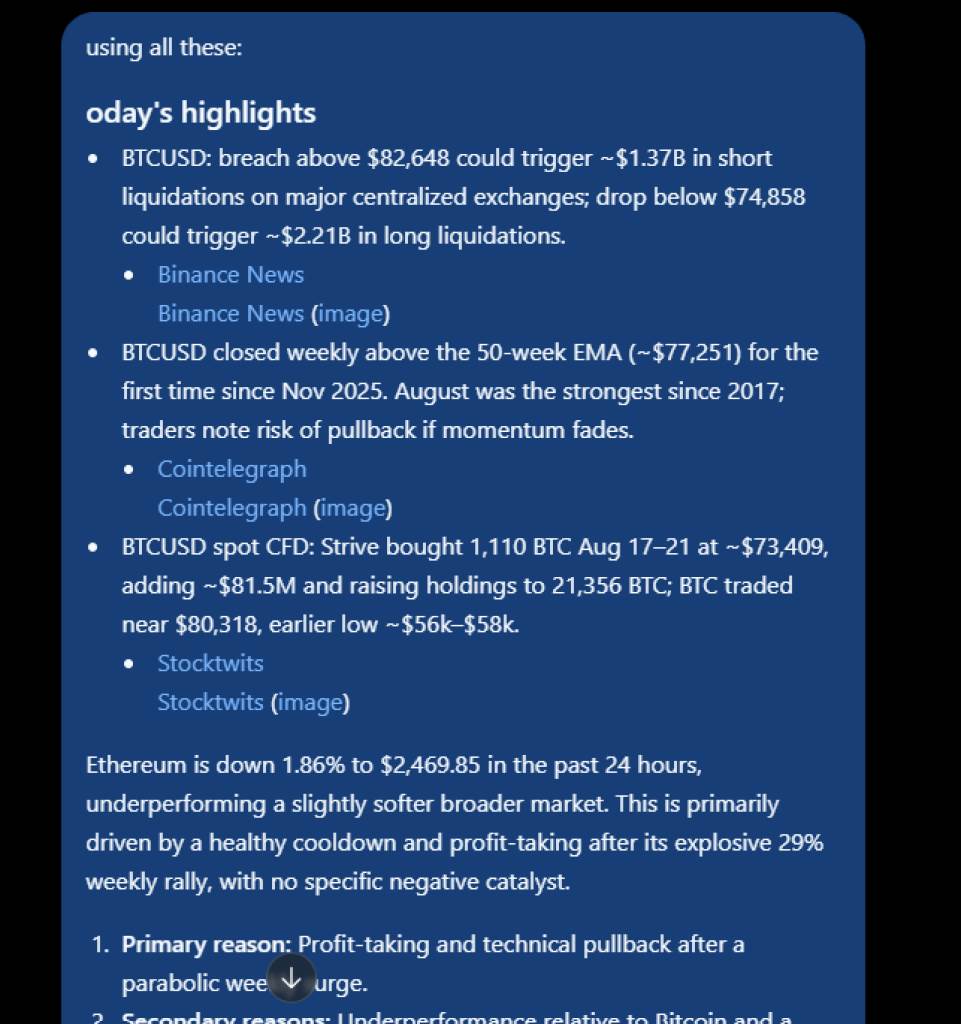
The model was also required to examine a wide range of options, rather than default to Bitcoin, Ethereum, XRP or Cardano. This is important because Bitcoin has risen by about 28% in August, while XRP has risen nearly 47% in seven days. So the issue is the room for percentage growth from now on, not which asset brand is the strongest or most liquid.
Market background is another part of the test. Bitcoin prices have regained the US$80,000 area, ETF inflows have returned, and treasury bond repurchases have created a liquidity-driven risk-appetite environment. In addition, the Jackson Hole meeting will begin on August 27, making Fed policy the main risk to the rally. This leaves smaller cryptocurrencies with more upside potential, but also exposes them to greater risk of overall market reversal.
ChatGPT picks next burst cryptocurrency
ChatGPT chose Hyperliquid (HYPE), citing a combination of protocol usage, revenue and token economics. In the market snapshot provided, HYPE is priced at approximately US$80.77 and has a market value of nearly US$18 billion. This is much lower than Bitcoin, Ethereum and XRP, but large enough to establish liquidity. 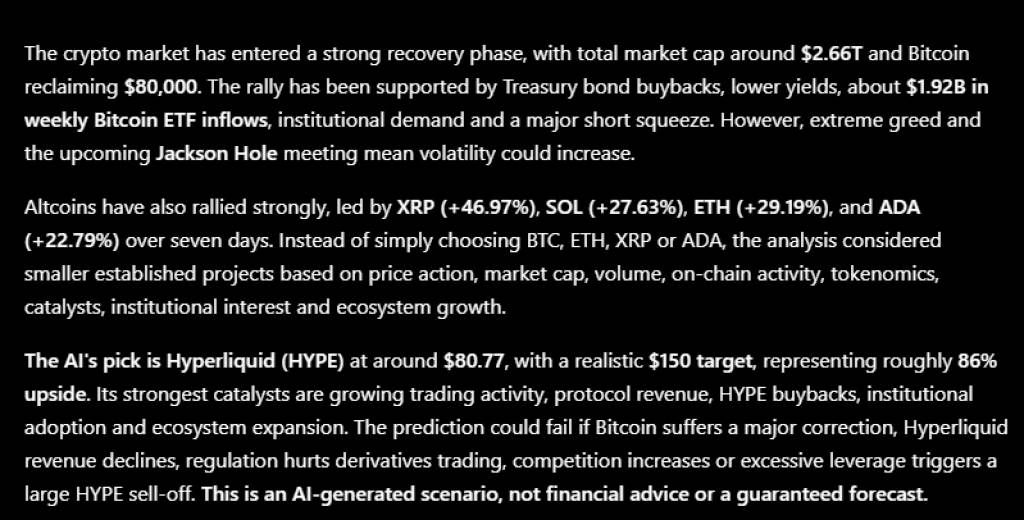
The most powerful part of HYPE's argument is the connection between network activity and tokens. Hyperliquid's document states that more than $1 billion in annualized fees were used for programmatic HYPE buybacks. These fees are channeled through the aid fund, which converts transaction fees into HYPE and destroys purchased tokens. Hyperliquid has also become a major online derivatives trading venue. Recent data shows that its perpetual contract trading volume is US$17.05 billion and its open positions are US$9.21 billion, indicating that there is real trading activity behind the agreement to support the token valuation. As a result, ChatGPT set a HYPE target price of $150, which is approximately 86% higher than $80.77. In a stronger bull market scenario, prices could rise to $180 -200.
Gemini picked next cryptocurrency to explode
Gemini chose Sui (SUI) because of its small valuation and the potential for a larger percentage increase. In the scenarios provided, the price is close to US$0.80 -0.85, and the market value is approximately US$3.29 billion, making SUI much smaller than HYPE. 
The argument revolves around Sui's first-level ecosystem, DeFi activities and institutional use cases. Gemini has set a bullish price target of $3.15, which is approximately 280%-290% higher than the starting price range provided. Key conditions include confirmed technological breakthroughs, continued growth in DeFi liquidity and a favorable macro environment. SUI does face more token supply risks than HYPE. The analysis provided shows that the circulating supply is approximately 4.07 billion SUIs, accounting for approximately 41% of the total supply. This means that if network demand does not grow fast enough, future unlocking may bring additional selling pressure.
Grok's pick for the next burst cryptocurrency
Grok chose Stacks (STX), giving the most aggressive percentage upside of the three. Among the snapshots provided, STX is priced at approximately US$0.25 -0.28, and its market value is close to US$450 - 480 million. A smaller valuation means a larger percentage increase with less money. 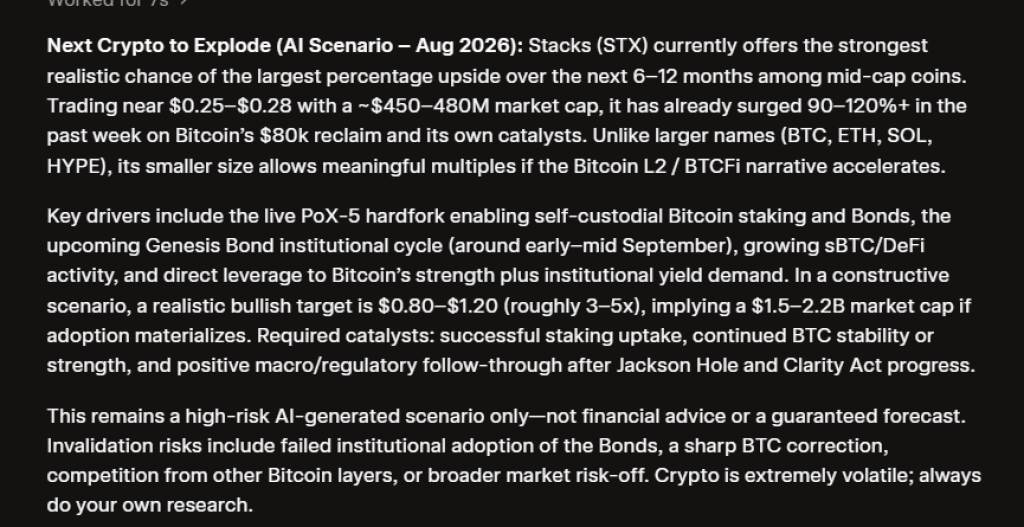
The fundamental catalyst is Bitcoin's native finance. Stacks activated the PoX-5 hard fork on July 30, laying the foundation for Bitcoin pledge, and the first institutional-level Genesis Bond is scheduled to be launched around September 10. Stacks also reported that in the second quarter, the cumulative users exceeded 1.6 million, the total value of 110 million STXs were locked, and the cumulative BitFlow transaction value exceeded US$5 billion. Grok's bullish target price is $0.80-$1.20, which means an increase of approximately 3 to 5 times from the starting price offered. The argument relies heavily on Bitcoin's continued strength, institutional participation in Bitcoin pledges, and the continued growth of sBTC and Stacks DeFi.
Comparison of three AI predictions
These three options represent three different risk scenarios. HYPE has the best combination of actual revenue, trading activity and direct repurchase mechanisms, but its valuation of approximately $18 billion limits the ease of achieving a three-fold increase. The smaller valuation of SUI may lead to a larger percentage increase, but token unlocking and ecosystem execution create more uncertainty. STX has the smallest valuation and the largest percentage return potential, but its arguments are highly dependent on the successful launch of Bitcoin DeFi and Bitcoin Pledge.
Which cryptocurrency has the strongest argument?
If the goal is the best balance between fundamentals and upside space, then HYPE's argument is strongest. Its fee income is measurable, trading activity is huge, and the repurchase mechanism directly connects agreement usage to HYPE demand. Hyperliquid's documentation also confirms that its ecosystem generates billions of dollars in transactions every day. If the goal is purely the maximum potential percentage increase, then STX wins in valuation. A rise from about $0.27 to $1.00 would bring about an increase of about 270%, but it would require multiple catalysts to work at the same time.
What may go wrong with these AI predictions?
The biggest risk is a reversal of macro gains. Bitcoin has a liquidation risk below US$74,858, and the market has entered a state of extreme greed. The Fed's hawkish rhetoric at the Jackson Hole meeting could push up yields and the dollar, putting pressure on cryptocurrency prices. HYPE also faces valuation and leverage risks, SUI faces pressure to unlock tokens, and STX is highly dependent on the successful adoption of Bitcoin pledges. Stacks has built the infrastructure for its Genesis Bonds, but the real test is the scale of institutional capital entering the system.
As a result, the three AI models did not agree on a winner: ChatGPT chose HYPE because it had the strongest fundamentals;Gemini chose SUI because it had a higher percentage increase; and Grok chose STX because it had the most aggressive risk-reward ratio. These are AI-generated scenarios, not financial advice or assurance forecasts.
Frequently Asked Questions
Which cryptocurrency is likely to explode the largest in the next 6-12 months?
HYPE, SUI and STX were selected for the three AI models, with STX providing the highest potential percentage increase. Grok's target price of $0.80-$1.20 represents an increase of about 3 to 5 times from the analytical price range.
Can Hyperliquid (HYPE) reach US$150?
HYPE could reach $150 if Hyperliquid maintains strong trading activity, fee revenue and token repurchases. Starting from about $80.77,$150 means an increase of about 86%.
Why did Gemini choose Sui (SUI) over Bitcoin and Ethereum?
Gemini focuses on percentage gains rather than market dominance. SUI's smaller market value provides more room for growth. The model target price is US$3.15, which is approximately 280%-290% higher than its analytical price.