Exchange Ranking
 Top Exchanges
 24h Volume Ranking
 Popularity Ranking
 Exchange BTC Balance
 Proof of Reserves
 Decentralized Exchanges
 Funding Rate
 Funding Heatmap
 Liquidation Data
 Max Pain
 Long/Short Ratio
 Whale L/S Ratio
 Binance/Okex/Huobi L/S
 Bitfinex Margin L/S
 ETF Tracker
 Solana ETF
 XRP ETF
 Hong Kong ETF
 Bitcoin Treasuries
 Crypto Reversal
 Ethereum Reserves
 HyperLiquid Wallet Analysis
 Hyperliquid Whale Watch
 Large Transactions
 On-chain Movement
 Bitcoin ROI
 Stablecoin Market Cap
 Options Analysis
 News
News Articles
 Economic Calendar
 Features
 Wallet
 Contract Calculator


 Security
 Collections
 Watchlist
 Following
 BTC
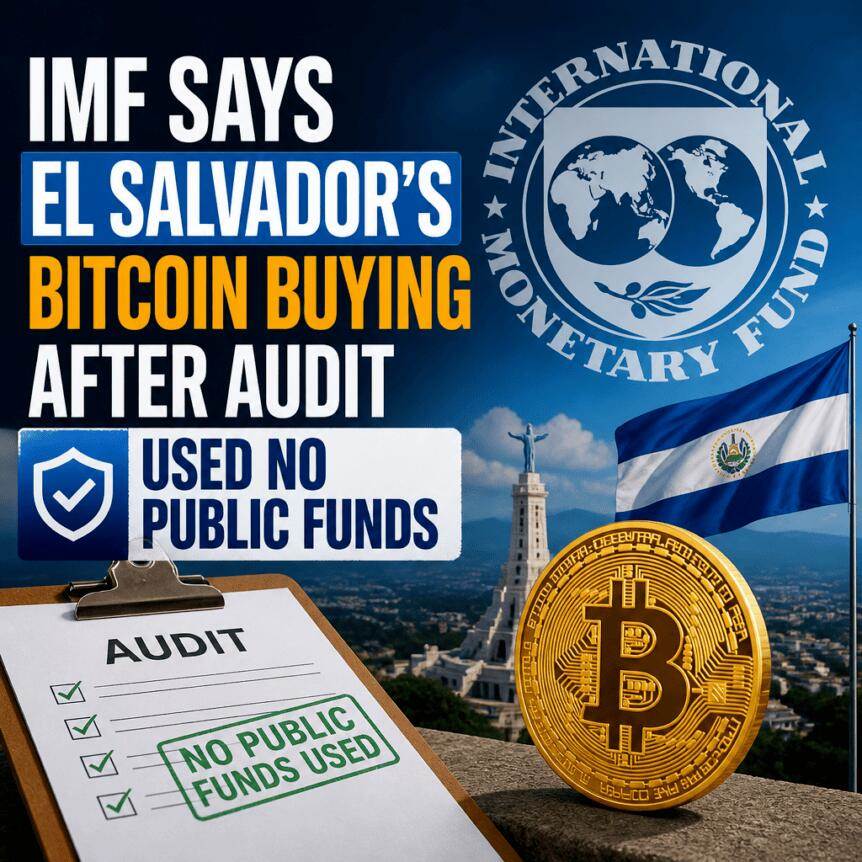
BTC IMF clarifies: El Salvador increases its holdings of Bitcoin after June 2025 and unspent public funds
El Salvador's Bitcoin holdings increased after the International Monetary Fund (IMF) reviewed parts of its $1.4 billion aid program in June 2025. However, the IMF made it clear that the country has not used public funds to accumulate additional bitcoin. In a statement released Thursday, the agency noted that documents provided by Salvadoran authorities confirmed the increase originated from private donations rather than government-funded purchases.
The IMF also pointed out that operating control of El Salvador's Chivo wallet has been transferred to private operators, while the government retains only a minority stake and custody responsibilities. The IMF added that apart from donations that can confirm the origin, it does not expect further accumulation of Bitcoin.
Core Points
- The IMF verified that Bitcoin holdings after June 2025 were funded by private donations rather than public resources.
- Most of the ownership and day-to-day operation control of Chiewo Wallet has been transferred to private operators, while the government retains minority equity and custody responsibilities. [TAG The explanation aims to address a new round of compliance concerns raised by El Salvador after it publicly reported large bitcoin purchases at the end of 2025. [TAG El Salvador still holds a sizable bitcoin reserve-about 7,764 BTC, worth about $628 million at the price level cited by CoinGecko.
IMF: June 2025 overweight does not involve government funds
According to the IMF, the key point of its June 2025 review was whether El Salvador's increase in Bitcoin holdings reflected public spending. In documents released Thursday, the IMF said it reviewed documents provided and found that the additional Bitcoin holdings were related to private donations.
This is critical because El Salvador's IMF-backed financing arrangements are tied to economic and policy conditions, including restrictions on public institutions 'participation in Bitcoin activities. The IMF's statement effectively distinguishes "donor-driven" growth from purchases that imply further public financing. [TAG Thursday's statement also noted that the government has no intention of accumulating additional bitcoins beyond those confirmed to be from donations-another signal that the IMF is drawing boundaries for what it considers to be eligible for the program.
Control of the Chivo wallet changes, but custodial responsibility remains
In addition to the source of funding, the IMF statement also addresses the structure of the Salvadoran Chivo bitcoin wallet. The agency said most ownership and operational control of the wallet had been transferred to private operators, while the government retained minority ownership and custodial responsibility.
To observers, this distinction goes beyond simple corporate governance. Previous IMF discussions on Bitcoin policy emphasized reducing public sector participation. By describing changes in operational control and retaining only a narrower role for government, the IMF clarified how it views the relationship between current settings and early conditions.
Why an explanation is needed again
Although the IMF has been closely monitoring El Salvador's bitcoin purchases, the latest clarifications came as the controversy reheated after El Salvador announced in November 2025 that it would acquire 1,090 bitcoins worth US$100 million.
The November announcement raised questions about El Salvador's compliance with its IMF program. Previous reports have pointed out that the IMF's arrangements include restrictions aimed at restricting certain types of public sector participation in Bitcoin. As a result, the IMF verification in June 2025 appears to be aimed at reconciling the country's reported reserve increases with the conditions it set-particularly when the El Salvador Bitcoin Office is still posting news of the continued accumulation despite a previous understanding.
From "removing Chiewo's participation" to "involuntary accumulation"
The current controversy lies in the original conditions under the IMF financing arrangements. In December 2024, El Salvador agreed to limit public sector participation in the Bitcoin space. The agreement outlines several elements: acceptance of Bitcoin by the private sector should be voluntary, taxes should be paid in U.S. dollars, and government participation in Chiwo should be phased out.
In March 2025, the IMF issued additional documents banning what it called the "voluntary accumulation" of bitcoin by the public sector. President Naib Buker publicly refuted, saying purchases had "not stopped" and that El Salvador would continue to add at least one BTC a day.
Subsequently, the Bitcoin Office frequently issued messages indicating that it was accumulating Bitcoin. In July 2025, the IMF provided a preliminary explanation for early reserve changes, saying no new bitcoins had been purchased since the December agreement and attributed the increase to consolidation between government wallets.
However, the November 2025 announcement of a larger acquisition has revived doubts. An IMF representative had previously told media that the agency would not provide "real-time comments" on the announcement and would assess compliance in an appropriate manner. Thursday's announcement can be seen as a timely assessment of the period after the agency's first review.
How big are El Salvador's Bitcoin reserves now?
According to the official reserve tracker of the National Bitcoin Office, El Salvador currently holds approximately 7,764 bitcoins. Based on the $80,900 price level cited by CoinGecko, the reserve is worth approximately $628 million.
Importantly, the IMF's position suggests that the post-agreement reserve growth was not explained at least in part by government purchases, but was driven by the flow of donations that Salvadoran authorities claimed to be recordable. Readers should note that the IMF's verification focuses on the source of accumulation rather than whether the absolute amount of reserves has increased.
Looking ahead, market participants are likely to pay close attention to two things: whether El Salvador will continue to provide documentation to support donation-related growth, and how Chivo Wallet's operating role under the private operator structure evolves. As the IMF translates compliance checks into formal conclusions, the durability of El Salvador's Bitcoin narrative under this heading may depend on the clarity and consistency of the evidence.