Exchange Ranking
 Top Exchanges
 24h Volume Ranking
 Popularity Ranking
 Exchange BTC Balance
 Proof of Reserves
 Decentralized Exchanges
 Funding Rate
 Funding Heatmap
 Liquidation Data
 Max Pain
 Long/Short Ratio
 Whale L/S Ratio
 Binance/Okex/Huobi L/S
 Bitfinex Margin L/S
 ETF Tracker
 Solana ETF
 XRP ETF
 Hong Kong ETF
 Bitcoin Treasuries
 Crypto Reversal
 Ethereum Reserves
 HyperLiquid Wallet Analysis
 Hyperliquid Whale Watch
 Large Transactions
 On-chain Movement
 Bitcoin ROI
 Stablecoin Market Cap
 Options Analysis
 News
News Articles
 Economic Calendar
 Features
 Wallet
 Contract Calculator


 Security
 Collections
 Watchlist
 Following
 BTC
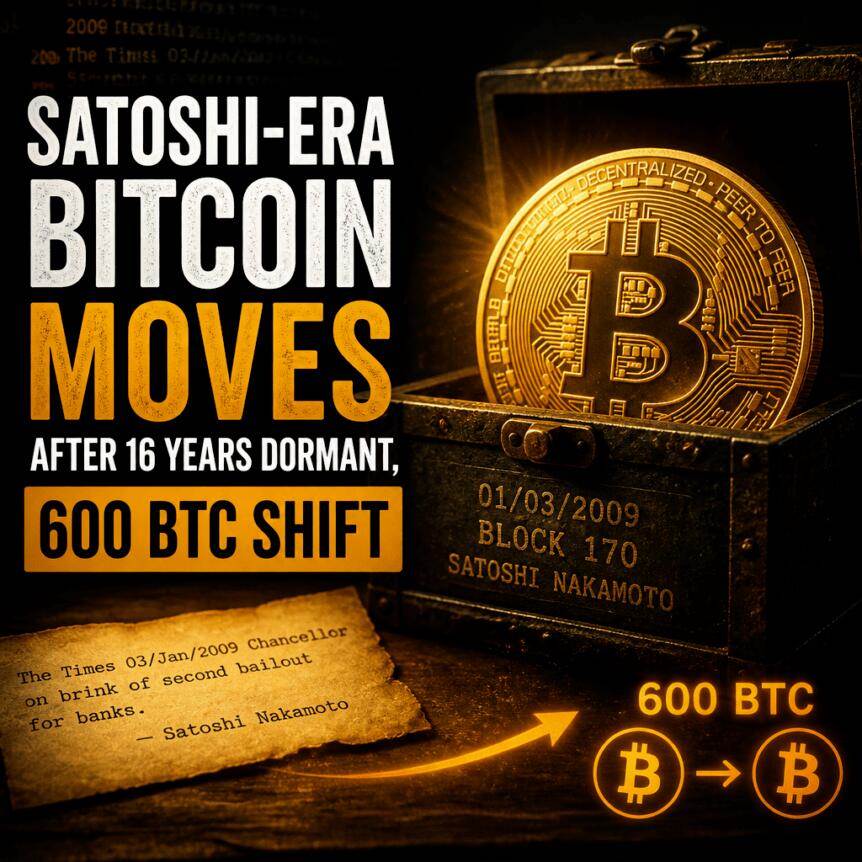
BTC Bitcoin is flowing again after 16 years of sleep, triggering a new round of discussions about the identity of Satoshi Nakamoto
Bitcoin rewards mined in March 2010 moved again after more than 16 years of long-term hibernation. This incident has reignited debate over whether the earliest batch of bitcoins were related to Satoshi Nakamoto. According to online data analysis, multiple addresses hold a total of about 600 bitcoins (worth about US$48 million). After more than a decade of silence, these addresses completed the transfer of funds on Saturday.
The reason why this transfer has attracted widespread attention is that its time window is during the period when Satoshi Nakamoto was actively involved in the early development of Bitcoin. However, an analysis by blockchain detective agency Whale Alert came to a different conclusion: the company said that after investigation, it did not find any connection between these specific mining blocks and Satoshi Nakamoto.
Core Points
- About 600 bitcoins flowed out of Bitcoin addresses after sleeping for more than 16 years, and related activities were traced through on-chain monitoring reports.
- Whale Alert pointed out that the funds came from block rewards in March 2010, when the subsidy per block was 50 bitcoins.
- Whale Alert said its research could not connect any of the 12 related mining blocks to Satoshi Nakamoto.
- Whale Alert previously analyzed seven of the rewards, and this survey expanded its scope to all 12 blocks.
- Lookonchain has previously identified seven miners 'wallets associated with the March 2010 mining period, further supporting this timeline.
Whale Alert refines the mapping of March 2010 rewards
Based on follow-up research disclosed to the media, Whale Alert identifies all of the circumstances behind the 12 reward events that led to these dormant money flows. These transfers originated from Bitcoin blocks mined in March 2010, when the reward for each block was 50 bitcoins. Over time, Bitcoin gradually reduces block subsidies through a preset halving mechanism.
The most recent halving occurred in April 2024, when Bitcoin block rewards dropped from 6.25 to the current 3.125 per block. While this historical background does not change the origin story of sleeping money, it helps explain why the output of individual blocks mined in early 2010 was much greater than the current circulation.
Previously, Whale Alert only analyzed seven of the rewards and posted a post on social media platforms stating that these blocks were not mined by Satoshi Nakamoto. The latest research extends the company's tracking to all 12 reward blocks associated with Saturday wallet activity.
The origin of the "Satoshi Nakamoto" conjecture and Whale Alert's refutation
The intensification of speculative sentiment stems from the reward that these moved coins belong to the "Satoshi era"-that is, they were mined while still involved in Bitcoin communication and development. Satoshi Nakamoto's exit did not happen suddenly. He still existed in the project in some form during 2010 and then gradually faded out. Previous reports pointed out that the last known communication occurred in April 2011.
However, Whale Alert believes that chronological order alone is not enough to prove a connection with Satoshi Nakamoto. A spokesperson for the company said that based on its research, none of the blocks associated with the 12 awards could be traced back to Satoshi Nakamoto. In other words, although the coins are old enough to maintain this mythical association, Whale Alert's mapping data does not support this origin proposition.
For traders and long-term holders, the actual revelation is that "old coins" and "Satoshi era" are not the same as "Satoshi's coins." This distinction is crucial because narratives related to Satoshi Nakamoto's positions tend to fuel speculation, even if there is a lack of substantive evidence or the evidence is ambiguous.
Breaking the silence: Testing transaction patterns and wallet behavior
Whale Alert also provides background interpretation for the transfer process. The company noted that one of the 12 reward payments moved several blocks earlier than most others. Whale Alert recommends that this sequence is similar to a test transaction followed by subsequent transfers to other related addresses rather than a single coordinated liquidation operation.
This behavioral detail is important because it affects observers 'interpretation of the motivations for sleeping wallet activity. A test transaction means that the sender may be verifying rules or paths before moving a larger amount, while a single instant merger often points to different types of operating intent. Without a private key or additional off-chain context, on-chain pattern analysis is the closest available perspective of observation.
In addition, Lookonchain previously identified seven miner wallets that moved 350 bitcoins after approximately 16.5 years of silence, and attributed these wallets to mining activity in March 2010. Taken together, the overlap in time supports the idea that sleeping activity is related to early mining subsidy periods, although participants remain anonymous.
As "Early Bitcoin" comes back online, what's worth watching next
These developments remind people that early distributions of Bitcoin still occasionally appear on the public ledger-sometimes after extremely long periods of silence. Even if these events have nothing to do with Satoshi Nakamoto, they are still significant: large transfers from long-dormant addresses could affect market sentiment about supply dynamics and could trigger short-term speculation about whether more old positions will move.
Currently, the key uncertainty is whether other wallets associated with early mining output remain silent or follow this pattern. Investors and traders should pay close attention to subsequent transactions at adjacent early-era addresses, as well as further on-chain attribution work, to confirm or improve the question of "which blocks are mined by whom".