
 Exchange Ranking
 Top Exchanges
 24h Volume Ranking
 Popularity Ranking
 Exchange BTC Balance
 Proof of Reserves
 Decentralized Exchanges
 Funding Rate
 Funding Heatmap
 Liquidation Data
 Max Pain
 Long/Short Ratio
 Whale L/S Ratio
 Binance/Okex/Huobi L/S
 Bitfinex Margin L/S
 ETF Tracker
 Solana ETF
 XRP ETF
 Hong Kong ETF
 Bitcoin Treasuries
 Crypto Reversal
 Ethereum Reserves
 HyperLiquid Wallet Analysis
 Hyperliquid Whale Watch
 Large Transactions
 On-chain Movement
 Bitcoin ROI
 Stablecoin Market Cap
 Options Analysis
 News
News Articles
 Economic Calendar
 Features
 Wallet
 Contract Calculator


 Security
 Collections
 Watchlist
 Following
 LINK
LINK Main points:
Standard Chartered predicts that Chainlink (LINK) prices will rise to US$200 by the end of 2030.
Standard Chartered expects Chainlink's fees to increase by approximately 25 times by 2030.
Chainlink guarantees more than US$110 billion in value and accounts for 70% of the value of DeFi, which relies on oracles.
Standard Chartered Bank gives an astonishing long-term valuation and opens coverage of Chainlink
Standard Chartered Bank gives an astonishing long-term valuation of Chainlink (LINK) and officially opens coverage research on it. The bank's Chainlink price forecast shows LINK will reach $200 by December 2030. When the research report was released, the token was trading at approximately $8.25, which means the target price is approximately 24 times the current price.
However, this forecast does not rise in a straight line. The bank set multiple phased goals of US$13, US$41, US$82 and US$133, eventually reaching US$200. Link prices did not change much after the report was released, indicating that traders were cautious about this forecast.
This conclusion is based on the tokenization process in the next few years, the growth of DeFi, and the market's demand for reliable blockchain data. It also requires secure and reliable cross-chain transmission in institutional financial markets as a support.
Chainlink price forecast is based on a 25-fold fee increase
Geoff Kendrick, global head of digital asset research at Standard Chartered Bank, links valuations to network fees. The bank expects these fees to increase about 25 times by 2030. Its model assumes that token prices will roughly follow this growth trend.
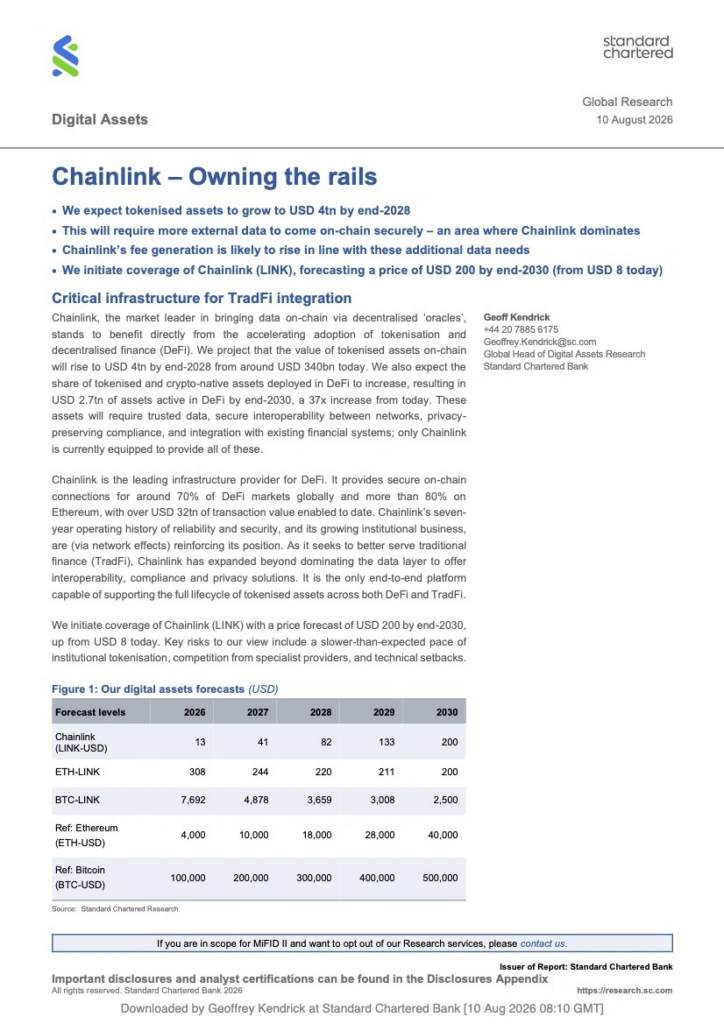 Chainlink Price Forecast| Photo source: Standard Chartered Bank
This assumption provides a measurable basis for Chainlink's price forecasts, but it also creates uncertainty. Higher network usage must generate ongoing fees rather than short-term pilot activities. As the ecosystem expands, token demand must also reflect this revenue.
The bank estimates that Chainlink guarantees more than US$110 billion in value and accounts for about 70% of the value of DeFi, which relies on Oracle globally. On Ethereum, its estimated share exceeds 80%, while Aave V3 accounts for 44% of its guaranteed value.
These data explain why Standard Chartered views market leadership as a core advantage. Oracle provides external prices, interest rates, reserves and asset values for blockchain applications. If such information cannot be obtained frequently, tokenized securities cannot operate reliably.
Tokenization and DeFi provide the core demand base
At the same time, the bank expects that tokenized assets on the chain will grow from approximately US$340 billion to US$4 trillion by 2028. The bank expects that by 2030, deployed DeFi assets will reach $2.7 trillion, a 37-fold growth.
This expansion provides support for Chainlink's price forecasts and its expected fee growth. Larger-scale tokenized funds and bonds may need to provide regular net asset value reports, as well as obtain interest rate data, reserve verification, compliance data, and achieve interconnection between different independent networks.
Standard Chartered Bank lists Swift, DTCC, Euroclear, JPMorgan Chase, MasterCard, UBS, Fidelity and Standard & Poor's Worldwide as Chainlink users. The participation of these institutions strengthens their institutional application prospects, although pilot projects do not guarantee lasting commercial scale.
Chainlink's Cross-Chain Interoperability Protocol (CCIP) further strengthens this argument. CCIP processed US$4.9 billion in transaction volume in the second quarter, a 353% increase from the same period last year. Research reports show that after a security breach in April, more than $7 billion was diverted from the old bridging system.
Despite this, the bank points out that Chainlink lags behind LayerZero in terms of cross-chain interoperability. This gap is critical as rival networks compete for asset transfers and institutional integration. As a result, the price of LINK cryptocurrency may depend on its adoption in both data services and interoperability tools.
Chainlink price forecasts still depend on execution
Even so, this forecast, which looks forward to 2030, still faces extremely high implementation risks. The implementation of tokenization at the institutional level may be slower than Standard Chartered expects, and pilot projects may not be able to transform into regular production systems, which will limit the growth of service fees.
In addition, competition is another major challenge for Chainlink price forecasts. Professional oracle providers can target data services, while interoperability projects can challenge CCIP's status. Technical glitches can also undermine the confidence of banks, agreements and asset issuers.
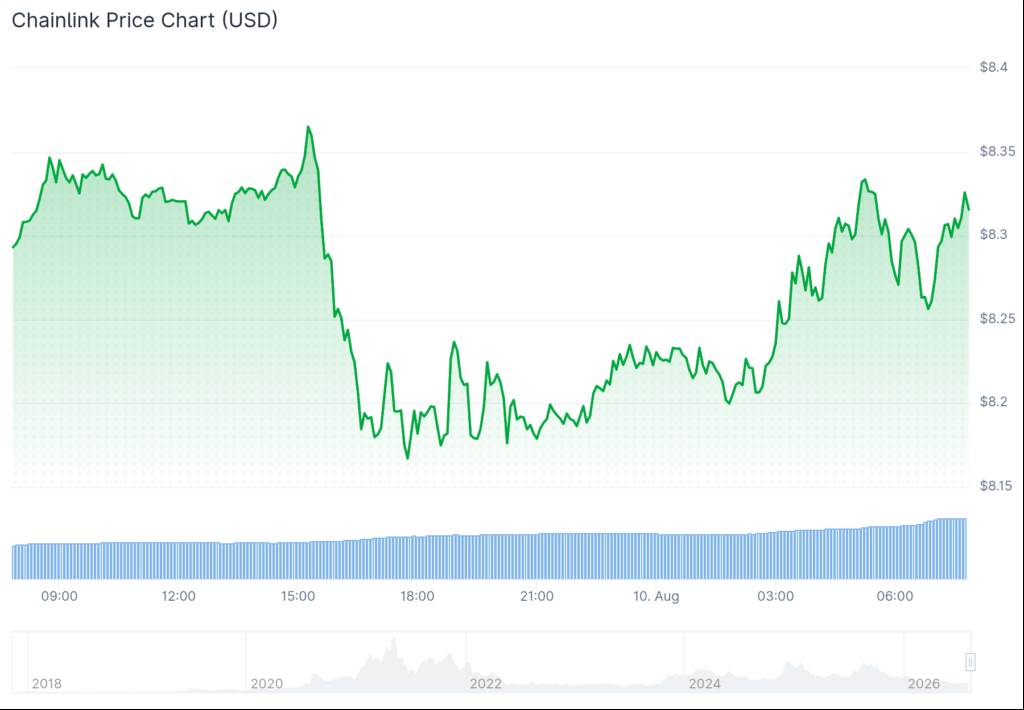 Chainlink (LINK) Price Trend| Image source: CoinGecko
Before any long-term goals become a reality, LINK cryptocurrency prices will first face a more recent test. After the report was released, LINK traded at approximately US$8.25, with limited market response. The bank expects its price to reach $13 by the end of 2026, followed by $41 in 2027 and $82 in 2028.
Its subsequent target is to increase to US$133 in 2029 and US$200 in 2030. Chainlink's price forecasts also face competitive challenges, all of which are based on the premise that tokenized assets, DeFi deployments, and Chainlink's service fees will all grow on the forecast trajectory.
























